
How to Organize Certificate Ceremonies: 2026 Guide

TL;DR:
- Organizing a certificate ceremony involves careful planning, including defining objectives and verifying recognition materials. Proper preparation, rehearsal, and clear communication ensure a smooth event that highlights achievements effectively. Using high-quality presentation covers and managing logistics prevent mistakes and enhance the recognition experience.
Organizing a certificate ceremony is the process of planning and executing a formal event that publicly recognizes individuals’ achievements through presentations of certificates or awards. Done well, recognition ceremonies build morale, reinforce institutional values, and create lasting memories for recipients and their families. Done poorly, they produce name errors, pacing disasters, and disengaged audiences. This guide covers every stage of the process, from setting goals and assembling your team to managing logistics, communications, and day-of execution, so you can run a ceremony that reflects the weight of the achievement it honors.
How to organize certificate ceremonies: essential prerequisites
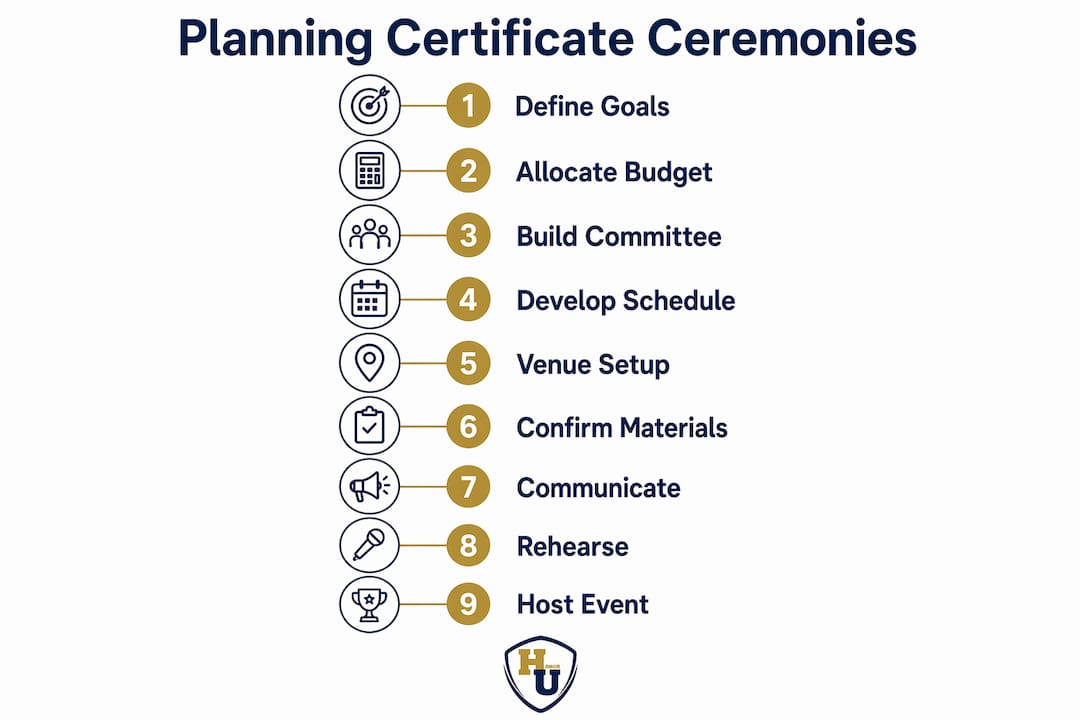
A successful certificate ceremony begins with clear objectives, not a venue booking. Define what the event is meant to accomplish before any other decision is made. Are you recognizing academic achievement, professional development, employee tenure, or community service? The answer shapes every downstream choice, from award categories to room layout.
Budget allocation is the second foundational decision. Budget recommendations suggest allocating 20–25% for awards and materials, 40–50% for venue and catering, and 10–15% as a contingency reserve. That contingency is not optional padding. Last-minute printing errors, AV failures, and catering overruns are common, and a funded buffer prevents them from derailing the event.
Timeline determines whether every other plan is achievable. Planning guidance recommends 3 months of lead time for small ceremonies and 6–9 months for large ones. Booking a venue, ordering custom certificate materials, and coordinating speakers all require time that organizers routinely underestimate.
Assemble a planning committee with defined roles before any vendor is contacted. Assign one person each to logistics, communications, certificate production, and day-of stage management. Overlapping responsibilities create gaps. Defined ownership creates accountability.
| Prerequisite | Key requirement |
|---|---|
| Goals and award categories | Defined before venue selection |
| Budget allocation | 20–25% awards, 40–50% venue/catering, 10–15% contingency |
| Planning committee | One owner per function: logistics, comms, production, stage |
| Timeline | 3 months minimum for small events; 6–9 months for large |
| Approvals | Institutional sign-off on award criteria before announcements |
Pro Tip: Write award criteria in specific, transparent language before finalizing categories. Specific award criteria build recipient trust and increase the perceived value of recognition far more than a generic title like “Excellence Award” ever will.
How do you develop and manage the program flow and event logistics?
Program flow is the backbone of any well-run recognition event. Optimal formal award programs run 60–90 minutes. Programs that exceed 2 hours risk audience fatigue, regardless of how meaningful the awards are. That constraint forces organizers to make deliberate choices about pacing and content.
Building your run-of-show
A run-of-show is a minute-by-minute script of the entire event, from doors opening to the final applause. It assigns time targets to every segment: welcome remarks, award category introductions, individual presentations, and transitions. Allow 3–5 minutes per honoree for typical ceremonies, reduced to 2–3 minutes for larger groups. A ceremony honoring 30 recipients at 4 minutes each consumes 2 full hours before a single welcome remark is delivered. Do the math before finalizing your recipient list or your program length.
Stage setup and presenter briefing
Stage design directly affects the quality of the ceremony and the quality of photographs. Position the podium stage left so presenters and recipients share the stage center for handoffs. Mark pathways with tape or floor guides so no one hesitates on camera. Presenters should be briefed on exact onstage movement, certificate handling, and exit paths before the event begins. A dedicated stage manager coordinates all transitions and keeps the program on schedule.

Rehearsals are not optional for large ceremonies. A single walkthrough with presenters and a stage manager catches the awkward moments that derail professional atmosphere. Dedicated stage management and rehearsals are the most reliable way to maintain pacing and prevent onstage uncertainty.
Key event logistics to confirm before the day of the ceremony:
- AV equipment: Microphones, projector or screen, and a dedicated AV technician on site
- Seating plan: Reserved front rows for recipients, clear aisle access for stage approach
- Photography: Designated photographer position and a shot list aligned to the run-of-show
- Lighting: Podium and stage lighting tested at the venue, not assumed
- Signage: Directional signs for guests and reserved seating markers for honorees
- Accessibility: Ramp or lift access to the stage confirmed for all recipients
For organizers managing a venue for the first time, a virtual venue tour can help you map stage placement, AV positions, and seating configurations before your first site visit.
Pro Tip: Build a 5-minute buffer into the run-of-show after every third award category. Ceremonies almost always run long, and a planned buffer is invisible to the audience while a visible delay is not.
What best practices ensure certificates and award materials support an effective ceremony?
The certificate itself is the physical artifact of the recognition. Its design, accuracy, and presentation quality signal how seriously the institution takes the achievement. A poorly printed certificate in a plain envelope undercuts even the most heartfelt ceremony.
Design and production timeline
Match certificate design to the formality of the event. A corporate leadership award warrants a different aesthetic than a youth volunteer recognition. Finalize design at least 6–8 weeks before the ceremony. Vendors typically need 3–4 weeks for certificate production after design approval, which leaves no margin for revision rounds if you start late.
Verification and accuracy protocols
Name errors on certificates are the most common and most embarrassing failure in recognition events. Cross-reference recipient names against official records at least 2 weeks before the event. That timeline allows for reprints without expedited shipping costs. Assign one person to own the verification process and sign off on the final proof. Never rely on memory or informal lists.
Certificate production and delivery checklist:
- Confirm final recipient list with official name spellings
- Submit design files to your production vendor with all variable data
- Review and approve a physical proof before full production run
- Receive completed certificates and verify each one against the recipient list
- Sort and organize certificates in presentation order matching the run-of-show
- Place each certificate in its presentation folder or cover before the event
- Store completed sets in a secure, labeled location accessible only to stage staff
Presentation materials
A quality certificate holder or document folder transforms a printed page into a keepsake. Tent-style covers with metallic foil printing add an heirloom quality that recipients display rather than file away. For bulk certificate holders, confirm that cover dimensions match your certificate size exactly. Non-standard document sizes require custom-fit covers, which must be specified at the time of order.
| Material element | Recommendation |
|---|---|
| Certificate design | Match formality to award type; finalize 6–8 weeks out |
| Production lead time | Allow 3–4 weeks after design approval |
| Name verification | Cross-reference official records 2 weeks before event |
| Presentation covers | Tent-style or folder format; confirm fit for document size |
| Spare certificates | Print 10–15% overage for last-minute corrections |
Pro Tip: Order a 10–15% overage of blank certificates and covers. Misprints, late additions, and on-site corrections happen at nearly every ceremony. Having spares on hand prevents a reprint crisis the morning of the event.
How to communicate effectively with recipients, guests, and stakeholders
Communication timing determines attendance rates and recipient preparedness. A well-organized ceremony with poor communication produces empty seats and unprepared honorees. Send save-the-dates 8 weeks in advance, formal invitations 4–6 weeks prior, and a final confirmation reminder one week before the event.
Recipient notifications deserve more care than general guest invitations. Each honoree should receive a personalized message explaining the specific award they are receiving, why they were selected, and what to expect on the day. Vague notifications produce anxious recipients who arrive uncertain about the program. Specific notifications produce confident, prepared honorees who engage more naturally during the presentation.
Managing RSVPs is a logistics function, not just a courtesy. Accurate attendance numbers drive catering quantities, seating configurations, and certificate counts. Use a simple RSVP system, whether a form, email confirmation, or event management platform, and set a firm deadline at least 2 weeks before the event.
Communication touchpoints and best practices:
- 8 weeks out: Save-the-date to all guests and recipients
- 4–6 weeks out: Formal invitation with event details, dress code, and accessibility information
- 3–4 weeks out: Personalized recipient notification with award details and any speech requests
- 2 weeks out: RSVP deadline and final headcount confirmation
- 1 week out: Reminder with parking, schedule, and arrival instructions
- Day after: Thank-you messages to recipients, presenters, and key guests with photo links
Request speeches in advance and notify speakers days before the event. Unplanned speeches cause timing overruns and visible discomfort. Pre-selected, briefed speakers deliver concise, polished remarks that strengthen the program rather than stall it.
What common challenges arise and how can organizers troubleshoot them?
Ceremony pacing is the challenge most organizers underestimate. A program that runs 20 minutes over schedule feels twice as long to the audience. The solution is not rushing presenters on the day. The solution is building a realistic run-of-show during planning and rehearsing it before the event.
Name errors on certificates remain the top source of last-minute stress. The fix is systematic, not heroic. A formal verification process against official records, completed 2 weeks before the event, eliminates nearly all errors before they reach the stage.
Common challenges and their solutions:
- Pacing overruns: Build buffer time into the run-of-show; assign a timekeeper with a visible signal system for presenters
- Certificate errors: Verify all names against official records 2 weeks out; keep a correction kit on site
- Presenter uncertainty: Brief all presenters on movement, handoff protocol, and exit paths before the event
- Last-minute no-shows: Confirm attendance 48 hours before; have a stage manager ready to adjust the order
- AV failures: Test all equipment the day before; have a backup microphone and a contact number for the AV technician
Pro Tip: Conduct a full dress rehearsal the day before the ceremony with all presenters, the stage manager, and AV staff present. A well-rehearsed event flow is the single most reliable way to prevent the onstage delays that undermine an otherwise well-planned program.
One structural choice that consistently improves pacing is the format recommended by event planning professionals: combine a focused 30–40 minute formal recognition program with a longer reception period for networking and celebration. The formal segment stays tight and memorable. The reception gives guests and honorees time to connect personally, which deepens the impact of the recognition without extending the formal program.
Key Takeaways
A well-organized certificate ceremony requires defined objectives, verified materials, and a rehearsed program flow to deliver recognition that recipients and institutions remember with pride.
| Point | Details |
|---|---|
| Start planning early | Allow 3 months minimum for small events and 6–9 months for large ceremonies. |
| Define award criteria clearly | Specific, transparent criteria build recipient trust and increase recognition value. |
| Verify all certificate names | Cross-reference official records at least 2 weeks before the event to prevent errors. |
| Rehearse the program flow | A dedicated stage manager and full rehearsal prevent pacing failures and onstage uncertainty. |
| Communicate with precision | Send save-the-dates 8 weeks out and personalized recipient notifications 3–4 weeks before the ceremony. |
What I have learned from organizing recognition events
The most common mistake I see organizers make is treating the ceremony as the entire recognition program. A single annual event, no matter how well executed, cannot carry the full weight of an organization’s appreciation for its people. Ceremonies work best as part of a year-round recognition strategy that keeps achievement visible between events. The ceremony then becomes a celebration of ongoing recognition rather than a substitute for it.
The second lesson is about specificity. Organizers spend enormous energy on venue, catering, and décor, and then write award categories like “Outstanding Performance.” That vagueness undercuts everything else. Transparency in award criteria is not a procedural detail. It is the foundation of fairness and the reason recipients feel genuinely honored rather than arbitrarily selected.
Stage management is the third area where I consistently see the gap between good intentions and professional results. Organizers who skip the rehearsal almost always regret it. The moments that go wrong on stage, the hesitant handoff, the presenter who walks the wrong direction, the certificate handed upside down for the photographer, are all preventable with a single walkthrough. The rehearsal is not overhead. It is the event.
Finally, the physical certificate and its presentation cover matter more than most organizers expect. Recipients keep these materials. They display them. A quality cover with proper branding and accurate printing signals institutional pride. A flimsy folder signals the opposite. The certificate is the artifact that outlasts the ceremony itself, and it deserves the same attention as the program.
, Manager
Professional certificate covers that complete your ceremony
Every well-planned ceremony deserves presentation materials that match the quality of the recognition itself. Wehonoru’s Classic Diploma Tent-Style Document Cover and Graduation Year Tent-Style Cover are designed specifically for certificate and graduation ceremony presentations, with metallic foil printing, durable construction, and an heirloom quality that recipients display with pride.

Wehonoru ships orders in 1 business day with no minimum order quantity, which means you can order exactly what your ceremony requires, whether that is 5 covers or 500, without setup fees or long production waits. Free shipping applies to orders over $35. For organizers who need custom sizing or institutional branding, Wehonoru’s award folder preparation guide walks through every option available for your specific event format.
FAQ
How far in advance should I start planning a certificate ceremony?
Allow at least 3 months for small ceremonies and 6–9 months for large events. This timeline covers venue booking, certificate production, and communication with recipients and guests.
How long should a certificate ceremony program run?
The optimal formal program runs 60–90 minutes. Programs exceeding 2 hours risk audience fatigue. A focused 30–40 minute recognition segment paired with a reception period is a proven format for keeping energy high.
How do I prevent name errors on certificates?
Cross-reference all recipient names against official records at least 2 weeks before the event. Assign one person to own the verification process and approve the final proof before full production.
When should I send invitations for a certificate ceremony?
Send save-the-dates 8 weeks before the event, formal invitations 4–6 weeks out, and a final reminder 1 week before the ceremony. Personalized recipient notifications should go out 3–4 weeks in advance.
What presentation materials do recipients value most?
Recipients consistently value a quality certificate holder or document cover that protects and displays their certificate. Tent-style covers with metallic foil printing add a professional, lasting quality that recipients are more likely to display than store.
Recommended
Taylor Pace writes Honor U guides. Blair Black reviews them. Honor U sells empty covers and holders.