
Educational Achievement Presentation: 2026 Planning Guide

TL;DR:
- A well-organized recognition ceremony celebrates student achievements and fosters school pride. It should last 60 to 90 minutes, with awards presented over 2 to 4 minutes each, using a tiered recognition system for maximum impact. Personalizing citations and extending recognition through digital and physical displays deepen emotional resonance and promote lasting motivation.
An educational achievement presentation is an organized ceremony that celebrates student accomplishments through structured recognition, meaningful awards, and engaging delivery. Known in event planning circles as an academic recognition ceremony or student achievement showcase, this format serves a purpose far beyond handing out trophies. It builds school culture, motivates students, and gives families a shared moment of pride. This guide covers 2026 industry standards for ceremony timing, award structure, presentation technique, and lasting recognition, so educators, administrators, and event planners can design events that genuinely resonate.
What makes an educational achievement presentation effective?
An effective educational achievement presentation balances prestige with inclusivity, keeping every student and family member engaged from start to finish. The ceremony must feel significant without becoming exhausting. When planned well, it reinforces the school’s values and sends students into the next chapter with a clear sense of what they accomplished.

Three factors define success in any academic success presentation: the right duration, a tiered recognition structure, and personalized delivery. Each of these elements depends on deliberate planning, not improvisation. The sections below address each factor in depth, drawing on 2026 guidance from educational event planning professionals.
How long should an achievement ceremony last?
Ceremony length is the single most underestimated variable in recognition event planning. Optimal ceremony duration is 60–90 minutes, according to 2026 industry guidance. Audiences that sit longer than 90 minutes lose focus, which undercuts the impact of every award that follows.
Pacing individual award presentations
Individual award presentations should run 2–4 minutes each. That window is enough time to read a personalized citation, call the student forward, present the award, and capture a photograph. Anything shorter feels rushed. Anything longer strains the audience’s attention, especially when dozens of students are being recognized.
Structuring the program for momentum
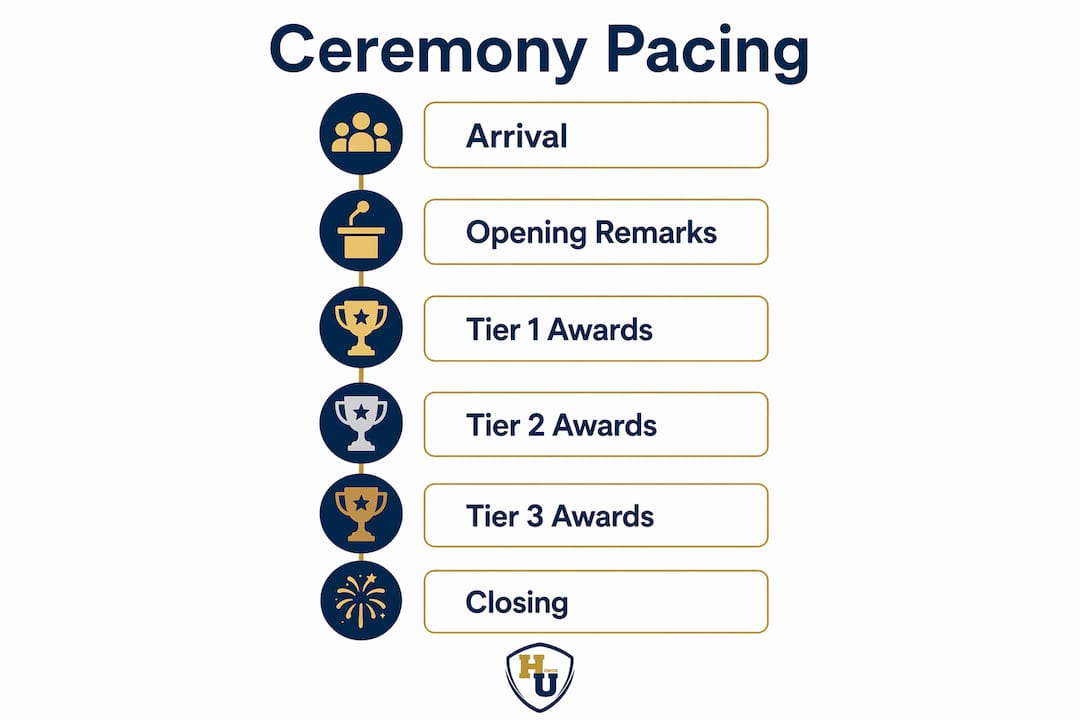
Alternating individual awards with group recognitions and multimedia segments maintains ceremony momentum within the optimal time frame. A practical sequence might look like this:
- Open with a 5-minute welcome and institutional values statement
- Present the first tier of awards (participation acknowledgments) as a group
- Transition to a 2-minute video highlight reel
- Present category-specific awards individually, 2–4 minutes each
- Insert a student performance or brief musical interlude at the midpoint
- Close with exceptional distinction honors and a final address
This format prevents the fatigue that sets in when 30 individual presentations run back to back without variation.
Pro Tip: A pre-show loop featuring nominee highlights and sponsor credits engages guests from the moment they arrive and reduces idle time before the program begins. Build it to run on a 10-minute cycle so latecomers still see every nominee.
What award types work best for student recognition?
The most effective student achievement showcase uses a three-tier recognition system that honors broad participation while preserving meaningful distinctions at the top. A three-tier system involving participation, category-specific, and exceptional distinction awards balances inclusivity with award prestige. That balance matters because students who receive no recognition disengage, while awards that feel too easy to earn lose their motivational power.
The three tiers defined
Tier 1: Universal participation acknowledgment. Every student who met a defined standard receives recognition. This tier uses certificates of completion, honor roll acknowledgments, or attendance awards. The goal is to affirm effort and presence without implying equal achievement across all students.
Tier 2: Category-specific awards. These honors target distinct domains, including academic excellence, artistic achievement, leadership, and community service. A student can win in multiple categories, which rewards well-rounded contributors. Educational award types commonly used in 2026 include the following:
- Academic Excellence Award (GPA or subject-specific distinction)
- Creative Arts Recognition (visual art, music, theater, writing)
- Leadership and Service Award (student government, mentoring, volunteerism)
- STEM Achievement Honor (science fair, robotics, coding competitions)
- Athletic Achievement Certificate (varsity letters, sportsmanship recognition)
Tier 3: Exceptional distinction honors. These are the ceremony’s highest awards, reserved for students who demonstrate outstanding achievement across multiple domains or who show rare, singular accomplishment. Valedictorian recognition, principal’s awards, and scholarship announcements fall into this tier.
Comparing recognition formats by tier
| Tier | Recognition format | Delivery method | Audience impact |
|---|---|---|---|
| Participation | Certificate of completion | Group presentation | Inclusive, affirming |
| Category-specific | Named award with citation | Individual call-forward | Motivating, specific |
| Exceptional distinction | Plaque, scholarship, or named honor | Formal individual ceremony | Prestigious, memorable |
A well-designed educational awards guide recommends matching the physical award format to the tier. Participation awards work well as folded certificate holders. Category-specific awards benefit from a named plaque or framed document. Exceptional distinction honors deserve the most formal presentation treatment, including a premium document cover and a handshake from the principal or superintendent.
How do you personalize recognition to maximize impact?
Personalization is the difference between a ceremony students remember and one they forget by the following week. Personalized award citations detailing specific student accomplishments increase emotional resonance compared to generic praise. A citation that names the project, the score, or the specific act of leadership lands with far more weight than “for outstanding achievement.”
“Generic award language reduces the recognition’s emotional impact. Meaningful recognition improves ceremony effectiveness and student morale. The citation is not a formality. It is the moment the student hears their story told back to them in front of their community.”
Write each citation to answer three questions: What did this student do? Why does it matter? How does it reflect the school’s values? A citation built on those three answers takes about 60 seconds to read aloud and leaves a lasting impression.
Integrating student voices
Student participation as emcees or performers enhances authenticity and audience engagement. When a peer introduces an award category, the ceremony shifts from an administrative event to a genuine community celebration. Assign student emcees to introduce category-specific awards. Invite student musicians or spoken-word performers to fill transitions. These choices cost nothing and add significant warmth.
Visual consistency across all materials
Consistent visual presentation in slides and award materials ensures equitable recognition and professionalism. Use a single slide template for all nominee photos, with uniform fonts, color palette, and photo framing. Inconsistency in slide design signals unequal effort, even when that is not the intent. Schools that standardize their slide decks report that families notice the polish and associate it with the seriousness of the recognition.
Framing awards within the school’s mission during opening remarks transforms recognition into a community celebration. The principal or emcee should open by connecting each award category to a specific institutional value. That framing gives the entire program coherence and reminds the audience why the ceremony exists.
Pro Tip: Prepare a personalized award citation template for each award category before the event. Fill in the student-specific details last. This approach keeps citations consistent in length and tone while still feeling personal.
How do you extend recognition beyond the ceremony?
A ceremony that ends when the lights go up misses most of its potential impact. Digital recognition displays and post-event online archives extend award visibility beyond the ceremony and increase lasting impact. Permanent records motivate future students and enrich school culture year over year.
Post-ceremony recognition strategies
- Digital archive: Upload the full ceremony recording to the school’s website or a password-protected parent portal within 48 hours of the event.
- Social media gallery: Post individual award photos with the student’s name and award title. Tag families where permission allows. This generates organic community engagement.
- Lobby display: Install a physical recognition board in the school’s main entrance featuring award recipients’ names and photos for the remainder of the academic year.
- Slideshow replay: Loop the ceremony highlight reel on hallway monitors for two weeks after the event. Students who were nervous during the live event often watch replays with more attention.
- Printed program archive: Keep a bound copy of the ceremony program in the school library as a permanent record.
Comparing post-event recognition formats
| Format | Reach | Duration of visibility | Cost level |
|---|---|---|---|
| Digital archive (website) | School community and beyond | Permanent | Low |
| Social media gallery | Broad, shareable | Ongoing | Low |
| Physical lobby display | On-site visitors | Academic year | Moderate |
| Hallway slideshow loop | Daily student and staff traffic | 2–4 weeks | Low |
| Printed program archive | Library visitors | Permanent | Low |
Schools that combine at least three of these formats report stronger student motivation in subsequent academic years. The physical lobby display carries particular weight because it is visible to prospective students and families during school tours, which ties recognition directly to institutional reputation.
Pro Tip: Prepare award folder organization before the event so every certificate is ready to hand out in the correct order. A misfiled document during a live ceremony breaks the ceremony’s flow and embarrasses the student.
Key Takeaways
A well-planned academic recognition ceremony combines precise timing, tiered awards, personalized citations, and permanent post-event visibility to maximize student motivation and school culture.
| Point | Details |
|---|---|
| Optimal ceremony length | Keep the total program within 60–90 minutes to maintain audience engagement throughout. |
| Three-tier award structure | Use participation, category-specific, and exceptional distinction tiers to balance inclusivity with prestige. |
| Personalized citations | Name the specific achievement in every citation to increase emotional impact over generic praise. |
| Student involvement | Assign student emcees and performers to make the ceremony feel like a peer-driven celebration. |
| Post-event visibility | Combine digital archives, social media, and lobby displays to extend recognition impact all year. |
What I’ve learned from planning recognition events
After working with schools and institutions across a range of ceremony formats, one pattern stands out clearly. The ceremonies that fall flat are almost always the ones where the planning focused entirely on logistics and ignored the emotional arc of the event. Organizers spend weeks on venue setup and award procurement, then write generic citations the night before. The students can feel the difference.
The most memorable ceremonies I have observed share a specific quality: they treat the citation as the centerpiece, not the award itself. The physical award is a symbol. The words spoken in front of the student’s family are what actually land. Schools that invest time in writing specific, story-driven citations consistently produce ceremonies where families are visibly moved.
The second lesson is about student involvement. Administrators sometimes resist giving students a role in the program because they worry about unpredictability. That concern is understandable but misplaced. A student emcee who stumbles slightly over a name creates a human moment. A flawless but impersonal program creates distance. Authenticity wins every time.
The third lesson is harder to hear: most ceremonies run too long. Forty-five individual presentations at three minutes each is 135 minutes of program. That is too much, regardless of how good each individual moment is. Cut the program before the event, not during it. Combine participation acknowledgments into a single group moment. Reserve individual call-forwards for category-specific and exceptional distinction awards only. Your audience will thank you, and the awards that remain will carry more weight.
, Manager
Presentation covers that complete the ceremony experience
Every award document deserves a presentation that matches the moment it represents. Wehonoru specializes in custom tent-style document covers and certificate holders built specifically for educational ceremonies, with metallic foil printing, no minimum order quantities, and next-day production.

Whether you are presenting diplomas at a graduation ceremony or distributing category awards at an end-of-year showcase, Wehonoru’s graduation tent-style document covers give every certificate a professional, heirloom-quality finish. The classic diploma cover suits formal commencement settings, while custom foil options let institutions add their logo and branding. Orders ship the next business day, so last-minute ceremony planning is never a problem. Free shipping applies to orders over $35.
FAQ
What is the ideal length for a student achievement ceremony?
The ideal ceremony length is 60–90 minutes. Programs that exceed 90 minutes cause audience fatigue and reduce the impact of later awards.
How long should each individual award presentation take?
Each individual presentation should run 2–4 minutes. That window covers the citation, the call-forward, the handshake, and a photograph without losing audience attention.
What is a three-tier recognition system in education?
A three-tier system organizes awards into participation acknowledgments, category-specific honors, and exceptional distinction awards. This structure ensures broad inclusivity while preserving meaningful prestige at the top tier.
How do personalized citations improve recognition ceremonies?
Personalized citations name the student’s specific achievement rather than offering generic praise. This specificity increases emotional resonance for the student, their family, and the broader audience.
How can schools extend recognition impact after the ceremony?
Schools extend impact through digital archives, social media galleries, physical lobby displays, and hallway slideshow loops. Combining multiple formats keeps recognition visible throughout the academic year and motivates future students.
Recommended
Taylor Pace writes Honor U guides. Blair Black reviews them. Honor U sells empty covers and holders.