
How to order bulk certificate holders without surprises

TL;DR:
- Ordering bulk certificate holders requires careful planning to prevent mismatches, shortages, or poor finishes during ceremonies. Essential steps include verifying document size, choosing the appropriate presentation format, ordering a buffer quantity, requesting physical samples, and confirming proofs before production to ensure quality and fit. Building relationships with reliable suppliers and maintaining samples and clear communication ultimately reduce last-minute stress and guarantee a polished presentation for recipients.
Ordering bulk certificate holders for a graduation ceremony or company recognition event sounds straightforward until the boxes arrive and nothing fits the documents you printed, the quantity falls short by a dozen, or the finish looks nothing like the digital proof. These are not rare scenarios. They happen to schools and HR departments every season, and the consequences range from a hurried last-minute scramble to a ceremony where award recipients receive bare-handed documents instead of a polished presentation. This guide walks you through exactly how to plan, order, verify, and recover from any hiccup so that your next event runs with the quiet confidence it deserves.
Table of Contents
- What you need before placing a bulk order
- Step-by-step: How to place a bulk certificate holder order
- Common mistakes to avoid and troubleshooting tips
- What to expect: Delivery, inspection, and last-minute changes
- What most guides miss about bulk certificate holder orders
- Get started: Reliable suppliers for bulk certificate holders
- Frequently asked questions
Key Takeaways
| Point | Details |
|---|---|
| Preparation is key | Double-check certificate size, orientation, and order 2-3 extras before you begin. |
| Step-by-step process | Follow proven steps: select supplier, check specs, request samples, confirm your order. |
| Avoid common mistakes | Test a sample and avoid last-minute orders to prevent mismatches or shortages. |
| Delivery best practices | Inspect all shipments as soon as they arrive and plan contingencies for event additions. |
| Partner with responsive suppliers | Choosing suppliers who offer flexible quantities and fast shipping prevents ceremony stress. |
What you need before placing a bulk order
With event expectations set, it is time to break down what you need to know before actually placing your order. The preparation stage is where most bulk orders succeed or fail, and the details that seem minor during planning become critical on the day of your ceremony.
Know your document specifications first
Before you request a single quote, you need to answer three questions about your certificates or diplomas: What is the exact finished size of the printed document? Is the orientation portrait or landscape? And is the document single-sheet or multiple pages that need to stay together inside the cover?
Standard certificate sizes in the U.S. typically run 8.5 x 11 inches, though many schools and corporate programs use 11 x 14 or even custom dimensions. If your documents were printed by an outside vendor or designed in-house, pull a physical sample and measure it. Do not rely on the template dimensions listed in your design software, since bleed settings and print margins can shift the actual finished size. Reading more about graduation certificate cover explained can help you match the right cover style to your specific document before you spend a dollar.
Understand your presentation format options
Certificate holders come in several distinct formats, and choosing the wrong one creates both a visual and practical mismatch. The primary categories are:
- Flat folder style, Two panels joined at the spine, suitable for single certificates presented at seated ceremonies
- Tent-style covers, Self-standing, with a triangular base that allows the cover to display upright on a table or desk, ideal for corporate award banquets and training completions
- Padded or leatherette covers, Premium feel with soft exterior materials, often chosen by universities and high-end corporate programs
- Cardboard certificate holders, Cost-effective and lightweight, frequently selected for large-volume school events where budget is the primary consideration
Each format carries different implications for cost, shipping weight, storage before the event, and the impression it leaves on the recipient. Reviewing custom certificate covers gives you a solid foundation for deciding which format aligns with your institution’s branding and budget.
Plan your quantity carefully, then add a buffer
For schools with stable enrollment, calculating quantity is straightforward. For organizations with fluctuating recognition lists, it requires a more conservative approach. A practical rule applies across all event types: order 2-3 extra holders beyond your confirmed recipient count. This small buffer protects against last-minute additions to the award list, holders damaged during transport or setup, and administrative errors in the original count.

Small or rural schools with tight class sizes often benefit from suppliers who have no minimum order quantity, since ordering exact quantities keeps costs controlled without leaving unused inventory. Corporate training departments whose cohort sizes shift between sessions follow the same logic, choosing flexible providers rather than locking into large minimums.
Pro Tip: Request a physical sample of your chosen holder before placing your full order. A sample reveals the true color, material weight, pocket depth, and finish in a way no product photo ever can.
Quick-reference table: Certificate holder material and finish options
| Material | Finish options | Best for | Typical cost range |
|---|---|---|---|
| Cardboard/chip board | Matte, gloss, foil-stamped | High-volume school events | $ |
| Leatherette/vinyl | Embossed, foil-printed | University graduations, HR programs | $$ |
| Faux leather (bonded) | Metallic foil, debossed | Corporate awards, recognition events | $$$ |
| Padded fabric | Sewn edges, ribbon | Premium ceremonies, healthcare licensing | $$$$ |
| Custom-dimension covers | Any of the above | Non-standard document sizes | $$ to $$$$ |
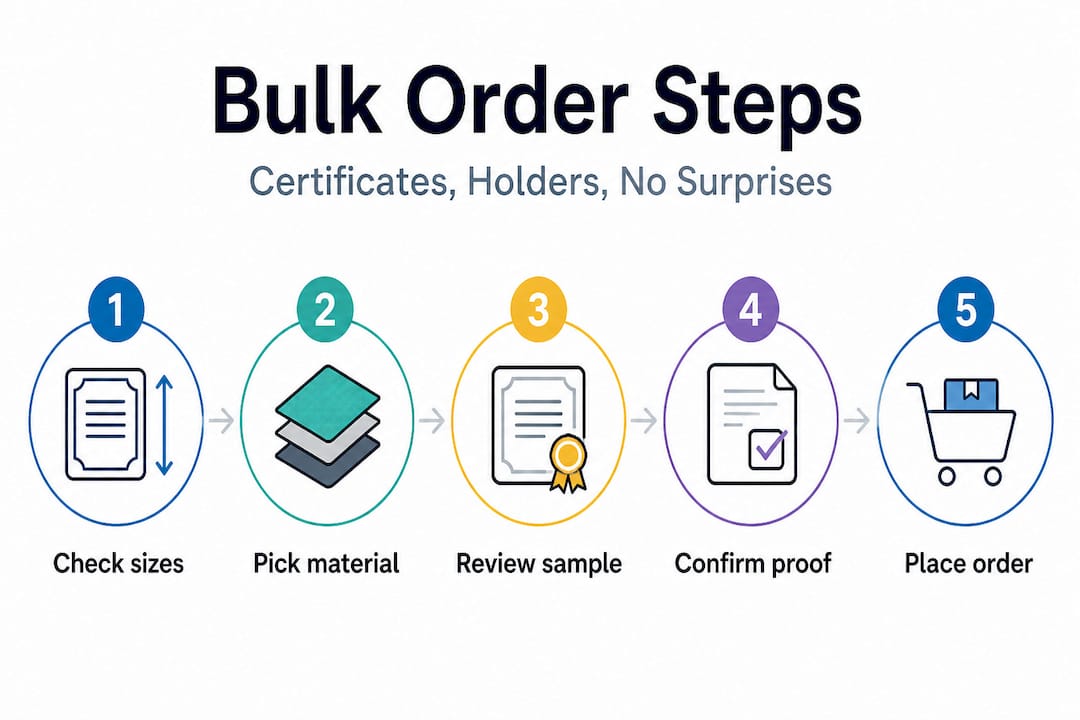
Step-by-step: How to place a bulk certificate holder order
Now that you are prepared, let us walk through the actual ordering process so nothing is left to chance. Each step below builds on the previous one, and skipping any of them is where delays and mismatches tend to originate.
Step 1: Identify reputable bulk suppliers
The U.S. market offers several reliable options for educational and corporate bulk orders. Knowing the difference between them saves time when you are comparing quotes. Reputable bulk suppliers for education and corporate clients include Honor U for fast custom turnarounds, OnTimeSupplies for general office bulk with free shipping thresholds, Graphic Awards for over 30 years of experience in custom engraving and foil work, Trainers Warehouse for training certification folders, Folders.com for variety across formats, and PlaqueMakerPro for plaque-style bulk packs. Each serves a slightly different niche, so matching your needs to the right supplier from the start prevents quote delays.
Step 2: Compare key variables before committing
Not all suppliers are equal when it comes to the specifics that matter most for your event. Use the comparison table below as a starting framework:
| Supplier type | Custom printing | Minimum order | Typical lead time | Best for |
|---|---|---|---|---|
| Specialty recognition vendor | Yes, foil and engraving | Often 25+ units | 5-10 business days | Corporate, healthcare |
| E-commerce document cover specialist | Yes, same-day setup | 1 unit | 1-2 business days | All segments, rush orders |
| Office supply bulk distributor | Limited | Often 50+ units | 3-7 business days | Budget school events |
| Trophy and awards shop | Yes, engraving | Varies | 5-14 business days | Award banquets |
| Print-on-demand platforms | Yes, digital | 1 unit | 5-10 business days | Small nonprofits, individual |
Understanding types of certificate folders alongside this comparison helps you avoid overpaying for a format that does not serve your event’s purpose.
Step 3: Request a physical sample before finalizing
After narrowing your supplier list to one or two candidates, request a physical sample of the specific product you plan to order. This step is non-negotiable for orders over 50 units. A sample reveals material weight, pocket fit, foil quality, and color accuracy. A digital proof confirms layout; a physical sample confirms the experience of holding the finished product.
Step 4: Submit and confirm your digital proof
Once you approve the physical sample, submit your artwork or customization details and request a digital proof for review. Check every element: logo placement, text spelling, foil color, and overall proportions. Approve the proof in writing before production begins, and keep a copy of that approval with your order records.
Step 5: Finalize and place the order
Confirm your quantity, including your 2-3 unit buffer. Verify the delivery address, requested ship date, and any event-specific deadlines with the supplier’s customer service team. Get your order confirmation and tracking information in writing.
Safety note: Always double-check size specifications against a physical sample of your actual printed certificate before approving production. A quarter-inch discrepancy in document size can mean the certificate does not fit properly inside the pocket, which becomes visible on stage.
Common mistakes to avoid and troubleshooting tips
Even with careful planning, mistakes happen. Here is how to sidestep and solve the most common pitfalls that affect schools and corporate teams every year.
Ordering the wrong size
This is the single most frequent error in bulk certificate holder orders. A team orders holders based on the document template dimensions, only to discover the printed certificates are slightly larger after trim and bleed adjustments. Always compare your holder dimensions against a physical, finished printed document, not a digital file.
- Measure your printed certificate in its final form before selecting holder dimensions
- If your document uses a non-standard size, look for suppliers offering made-to-fit custom dimensions
- Confirm whether the holder’s pocket depth accommodates both the document and any ribbon or tissue insert you plan to include
Underestimating quantity
Running short at a recognition ceremony is one of the most uncomfortable situations an event coordinator can face. Someone’s achievement gets presented without the proper holder, and that moment is remembered for the wrong reasons. The consistent guidance across the industry is clear: always order 2-3 extra units beyond your confirmed count, and stack a physical sample against the first pieces off the production run to verify consistency across the batch.
Pro Tip: For large institutional orders above 200 units, consider ordering 5% over your confirmed count. At that scale, the per-unit cost reduction from bulk pricing more than covers the small additional quantity, and you will have ample extras for damaged pieces or late additions.
Waiting until the last minute
Ceremony dates are fixed. Production and shipping timelines are not infinitely flexible. Placing a custom order two days before an event is a high-risk move, even with suppliers offering fast turnarounds. If you find yourself in that position, prioritize suppliers with confirmed in-stock options and standard sizes that ship immediately. Stock covers without custom printing can be a dignified and professional solution in a pinch.
Receiving defective products
Despite strong quality control from reputable suppliers, defects do occasionally occur in bulk shipments. The most common issues are foil that has not adhered properly, covers with misaligned pockets, and exterior finishes with scuffs or color inconsistencies. When this happens, document the defects with photos immediately, and contact the supplier within 24 hours of receipt. Most reputable vendors will offer replacement production or a refund for clearly defective merchandise, particularly when defects affect a significant portion of the order.
Additional mistakes to avoid:
- Skipping the proof approval step to save time
- Choosing a supplier solely on price without verifying lead time
- Not confirming whether the supplier ships to your specific location within your required window
- Failing to account for shipping time separately from production time
For guidance on customizing diploma covers for non-standard situations, detailed customization options are worth reviewing before you finalize your artwork files.
What to expect: Delivery, inspection, and last-minute changes
Once your order is placed, here is how to ensure it arrives on time, exactly as expected, and what to do if you need an emergency fix.
Typical delivery windows and tracking
Delivery timelines vary significantly based on whether your order is custom-printed or drawn from stock inventory. The table below summarizes what to realistically expect from common order types:
| Order type | Production time | Shipping time (standard) | Total lead time |
|---|---|---|---|
| Stock, no customization | Same day | 2-5 business days | 3-6 business days |
| Pre-phrased, no logo | 1 business day | 2-5 business days | 3-7 business days |
| Custom logo, foil-printed | 1-3 business days | 2-5 business days | 3-8 business days |
| Made-to-fit custom dimensions | 2-5 business days | 2-5 business days | 5-10 business days |
| Large institutional (500+ units) | 5-10 business days | 3-7 business days | 8-17 business days |
Last-minute needs are best addressed through stock covers that ship immediately or through suppliers with confirmed 1-day production. Corporate training teams and schools with fluctuating event schedules benefit most from maintaining a small standing inventory of blank or pre-phrased covers, replenishing after each event to avoid the rush.
Step-by-step inspection checklist upon arrival
- Count the units against your packing list before opening packaging further. Discrepancies in quantity are easier to report with all packaging intact.
- Inspect the exterior finish on a representative sample of 10-20% of the order. Look for consistent foil adhesion, color uniformity, and clean folds.
- Check pocket fit by sliding a physical certificate into the pocket of three to five random holders. The document should seat cleanly without forcing or buckling.
- Verify custom printing accuracy against your approved digital proof. Check logo placement, text spelling, foil color, and alignment margins.
- Inspect corners and spines for any cracking or delamination, particularly on leatherette and padded covers shipped in cold weather.
- Document any defects with clear photos and note the unit count affected before contacting the supplier.
Handling last-minute additions to your recipient list
Even after your order is placed and confirmed, new recipients sometimes appear on recognition lists. A training cohort adds a late completer. A school’s honor roll gains a student who corrected a grade. For these situations, flexible providers with no minimum order quantities allow you to place a small supplemental order without the penalty of large minimums or setup fees that would make a single-unit addition prohibitively expensive. Building a relationship with a supplier who accommodates these small additions is one of the most practical decisions a recurring event coordinator can make.
For additional guidance on making the most of your presentation at the ceremony itself, reading about creating a memorable graduation ceremony with diploma covers provides useful perspective on the full experience beyond the product itself.
What most guides miss about bulk certificate holder orders
Most ordering guides focus on checklists and lead times, which are genuinely useful. But after supporting thousands of institutional orders, the most consistent finding is that the difference between a stress-free event and a last-minute crisis rarely comes down to price. It comes down to relationships.
The institutions that navigate bulk ordering most successfully are the ones that have identified one or two reliable suppliers and return to them repeatedly. They know their contact’s name. They understand the supplier’s production calendar and when to place orders to avoid the seasonal crunch of May graduation ceremonies. They have established a sample review routine that happens months before the event, not days before. That institutional memory, built order by order, is worth more than a 10% discount from a new vendor who has never handled your specific document size.
There is also a strong case for physical samples that goes beyond quality verification. A physical sample held during a planning meeting changes the conversation among stakeholders in a way that a screen share of a product photo never does. When your principal, HR director, or department head holds the actual cover and sees the metallic foil catch the light, decisions about customization, color, and format get made faster and with more confidence. That tactile experience accelerates approval cycles and reduces the chance of late-stage changes that compress your timeline.
The harder truth is that the cost of getting bulk certificate holders wrong is almost never the cost of the product itself. It is the labor of managing the problem, the stress on your team, and the diminished experience for recipients who deserved better. A ceremony where 15 out of 200 graduates receive a holder that does not match the others is remembered. Precision in ordering is not bureaucratic overcaution. It is respect for the people being honored.
Choosing between a certificate cover vs folder format is one of those decisions that benefits most from a physical sample review alongside your actual document, not just a spec comparison on a supplier’s website.
Hard-won lesson: The most expensive bulk order mistake is not ordering too many. It is ordering too few, too late, or from a supplier you have never tested. One ceremony’s last-minute scramble costs far more in staff hours and institutional credibility than a 5% overage on holders every year.
Get started: Reliable suppliers for bulk certificate holders
Ready to order with confidence? Here is where to connect your needs with proven providers. Everything covered in this guide points to a clear next step: match your event’s specific requirements to a supplier that combines production speed, flexible quantities, and genuine customization capability.

For schools planning graduation ceremonies, HR teams managing recognition programs, or training departments issuing completion certificates, WeHonorU.com brings together the three qualities that matter most: 1-day production turnaround, no minimum order requirements, and metallic foil customization for any document size. Whether you need a single classic diploma cover or a full institutional run of branded holders, you can browse the complete range of customizable diploma and certificate covers to find the right format and finish for your event. Start your order or request a sample at WeHonorU.com and get the professional presentation your recipients deserve, delivered on your schedule.
Frequently asked questions
What is the typical minimum order for certificate holders?
Many suppliers allow orders in small quantities, and some providers offer no minimum order at all, which is particularly valuable for small or rural schools with exact class sizes and limited budgets.
How far in advance should I place a bulk certificate holder order?
Allow at least 2 to 4 weeks for fully custom orders to ensure adequate production and shipping time; if your timeline is tight, stock cover options can ship much faster for last-minute needs.
Should I order extra certificate holders?
Yes, always order 2 to 3 additional units beyond your confirmed recipient count to cover unexpected last-minute additions or holders that arrive damaged.
If I have different certificate sizes, can I combine them in one order?
Most suppliers accommodate mixed sizes within a single order, but you should clarify customization options, pocket dimensions, and finish consistency for each size separately when submitting your order details.
What should I do if my holders arrive with defects?
Photograph the defective units immediately and contact your supplier within 24 hours of delivery, as most reputable vendors will arrange replacements or issue a refund for verified production defects.
Recommended
Taylor Pace writes Honor U guides. Blair Black reviews them. Honor U sells empty covers and holders.