
Certificate Cover Checklist: Complete 2026 Guide

TL;DR:
- A certificate cover checklist verifies accuracy and design standards before production, preventing costly errors. Material choices, design details, and verification processes ensure professional presentation and legal validity at ceremonies. Implementing automation and validation tools enhances accuracy and security of certificates across large groups.
A certificate cover checklist is a structured verification tool that confirms every element of a certificate holder meets accuracy, design, and presentation standards before a ceremony or award event. Skipping this process is the single most common cause of misprinted names, misaligned logos, and covers that undermine the credibility of the document inside. For schools, universities, corporate HR teams, religious organizations, and individual planners, a thorough checklist for certificate covers is the difference between a polished ceremony and a costly reprint. This guide covers every step of the certificate cover setup workflow, from material selection to digital verification, so your presentation is right the first time.
1. What must a certificate cover checklist include?
A complete certificate cover checklist addresses six core areas: text accuracy, logo placement, color matching, material quality, security features, and bulk order validation. Miss any one of these and you risk errors that cannot be corrected on ceremony day. The industry term for this process is a “pre-production proof review,” and it applies whether you are ordering one cover or one thousand.

Text accuracy is the foundation. Verify every name for spelling, degree titles, and graduation year before any production run begins. A single transposed letter on a recipient’s name can invalidate the document in formal or legal contexts.
Logo and crest placement must be confirmed against your institution’s brand guidelines. Logos should be centered or positioned exactly as specified, and sizing must be consistent across all covers in a batch. Foil colors need to match the approved brand palette, not a close approximation.
Pro Tip: Request a physical proof sample, not just a digital preview, before approving a bulk order. Screen colors and printed foil colors differ significantly, and a physical sample eliminates that gap.
Here is a complete checklist organized by category:
- Text verification: Recipient full legal name, degree or award title, institution name, issue date, graduation year
- Logo and crest: Correct file version, centered placement, approved sizing, no pixelation
- Foil and color: Foil color matches brand guidelines, embossing depth is consistent, no smearing on test prints
- Layout and balance: Adequate white space, signature line placement, typography uses classic or serif fonts for professional authority
- Material and construction: Cover material confirmed (leatherette, vinyl, or paper-based), interior liner type selected, corner ribbon count verified
- Security features: QR code or certificate ID included if required, verification URL tested and active
- Bulk order validation: Random sample check across the full batch, 100% name accuracy confirmed before shipping
2. How do certificate cover design and material choices affect presentation?
The material of a certificate holder determines both its visual impact and its long-term durability. Leatherette is the most common choice for graduation and professional awards because it resists scuffs, holds its shape, and conveys a sense of permanence. Vinyl is a cost-effective alternative that works well for high-volume orders where budget is a constraint. Paper-based covers are appropriate for informal recognition programs but are not recommended for documents intended for long-term display.
Interior liners matter more than most planners expect. Silk moire lining and acetate protectors protect the document from scuffs and surface damage while adding a refined, heirloom feel to the presentation. Four or eight silk ribbon corners secure the certificate inside the cover without adhesive or puncture damage. This detail is especially valued in healthcare and legal settings where the original document must remain pristine.
Foil stamping and embossing are the two primary personalization methods. Foil stamping applies a metallic layer to the cover surface and produces sharp, high-contrast text and logos. Embossing creates a raised impression without color, which reads as understated and formal. Both methods require vector files in .AI or .EPS format to prevent pixelation and font compatibility errors during production.
Pro Tip: Always convert fonts to outlines before submitting design files. This prevents font substitution errors that can alter the appearance of your institution’s name or logo.
| Material | Durability | Cost | Best Use |
|---|---|---|---|
| Leatherette | High | Moderate | Graduation, professional awards |
| Vinyl | Moderate | Low | High-volume, budget orders |
| Paper-based | Low | Very low | Informal recognition programs |
| Padded cover | High | High | Premium ceremonies, executive awards |
Size selection follows document dimensions. Standard diploma sizes run 8.5 x 11 inches and 11 x 14 inches, but non-standard documents require made-to-fit covers. Ordering a standard size for a non-standard document results in a poor fit that diminishes the entire presentation. Wehonoru offers custom-dimension covers for exactly this reason, serving institutions whose documents fall outside the typical range.
3. What technologies and workflows can improve certificate cover setup?
The certificate cover setup workflow becomes significantly more reliable when supported by the right tools. A master data sheet containing every recipient’s full legal name, degree title, and issue date is the starting point. This sheet feeds directly into certificate generation and cover personalization, reducing manual entry errors at every stage.
API-driven certificate generation tools can produce hundreds of certificates per hour at 99.9% accuracy. That level of output is not achievable through manual production, and the accuracy rate reflects the elimination of human transcription errors. For large graduation classes or corporate training cohorts, this technology is the practical standard.
Here is a recommended certificate cover setup workflow for organizations managing 50 or more recipients:
- Build and lock the master recipient data sheet at least two weeks before the ceremony
- Run the data sheet through an API-driven generation tool to produce all certificate files
- Embed QR codes linking to a verification URL for each certificate
- Generate digital proofs for internal review and sign-off
- Submit approved files to your cover supplier with a physical proof request
- Conduct a random sample check of the printed batch upon delivery
- Organize covers alphabetically or by seating order before the ceremony
QR-based verification reduces fraudulent claims by approximately 70%. This figure reflects the deterrent effect of linking each physical certificate to a unique, publicly verifiable digital record. For healthcare licensing boards, government agencies, and professional certification bodies, this feature is no longer optional.
Automation platforms such as Make (formerly Integromat) integrate with design tools to batch-produce certificates and distribute digital copies by email. The DesignLumo API reduces design time from hours to minutes and supports batch production of up to 500 certificates per hour with 99.9% accuracy. Organizations running annual ceremonies benefit from building this workflow once and repeating it with minimal adjustment each cycle.
4. How to customize certificate covers to reflect your organization’s branding
Certificate cover selection workflow decisions should begin with your institution’s brand guidelines, not with a supplier’s catalog. The cover is the first thing a recipient and their family see, and it must communicate the prestige and identity of the issuing organization before the document inside is even opened.
Logo and crest integration requires the highest-resolution files available, ideally in vector format. Foil stamping colors should be matched to your official brand palette. Gold foil is the traditional choice for academic institutions, while silver and copper foil suit corporate and healthcare settings. Wehonoru offers metallic foil printing in multiple colors, which allows institutions to maintain brand consistency across every cover in a batch.
Corner ribbons and interior lining colors are secondary branding elements that add depth to the presentation. Matching the ribbon color to your institution’s colors creates a cohesive look that recipients notice. For religious organizations following a religious certificate cover checklist, these details carry additional symbolic weight. A church or seminary may choose ribbon colors that align with liturgical traditions, while a synagogue may select colors associated with its community identity.
Custom text elements require careful planning. The degree or award name must appear exactly as it is officially recognized by the institution. Abbreviated titles or informal phrasing can create confusion or, in some jurisdictions, legal complications. For ordination and religious credentials, exact legal names and issue dates must match government-issued identification to preserve the document’s validity.
Consider these customization decisions before placing any order:
- Confirm the exact wording of the institution name as it appears on official documents
- Decide whether the cover will display the graduation year, event name, or both
- Select foil color from your approved brand palette, not from a generic color chart
- Choose interior lining color to complement the cover exterior
- Determine whether corner ribbons will be four-corner or eight-corner based on document weight
- Confirm whether the cover will be blank, pre-phrased, or fully custom-printed
For institutions managing professional branding across covers, consistency across every unit in a batch is non-negotiable. One cover with a misaligned logo or an off-color foil stamp stands out immediately in a ceremony setting.
5. How to verify legal accuracy before finalizing any certificate cover order
Legal validity of certificates depends on exact full legal names, issue dates, and signatures that match government-issued identification and applicable local laws. This requirement applies to academic diplomas, professional licenses, religious ordination certificates, and marriage certificates alike. A template alone does not guarantee legal validity. The data entered into that template must be verified against official records before production begins.
Name discrepancies are the most frequent source of post-ceremony problems. A middle name omitted, a hyphenated surname split incorrectly, or a legal name that differs from a preferred name can cause delays or invalidation in formal proceedings. The verification step must compare the certificate data against the recipient’s official identification, not against a registration form that may contain errors.
Signature placement and authority also require confirmation. The signing official’s title must match their current role, and the signature must be original or reproduced with explicit authorization. For digital certificates, a digital signature with a verifiable certificate ID satisfies this requirement in most jurisdictions.
Issue dates must reflect the actual conferral date, not the print date or the ceremony date if those differ. For institutions that confer degrees before the ceremony, the official conferral date is the legally correct date. Using the ceremony date instead is a common error that creates discrepancies in official records.
Pro Tip: Build a two-person review step into your workflow. The person who enters the data should not be the same person who approves the final proof. A fresh set of eyes catches errors that familiarity obscures.
For organizations managing bulk diploma cover orders, a 100% accuracy validation check across the entire batch is the standard before any covers leave the production facility. Sampling is not sufficient when legal documents are involved.
Key takeaways
A complete certificate cover checklist is the most reliable way to prevent errors, protect legal validity, and deliver a professional presentation at any graduation or award ceremony.
| Point | Details |
|---|---|
| Text accuracy is non-negotiable | Verify every name, title, and date against official records before production begins. |
| Material choice determines longevity | Leatherette and padded covers outperform vinyl and paper for long-term display. |
| Vector files prevent print errors | Submit .AI or .EPS files with fonts converted to outlines for all foil stamping work. |
| QR codes reduce fraud by ~70% | Linking each certificate to a verification URL protects institutional credibility. |
| Legal names must match official IDs | Discrepancies in names can invalidate certificates in formal or legal proceedings. |
What I have learned from years of certificate cover preparation
The single most underestimated step in any certificate cover setup workflow is the final proof approval. Organizations invest significant time in selecting materials, matching foil colors, and building automation workflows, then rush the proof review because the ceremony date is approaching. That is exactly when errors slip through.
My strongest recommendation is to treat the proof approval as a formal sign-off, not a formality. Assign a named individual with authority to approve, set a hard deadline at least five business days before production, and require written confirmation. Verbal approvals create ambiguity when something goes wrong.
I have also seen institutions underestimate the value of working with a supplier who understands institutional branding. A supplier who has produced covers for universities, healthcare organizations, and government agencies brings a level of quality awareness that a general print shop cannot match. The document cover selection process should include a conversation about the supplier’s experience with your type of organization, not just a comparison of price per unit.
For large ceremonies, automation is not a luxury. It is the only way to maintain 99.9% accuracy across hundreds of recipients. Build the workflow before you need it, test it with a small batch, and document every step so the process can be repeated without starting from scratch each year.
Finally, do not overlook security features. QR codes and certificate IDs are no longer reserved for high-stakes professional credentials. Any organization that issues certificates publicly, whether a trade school, a fitness studio, or a religious community, benefits from the credibility that verifiable certificates provide.
, Manager
Wehonoru’s tent-style covers for graduation ceremonies
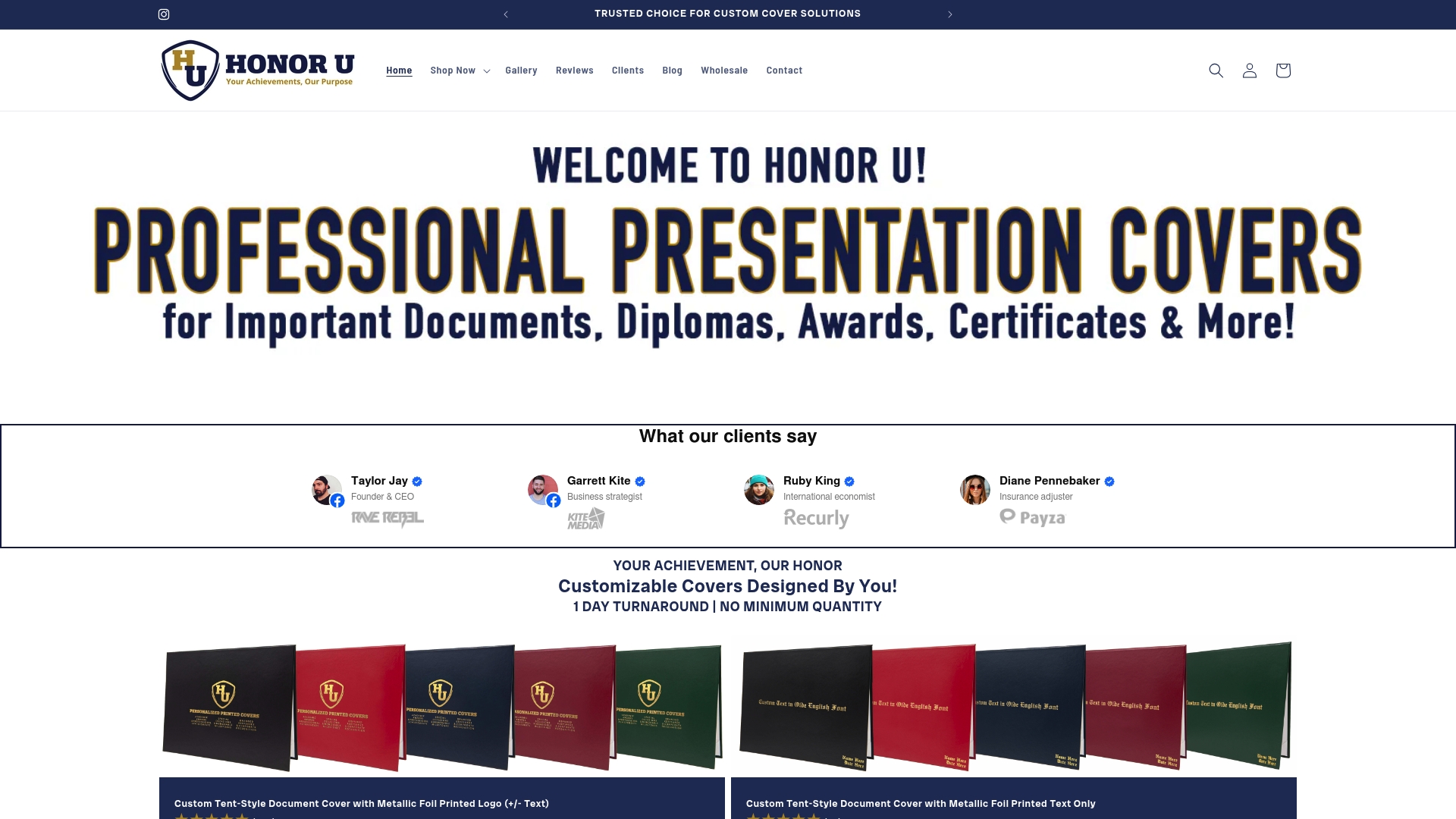
Wehonoru’s Classic Diploma of Graduation tent-style document cover is built for exactly the kind of ceremony preparation this guide describes. The covers are available in multiple colors with metallic foil printing, made-to-fit sizing for non-standard documents, and no minimum order quantity. Whether you need one cover for a single graduate or a full batch for a class of hundreds, Wehonoru ships orders the next business day from its Virginia fulfillment center. Explore the graduation tent-style cover to find the right fit for your ceremony, or browse the Class of year cover for a personalized class year option.
FAQ
What is a certificate cover checklist?
A certificate cover checklist is a pre-production review tool that verifies spelling, logo placement, foil colors, material selection, and legal accuracy before any certificate holder goes to print. It prevents errors that cannot be corrected after a ceremony.
What are the best certificate cover materials for graduation?
Leatherette is the best material for graduation certificate holders because it is durable, scuff-resistant, and conveys a professional, heirloom quality. Padded covers are the premium option for executive or high-prestige ceremonies.
How do QR codes improve certificate presentation?
QR codes link each physical certificate to a unique verification URL, which reduces fraudulent claims by approximately 70% and adds a layer of credibility that recipients and employers can confirm instantly.
What file format is required for foil stamping on certificate covers?
Vector files in .AI or .EPS format are required for foil stamping. Fonts must be converted to outlines before submission to prevent pixelation and font substitution errors during production.
Why does legal name accuracy matter on a certificate cover?
Exact full legal names must match government-issued identification for certificates to hold legal validity. Discrepancies can cause invalidation or delays in formal proceedings, including religious ordinations, professional licensing, and academic degree conferral.
Recommended
More on certificate covers
What is included, and which size to order, live on the FAQ.
Taylor Pace writes Honor U guides. Blair Black reviews them. Honor U sells empty covers and holders.