
The Role of Recognition Ceremonies in Building Culture

TL;DR:
- Recognition ceremonies reinforce organizational values through repeated rituals that build shared identity and motivate effort.
- Effective ceremonies include storytelling, high-quality awards, and structured segments under two hours to maximize impact.
Recognition ceremonies are formal events designed to honor individuals or groups for their accomplishments, reinforcing organizational values and motivating future success. The role of recognition ceremonies extends well beyond handing out awards. These events function as structured rituals that encode culture, signal what an organization values, and create lasting emotional memories for recipients and witnesses alike. Research confirms that employees recognized early are 69% more likely to stay one year later, while unrecognized employees are twice as likely to consider quitting. That single statistic reframes recognition from a “nice to have” into a retention and engagement tool with measurable business consequences. Whether you lead an HR department, coordinate school graduations, or manage a nonprofit volunteer program, understanding how to design and execute recognition events is one of the highest-return investments you can make in your people.
How do recognition ceremonies strengthen culture and morale?
Recognition ceremonies function as cultural rituals encoding values, reinforcing shared norms and social accountability through repetition. This is not a metaphor. Anthropologists and organizational psychologists use the term “schema encoding” to describe how repeated rituals wire group identity into individual behavior. When an organization holds an annual awards ceremony, it is not simply celebrating the past year. It is teaching every person in the room what excellence looks like and what the community rewards.
The psychological mechanism works on two levels simultaneously. Recipients experience public validation, which satisfies the fundamental human need for belonging and status. Observers experience what researchers call “motivational contagion,” meaning they absorb the message that effort leads to visible, public reward. Both effects compound over time when ceremonies repeat on a predictable schedule.
“Recognition ceremonies act as cultural rituals reinforcing shared values and creating social accountability through participation. When people witness peers being honored, they internalize the standards being celebrated and adjust their own behavior accordingly.”
Formal ceremonies and informal recognition serve different but complementary functions. Formal recognition creates motivational peaks tied to milestones, while informal recognition sustains engagement between those peaks. A quarterly awards ceremony builds anticipation and delivers a powerful emotional moment. A manager’s verbal acknowledgment on a Tuesday afternoon keeps daily motivation alive. Neither replaces the other.
The research on engagement reinforces this point. A statistically significant correlation of 0.607 exists between perceived manager recognition and discretionary engagement. That means organizations with strong recognition cultures get measurably more voluntary effort from their people. Discretionary effort is the work employees choose to do beyond their minimum requirements, and it is the engine of organizational performance.
- Ceremonies create shared memory. A room full of people witnessing an award presentation forms a collective reference point that shapes future behavior.
- Repetition builds expectation. Annual or quarterly ceremonies train people to anticipate recognition, which sustains motivation across the full calendar year.
- Public acknowledgment amplifies impact. Private praise is valuable, but public recognition multiplies the social signal by the size of the audience.
- Ceremonies reinforce criteria. When leaders explain why someone is being recognized, they teach the entire organization what behaviors and results matter most.
What are the key elements of effective recognition ceremonies?
Thoughtful ceremony planning with storytelling and quality awards produces memorable, motivating events that strengthen organizational culture. Generic announcements, by contrast, produce forgettable moments that fail to justify the time and cost of gathering people together.

Storytelling over name-reading
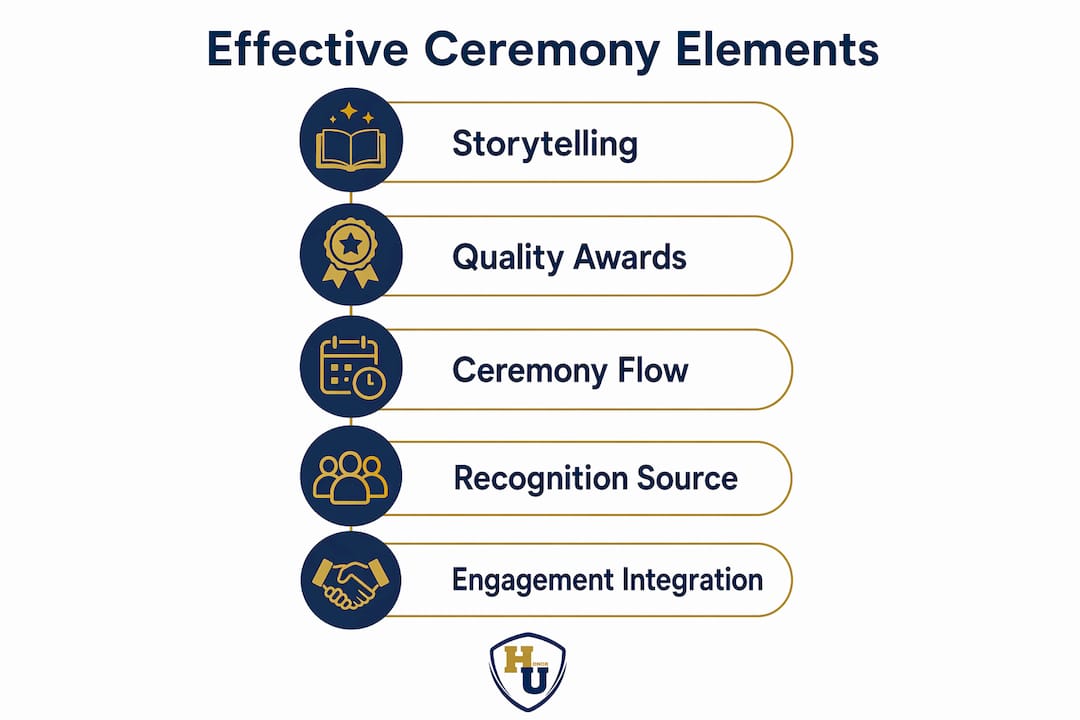
The single most underused element in recognition ceremonies is storytelling. Reading a name and handing over a plaque takes 15 seconds. Describing the specific contribution, the challenge overcome, and the impact created takes 90 seconds and produces an entirely different emotional response. Storytelling about contributions and impact during award presentation is critical to create emotional resonance beyond simple name-reading. The audience connects with the narrative, and the recipient feels genuinely seen rather than processed.
Physical awards and presentation quality
The physical award is a lasting artifact of the ceremony. Its quality communicates the organization’s level of regard for the achievement. A premium, personalized certificate holder or custom diploma cover signals permanence and prestige. A flimsy paper certificate in a generic folder signals the opposite. Visual hierarchy in awards, such as larger or more elaborate presentations for top honors, helps the audience intuitively understand the relative significance of each achievement.
Ceremony length and flow
Optimal ceremonies last under 2 hours with structured segments to maintain engagement and clear award hierarchies for audience understanding. Beyond two hours, attention drops sharply and the emotional impact of later awards diminishes. Structure the program with a clear opening, a keynote or leadership address, tiered award presentations from lower to higher honors, and a closing that reinforces the organization’s values.
Recommended ceremony structure:
- Welcome and context setting (10–15 minutes): Leadership opens with a statement of organizational values and the purpose of the gathering.
- Recognition of group achievements (10–15 minutes): Acknowledge team or departmental milestones before individual awards.
- Tiered individual awards (45–60 minutes): Present awards from participation-level recognition up to top honors, with storytelling for each.
- Keynote or cultural address (15–20 minutes): A leader or guest speaker connects the day’s recognition to the organization’s broader mission.
- Closing and celebration (10–15 minutes): Reinforce community, invite photography, and transition to informal networking.
Pro Tip: Train at least two staff members in every aspect of ceremony coordination. Institutional memory lives in people, not documents. If your primary coordinator is unavailable on the day of the event, a trained backup preserves the quality of the experience.
| Element | Best Practice |
|---|---|
| Storytelling | Describe specific contributions and measurable impact for each recipient |
| Physical award quality | Use premium, personalized covers and holders that recipients will display |
| Ceremony length | Keep total runtime under 2 hours to maintain audience engagement |
| Award hierarchy | Scale award size and presentation time to reflect achievement level |
| Leadership involvement | Require senior leaders to present top honors personally |
| Rehearsal | Conduct a full run-through with all presenters at least 48 hours before the event |
How does recognition source and anticipation affect motivation?
Unanticipated recognition from a direct manager leads to greater reciprocal effort than anticipated recognition or recognition from higher executives. This finding challenges the common assumption that recognition from the CEO or board carries the most weight. The data points in a different direction.
The explanation lies in social exchange theory. When a direct manager, the person who sees your daily work and understands your specific contribution, takes the initiative to recognize you publicly and unexpectedly, the gesture carries a personal quality that top-down recognition cannot replicate. It signals that your immediate community noticed and valued your effort, not just the organization’s formal hierarchy.
Anticipation plays a separate and equally important role. Employees who know a recognition ceremony is coming adjust their behavior in advance. That pre-ceremony motivation is real and valuable. The more significant finding, however, is that anticipation influences post-recognition motivation more than pre-recognition effort. Recipients who did not expect to be recognized show stronger follow-on performance than those who anticipated the award. The surprise element creates a sense of obligation and gratitude that drives continued effort.
Practical implications for ceremony design:
- Preserve some element of surprise. Even within a structured ceremony, withhold the names of top honor recipients until the moment of presentation. The anticipation in the room amplifies the impact.
- Empower direct managers to present awards. Resist the instinct to centralize all presentations with senior leadership. A manager presenting an award to their own team member carries distinct emotional weight.
- Vary recognition sources across the program. Mix peer-nominated awards, manager-presented awards, and leadership-level honors to create a layered recognition experience.
- Design follow-up touchpoints. Schedule a one-on-one conversation between the manager and the recognized employee within one week of the ceremony to sustain the motivational momentum.
Recognition source matters as much as recognition itself. Organizations that route all awards through a single executive lose the personal quality that makes recognition genuinely motivating.
What are the best practices for integrating recognition into broader engagement?
Formal ceremonies create motivational peaks, but 30–50% of employees in initial engagement audits report feeling inadequately recognized. That gap exists because organizations rely on annual or quarterly ceremonies without building a supporting infrastructure of everyday appreciation. The solution is a two-tier recognition architecture.
Formal ceremonies as motivational anchors
Formal recognition events anchor the recognition calendar. They create shared milestones that employees look forward to and prepare for. Scheduling ceremonies at consistent intervals, such as annually in december or quarterly at the end of each fiscal period, trains the organization to expect and value recognition as part of its culture. Consistency matters as much as quality. An irregular ceremony schedule signals that recognition is an afterthought rather than a commitment.
Informal recognition as daily practice
Informal recognition fills the space between ceremonies. A manager’s specific, timely acknowledgment of a completed project, a peer-to-peer shout-out in a team meeting, or a written note following a difficult client interaction all sustain the motivational baseline. Technology platforms that integrate recognition into daily workflow, such as tools embedded in project management or communication software, make informal recognition frictionless and consistent.
Pro Tip: Build recognition criteria into your performance management framework. When the behaviors and results that earn recognition are defined in writing and shared with all employees, the process becomes transparent and fair, which increases both participation and trust.
| Recognition type | Frequency | Primary purpose | Delivery method |
|---|---|---|---|
| Formal ceremony | Annual or quarterly | Motivational peak, cultural reinforcement | In-person event with physical award |
| Manager-led recognition | Monthly or as earned | Reciprocal effort, personal connection | Direct conversation or team meeting |
| Peer recognition | Ongoing | Belonging, social accountability | Platform-based or verbal acknowledgment |
| Milestone recognition | Event-triggered | Retention, tenure celebration | Personalized certificate or award |
Fairness and diversity in recognition criteria are non-negotiable. When the same profiles consistently receive awards, the ceremony loses credibility for everyone else. Audit your recognition data annually. Review award recipients by department, tenure, role level, and demographic group. Adjust nomination processes to surface contributions that formal metrics may undercount, such as mentoring, cross-functional collaboration, and institutional knowledge transfer.
The importance of recognition events compounds when ceremonies are embedded in a broader engagement strategy rather than treated as standalone events. Organizations that connect ceremony themes to annual goals, values statements, and performance frameworks report stronger cultural alignment than those that treat recognition as a separate HR program.
Key Takeaways
Recognition ceremonies are most effective when they combine authentic storytelling, quality presentation materials, and a two-tier structure of formal events and informal daily appreciation.
| Point | Details |
|---|---|
| Early recognition drives retention | Employees recognized in their first week are 69% more likely to stay one year later. |
| Manager recognition outperforms executive recognition | Unanticipated recognition from direct managers produces stronger follow-on effort than top-down awards. |
| Ceremony length affects impact | Keep events under 2 hours with structured segments to maintain audience engagement throughout. |
| Storytelling is the most underused tool | Describing specific contributions creates emotional resonance that name-reading alone cannot achieve. |
| Formal and informal recognition work together | Ceremonies create motivational peaks; daily acknowledgment sustains engagement between those peaks. |
Why ceremony design is a leadership responsibility, not an HR task
After years of observing how organizations approach recognition, one pattern stands out clearly. The ceremonies that people remember and talk about for years are not the ones with the biggest budgets. They are the ones where leadership showed up with genuine attention and personal knowledge of the people being honored.
The most common mistake I see is treating the ceremony as a logistics problem. Organizations focus on venue, catering, and award engraving while neglecting the content of the presentations themselves. A leader who reads a generic citation from a card communicates, unintentionally, that the recipient’s work was not worth the time to understand. A leader who speaks for 90 seconds about a specific project, a specific obstacle, and a specific outcome communicates the opposite.
Ceremonies are cultural rituals. They require the same intentionality as any other ritual your organization holds sacred. The annual budget review gets rehearsed. The board presentation gets rehearsed. The recognition ceremony deserves the same discipline. When presenters rehearse their remarks, when the program flows without awkward pauses, and when the physical awards reflect the quality of the achievement, the ceremony becomes a cultural artifact that people carry with them.
The second pattern worth naming is the tendency to over-centralize recognition. When every award flows through the same executive, the ceremony becomes a performance of hierarchy rather than a genuine celebration of contribution. Distributing presentation responsibilities across managers, peers, and leaders at multiple levels creates a richer, more credible event. It also develops leadership capacity across the organization, because presenting a recognition award well is a skill that improves with practice.
Recognition ceremonies work best when they are treated as a leadership practice, not an administrative function. The organizations that understand this distinction build cultures where people feel genuinely valued, and that feeling translates directly into retention, discretionary effort, and long-term performance.
— Manager
Recognition ceremony supplies from Wehonoru
A well-planned ceremony deserves presentation materials that match the quality of the achievement being honored.

Wehonoru specializes in premium custom diploma covers and certificate holders designed for schools, corporations, healthcare organizations, and nonprofits. Every cover is available with metallic foil printing, custom institutional branding, and made-to-fit sizing for non-standard documents. Orders ship in one business day with no minimum quantity required, making Wehonoru the practical choice for both large annual ceremonies and single-event presentations. For graduating classes, the Class of graduation cover adds a personalized, year-specific detail that recipients keep long after the ceremony ends. Browse the full collection at Wehonoru to find presentation products that honor every achievement with the quality it deserves.
FAQ
What is the primary role of recognition ceremonies?
Recognition ceremonies publicly honor individual and group achievements, reinforcing organizational values and motivating continued excellence. They function as cultural rituals that encode shared norms through repetition and social accountability.
How long should a recognition ceremony last?
Effective recognition ceremonies run under 2 hours with structured segments. Exceeding that threshold reduces audience engagement and diminishes the emotional impact of later awards.
Does it matter who presents the award?
Recognition source significantly affects recipient motivation. Unanticipated recognition from a direct manager produces stronger reciprocal effort than anticipated recognition or awards presented by distant senior executives.
How do you balance formal ceremonies with everyday recognition?
Formal ceremonies create motivational peaks tied to milestones, while informal recognition sustains daily engagement. Both are necessary. Organizations that rely solely on annual events leave a recognition gap that reduces overall employee satisfaction.
What makes a recognition ceremony memorable?
Storytelling about specific contributions and measurable impact, combined with quality physical awards and genuine leadership involvement, produces ceremonies that recipients and audiences remember long after the event concludes.