
Why Quick Turnaround Covers Matter for Ceremonies

TL;DR:
- Quick turnaround covers enable timely recognition for awards and diplomas, reinforcing motivation and ceremony quality. Treating cover procurement as a critical stage prevents delays, mismatches, and disruptions that can diminish the event’s professionalism. Ordering custom-sized covers early, with vendor support for rapid production, ensures a smooth, memorable ceremony experience.
Quick turnaround covers are defined as diploma, certificate, or award presentation covers produced and delivered rapidly enough to support timely recognition at scheduled events. The importance of quick turnaround covers extends well beyond convenience. Neuroscience research confirms that recognition within 48–72 hours produces the strongest behavioral reinforcement, while delays beyond one week measurably weaken that effect. For event planners, school administrators, corporate HR teams, and ceremony coordinators, this means cover availability is not a logistical afterthought. It is a direct driver of recognition impact, ceremony quality, and the lasting impression left on every honoree.
Why the importance of quick turnaround covers is backed by science
Timely recognition activates dopamine-driven reward circuits in the brain. When an honoree receives a beautifully presented diploma or certificate cover within days of their achievement, the brain links the reward directly to the behavior being recognized. That connection is what drives future performance and sustained engagement.
Research on recognition timing shows that delays beyond one week weaken this reinforcement significantly. When recognition stretches beyond one month, the impact is reduced to little more than a pleasant memory. The achievement is still appreciated, but the motivational signal fades. For organizations investing in graduation ceremonies, employee award programs, or academic recognition events, that fade represents a real loss of return on the effort spent planning the event.
The science of appreciation at work confirms that recognition timing outweighs gift value. A well-presented cover delivered promptly does more for morale than a premium award handed over weeks late.
The practical implication is direct. If your ceremony is scheduled and the covers are not ready, you are not simply facing a logistical inconvenience. You are undermining the motivational purpose of the entire event. Research also shows that a 7-day recognition cycle boosts engagement, and that 30–50% of employees cannot recall recent recognition, which correlates with higher turnover risk. Timely, well-presented covers are one of the most tangible ways to make recognition memorable and immediate.
Pro Tip: Order covers at least 10 business days before your ceremony date. This buffer accounts for shipping, quality review, and any sizing corrections without creating last-minute pressure.
The behavioral science case for fast turnaround cover delivery is clear. Speed in recognition supply chains is not a luxury. It is the mechanism through which recognition actually works.

How timely cover availability protects your event’s professional flow
A ceremony’s success depends on logistics that the audience never notices. When everything runs smoothly, guests focus entirely on the honorees. When something goes wrong, including missing or mismatched covers, the disruption pulls attention away from the moment that matters most.
Event management data shows that projects with detailed, integrated timelines achieve a 92% on-time delivery rate, compared to 65% for events without such timelines. That 27-percentage-point gap reflects the direct cost of poor planning. The same data identifies late cover procurement as one of the primary causes of failed events. Covers are not background supplies. They are front-of-stage presentation materials that every attendee sees during the ceremony’s most visible moments.
Professional event producers describe this as the “theater of recognition.” Award ceremonies rely on flawless logistics to maintain that theater. Rushed or missing covers break the atmosphere, distract audiences, and shift focus from honorees to the disorganization on stage. The cover is the first physical object an honoree holds. Its quality and readiness signal the organization’s respect for the achievement being recognized.
Treating certificate covers as critical path dependencies, rather than simple supplies, is the professional standard for experienced ceremony planners. The steps below reflect how leading event coordinators sequence cover-related tasks:
- Confirm the final recipient list at least three weeks before the event date.
- Place the cover order immediately after list confirmation, accounting for production and shipping time.
- Receive and inspect covers no later than three business days before the ceremony.
- Stage covers in recipient order before guests arrive to prevent presenter confusion during the program.
- Designate a cover handler on the day of the event to manage distribution without interrupting the ceremony flow.
Pro Tip: Stage covers in alphabetical or program order inside the presentation area before the first guest is seated. Presenters should never be sorting covers at the podium.
Experienced producers note that covers staged in order before guests arrive prevent presenter distraction and preserve the solemnity of the moment. This is not a minor operational detail. It is the difference between a ceremony that feels polished and one that feels improvised.
What are the most common pitfalls in cover procurement?
The most frequent mistake planners make is treating cover ordering as a low-priority task that can wait until other logistics are confirmed. This approach creates a cascade of problems that are difficult to resolve under time pressure.
The “standard size trap” is particularly costly. Many planners assume that a generic cover size will fit their documents. Diplomas, certificates, and award documents vary widely in dimension across institutions, programs, and issuing bodies. When a cover does not fit the document, the options are limited and none of them are good. Planners either present documents without covers, fold documents to fit an undersized cover, or scramble for a substitute that looks nothing like the intended presentation material.
Common pitfalls in cover procurement include:
- Ordering too late to allow for production, shipping, and inspection before the event date
- Assuming standard sizes fit all documents without measuring actual certificate dimensions first
- Underestimating quantity by failing to account for last-minute additions to the recipient list
- Skipping the inspection step and discovering defects or errors on the day of the ceremony
- Choosing vendors without custom sizing capability, which forces planners into the standard size trap
Waiting until the last minute to order covers risks size mismatches and unprofessional substitutes. Partnering with vendors who offer custom dimensions and rapid production eliminates this risk entirely. Wehonoru, for example, produces custom-dimension covers with a 1-business-day turnaround, which means even planners working with non-standard document sizes can receive correctly fitted covers without sacrificing speed.
Pro Tip: Measure your actual documents before placing any cover order. Width and height both matter. A cover that is even a quarter-inch too small will not close properly and will look unprofessional on stage.
The significance of fast cover designs also extends to branding. Covers printed with institutional logos, foil text, or custom colors reinforce organizational identity at the moment of recognition. Generic covers undercut that message. Custom covers, delivered quickly, deliver both the timing and the quality that recognition events require.
How to build cover procurement into your event timeline
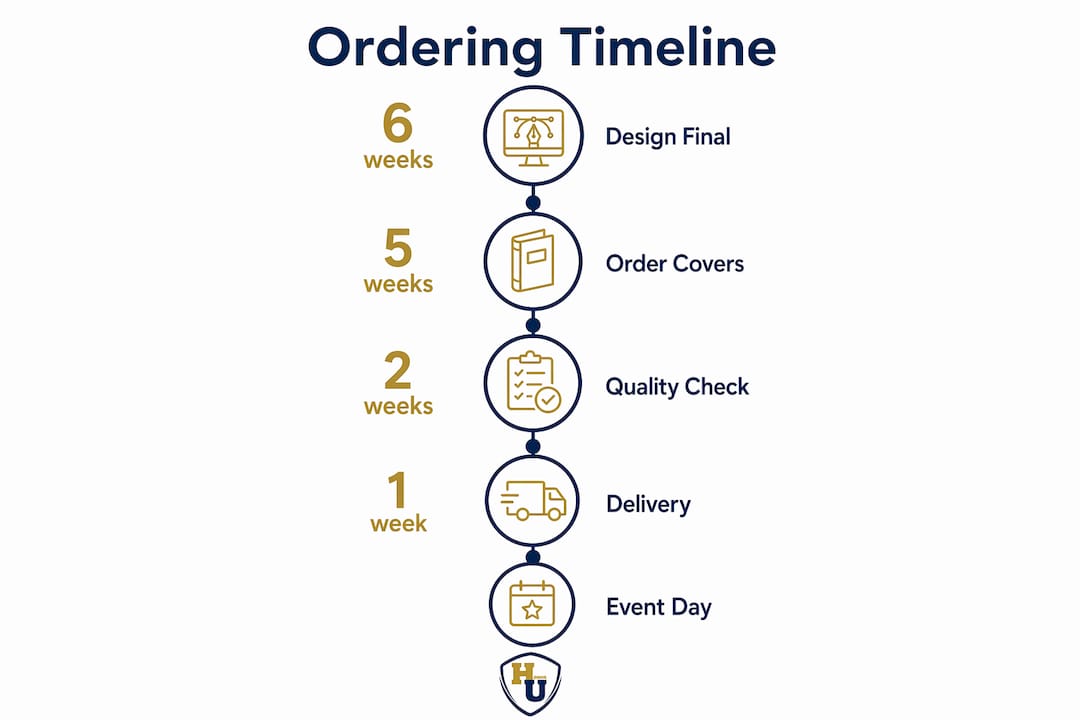
Backward planning is the most reliable method for ensuring covers arrive on time. Starting from the event date and working backward, planners can identify every dependency and assign realistic deadlines to each task.
The table below maps a standard cover procurement timeline for a ceremony with a confirmed date:
| Weeks Before Event | Milestone |
|---|---|
| 6 weeks | Confirm document dimensions and finalize cover design specifications |
| 5 weeks | Submit cover order with custom sizing and branding requirements |
| 3–4 weeks | Receive covers, inspect for quality, and confirm quantity accuracy |
| 2 weeks | Resolve any errors or reorders with vendor |
| 1 week | Stage covers in program order and brief the cover handler |
| Day of event | Final check: covers staged, handler briefed, backup plan confirmed |
Backward-mapped timelines make dependencies visible and prevent last-minute issues. The cover order milestone at week five is not arbitrary. It accounts for production time, shipping, inspection, and a buffer for corrections.
Approval chains add complexity that planners often underestimate. Institutional logos, custom text, and foil color selections frequently require sign-off from multiple stakeholders. Delayed approvals can push back related tasks by weeks, compressing the window for cover production and delivery. Building approval deadlines into the timeline, with clear ownership and escalation paths, prevents this compression.
The steps below translate the timeline table into a repeatable planning process:
- Set the event date as the fixed anchor and work every other deadline backward from it.
- Identify all approval dependencies for cover design, including logo files, text content, and color selections.
- Assign ownership for each approval step, with a named person responsible for sign-off.
- Build in a two-week buffer between cover receipt and the event date to absorb any corrections.
- Use a cover planning checklist to track every task from order placement through ceremony-day staging.
The document cover selection process also benefits from early attention. Selecting the right cover material, finish, and format for your specific event type takes time. Rushing this decision often results in covers that look mismatched with the ceremony’s tone or the institution’s brand standards.
Key Takeaways
Fast turnaround cover delivery is the single most controllable factor in maximizing both the motivational impact of recognition and the professional quality of any ceremony.
| Point | Details |
|---|---|
| Timing drives impact | Recognition within 48–72 hours produces the strongest behavioral reinforcement for honorees. |
| Covers are critical path items | Treat cover procurement as a ceremony dependency, not a background supply task. |
| Standard sizes create risk | Always measure actual documents and order custom-dimension covers to avoid presentation failures. |
| Backward planning prevents delays | Map cover ordering deadlines from the event date backward, with approval buffers built in. |
| Vendor speed matters | Choose vendors with 1-business-day production capability to protect against last-minute disruptions. |
Why I stopped treating covers as an afterthought
After working with dozens of recognition events across education, corporate, and nonprofit settings, the pattern is consistent. The ceremonies that feel polished and memorable are the ones where every physical element, including the cover in the honoree’s hands, was treated as seriously as the program itself.
The ceremonies that fall flat share a common thread. Someone decided that covers could be ordered later, or that a generic size would work, or that the vendor’s standard 7–10 day turnaround was fine. It never is. The moment a presenter pauses at the podium to sort through a stack of mismatched folders, the ceremony loses something it cannot recover. The audience notices. The honorees notice. And the organization’s investment in the event is diminished by a detail that was entirely preventable.
The mindset shift I advocate for is simple. Covers are not supplies. They are morale enhancers. They are the physical object that an honoree takes home, displays, and associates with the recognition they received. A cover that fits perfectly, carries the institution’s branding, and arrives on time communicates that the organization took the achievement seriously. A cover that does not fit, or that arrives two days after the ceremony, communicates the opposite.
Reliable vendor partnerships are the practical solution. Wehonoru’s production that starts the next business day, with most orders finished in 1 to 2 business days exists precisely because recognition events operate on fixed schedules. Preparing award folders correctly, with the right dimensions and the right timing, is not complicated when the right vendor relationship is in place. The planners who build that relationship before they need it are the ones whose ceremonies run without incident.
, Manager
Wehonoru’s tent-style covers: built for ceremony deadlines
Planning a graduation, award ceremony, or recognition event requires every element to arrive on time and look the part.

Wehonoru’s Classic Diploma Tent-Style Document Cover ships in 1 business day, with no minimum order quantity and no setup fees. Custom sizing is available for non-standard document dimensions, eliminating the standard size trap entirely. Metallic foil printing options let institutions add logos, custom text, and branding that reflect the prestige of the achievement. For class-specific events, the Class of graduation cover offers year-specific customization with the same rapid production timeline. Order early, stage covers in program order, and let the ceremony speak for itself.
FAQ
What is the ideal lead time for ordering ceremony covers?
Order covers at least three to four weeks before your event date to allow for production, shipping, inspection, and any corrections. Vendors with 1-business-day production capability compress this window, but a buffer always protects against unexpected issues.
Why does recognition timing affect motivational impact?
Recognition within 48–72 hours produces the strongest behavioral reinforcement because the brain’s reward circuits link the recognition directly to the achievement. Delays weaken this connection and reduce the motivational return of the recognition event.
What happens when certificate covers do not fit the documents?
Ill-fitting covers force presenters into awkward improvisations on stage, including folding documents or presenting without covers. Certificate covers are critical path dependencies, and sizing errors compromise the entire presentation sequence.
How do custom-dimension covers prevent last-minute problems?
Custom-dimension covers are produced to match the exact measurements of your specific documents, eliminating the risk of size mismatches. Choosing a vendor that offers both custom sizing and rapid production removes the two most common sources of cover-related ceremony disruptions.
What is the “theater of recognition” in award ceremonies?
The theater of recognition refers to the flawless logistics that keep audience attention on honorees rather than on operational details. Professionally presented, correctly fitted covers are a core element of maintaining that atmosphere throughout the ceremony.
Recommended
Taylor Pace writes Honor U guides. Blair Black reviews them. Honor U sells empty covers and holders.