
Types of Document Folders: A Complete 2026 Selection Guide

TL;DR:
- Document folders are designed to store, organize, and present various documents securely and professionally. Choosing the appropriate style, such as pocket folders, file jackets, or diploma covers, depends on factors like document size, usage frequency, and presentation needs to ensure optimal protection and organization. Customization options, material quality, and sizing further enhance their suitability for formal presentation and long-term preservation.
Types of document folders are distinct physical folder styles designed to store, organize, and present documents securely and professionally. Whether you are a school administrator preparing graduation materials, an HR director managing employee certifications, or an individual protecting a marriage certificate, the folder style you choose directly affects both the document’s safety and the impression it makes. This guide covers every major category, from standard file jackets and hanging folders to premium diploma covers and tent-style presentation folders, with practical guidance on matching each style to your specific needs.
What are the main types of document folders?
File folders are typically made of heavy paper stock or stiff material folded in half to keep documents organized physically, with variations differentiated by tab placement, pocket configuration, and material weight. That basic construction has evolved into at least six distinct categories, each serving a different organizational or presentational purpose.
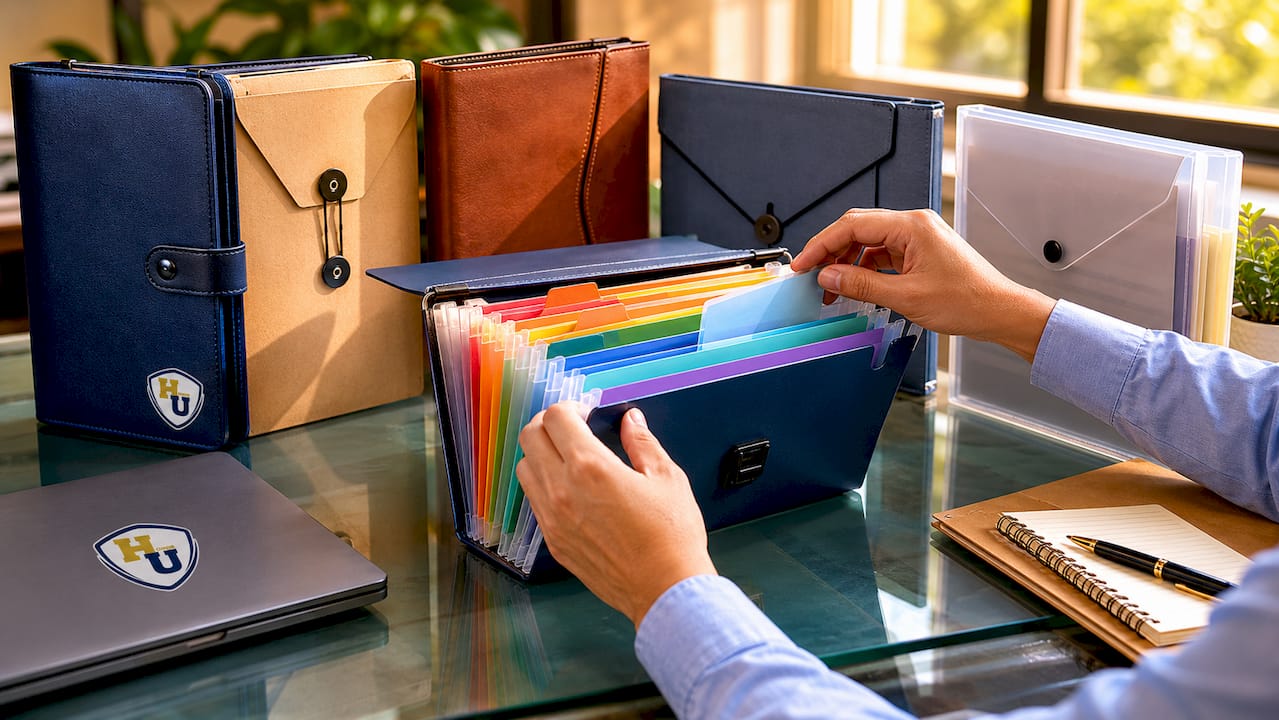
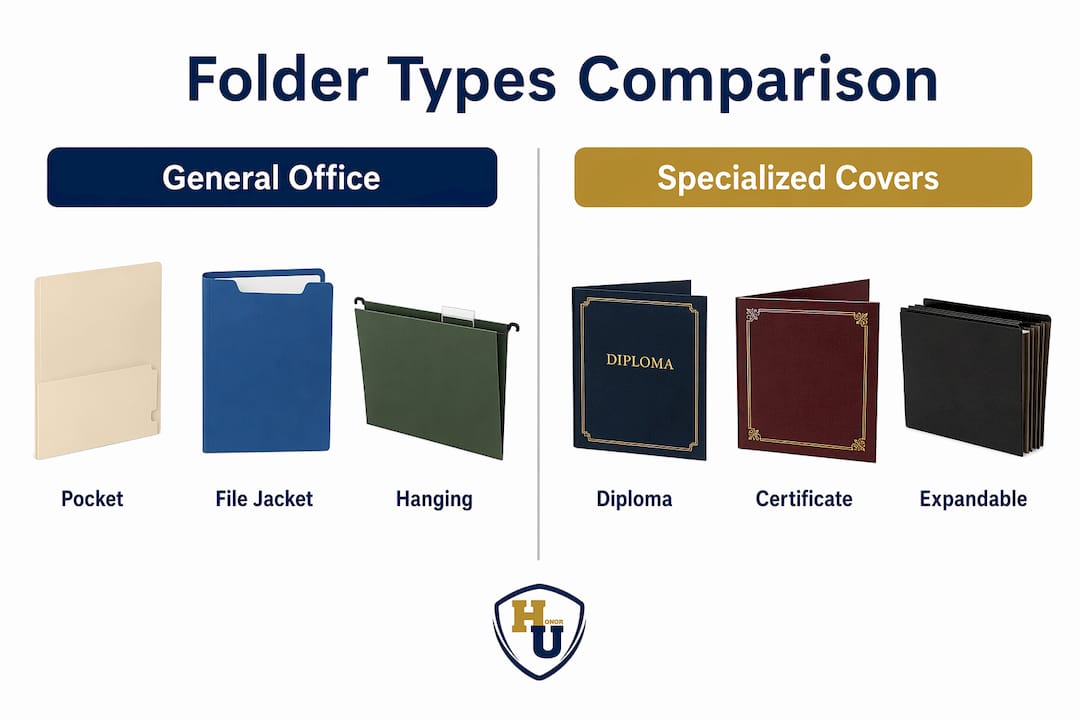
The table below compares the most common document folder styles by their primary use, material, and capacity.
| Folder type | Primary use | Typical material | Capacity |
|---|---|---|---|
| Pocket folder | Presentations, proposals | Cardstock, laminated paper | 2 pockets, 20-50 sheets each |
| File jacket | Long-term filing | Manila or kraft paper | Single document set |
| Hanging folder | Filing cabinet systems | Lightweight card with metal rods | Multiple documents with tabs |
| Classification folder | Multi-section filing | Heavy pressboard | 2-6 divider sections |
| Expandable folder | High-volume storage | Polypropylene or accordion paper | 13-31 pockets |
| Diploma or certificate cover | Formal presentation | Leatherette, linen, or faux leather | Single document |
Pocket folders are the most widely recognized office folder type. They feature two interior pockets and are produced in cardstock or laminated finishes, making them the standard choice for client proposals, sales presentations, and school take-home packets. Business card slits and CD slots are common additions for corporate use.
File jackets, sometimes called document envelopes, are flat folders sealed on three sides with an open top. They hold a single set of documents and are the preferred choice for long-term archival filing because their enclosed construction reduces dust exposure. Law firms and medical offices rely on file jackets to store individual case files or patient records.
Hanging folders, also called suspension files, attach to the rails of a filing cabinet drawer via metal rods. They are designed to hold standard manila folders inside them, creating a two-tier system that keeps documents upright and accessible. This style is the backbone of most office filing cabinet systems.
Classification folders are the most structured of the general office folder types. Built from heavy pressboard, they contain multiple interior dividers with fasteners, allowing a single folder to hold several categorized document sets. HR departments use classification folders to keep employee records, performance reviews, and onboarding paperwork in one organized unit.
Expandable folders use an accordion-style spine to accommodate large document volumes. Polypropylene versions are water-resistant and durable enough for field use, making them popular with contractors, real estate agents, and educators who carry documents between locations.
Diploma and certificate covers occupy a separate category entirely. These are purpose-built presentation folders for formal documents, constructed from premium materials like leatherette, linen-textured board, or faux leather, and often finished with metallic foil printing. They are discussed in detail in a later section.
How do folder types differ in protection and organization?
The functional differences between document folder styles go well beyond appearance. Each design makes specific trade-offs between document protection, accessibility, and organizational capacity.
Protection features vary significantly across folder styles:
- Enclosed construction: File jackets seal on three sides, shielding documents from dust, light, and handling damage. This makes them the strongest choice for archival storage of irreplaceable documents.
- Fastener hardware: Classification folders include metal prong fasteners that secure documents in place, preventing shuffling or loss during transport. This is critical for legal files or medical records that must maintain page order.
- Reinforced edges: Premium hanging folders and classification folders feature reinforced edges and tabs that resist tearing under repeated use. Standard manila folders lack this reinforcement and degrade faster in high-traffic filing systems.
- Material durability: Polypropylene expandable folders resist moisture and tearing, while cardstock pocket folders are more vulnerable to humidity and heavy handling.
Organizational features are equally varied. Hanging folders use plastic or paper tabs to label contents visibly from above, which is why they remain the dominant system in office filing cabinets. Classification folders go further by subdividing a single folder into multiple sections, reducing the number of folders needed for complex records. Color-coded folder systems and visual cues, including background colors and custom thumbnails in digital analogs, make folders easier to identify and prioritize at a glance. The same principle applies physically: color-coded hanging folders in red, blue, green, and yellow allow an office to segment departments or document types without reading every label.
Pocket folders prioritize accessibility over protection. Their open-top pockets allow quick insertion and retrieval, which suits presentation contexts where documents are handled frequently. However, they offer no fastening mechanism, so they are not appropriate for permanent filing.
Pro Tip: When building a filing system for shared office use, combine hanging folders as the outer container with classification folders inside for subdivided records. This two-tier approach keeps the cabinet organized at the category level while maintaining document order within each file.
Customization is another functional dimension worth considering. Tools like TagSpaces enable folder customization with descriptions and thumbnails that transform standard folders into visual information hubs, speeding up navigation in large digital archives. For physical folders, color coding and printed labels serve the same purpose. For formal presentation contexts, metallic foil printing on diploma covers and certificate holders adds a layer of institutional branding that signals quality and permanence.
What should you consider when choosing the best folder type?
Choosing the right folder type requires matching the folder’s physical and functional characteristics to the specific demands of your documents, your workflow, and your presentation context. The following factors guide that decision.
-
Document size and format. Standard letter-size folders (8.5 x 11 inches) fit the majority of U.S. office documents, but legal-size files, architectural drawings, and non-standard certificates require folders built to those dimensions. Forcing an oversized document into a standard folder damages edges and creates a poor presentation. Wehonoru, for example, produces made-to-fit custom-dimension covers for non-standard document sizes, which is a capability most general office suppliers do not offer.
-
Frequency of access. Documents retrieved daily need folders that support quick, repeated handling. Hanging folders and pocket folders excel here. Documents stored for years without regular access, such as original diplomas, marriage certificates, or legal deeds, need enclosed or sealed construction that prevents degradation over time.
-
Volume of documents. A single certificate needs a single presentation cover. A complete employee personnel file may contain 50 or more pages across multiple categories, making a classification folder with multiple fastener sections the appropriate choice. Experts recommend limiting top-level folders to 5 to 7 categories in any filing system, whether digital or physical, to prevent over-engineering and reduce retrieval complexity.
-
Presentation context. A pocket folder used in a client meeting communicates professionalism through its finish and print quality. A diploma cover presented at a graduation ceremony communicates institutional pride through its material weight, foil printing, and structural design. Matching the folder’s aesthetic to the occasion is not a superficial concern. It directly affects how the recipient perceives the document inside.
-
Material and durability requirements. Cardstock pocket folders are cost-effective for high-volume distribution but degrade with repeated handling. Pressboard classification folders withstand years of daily use. Leatherette diploma covers carry an heirloom feel that preserves the document’s significance for decades.
-
Branding and customization needs. Corporate HR departments, universities, and healthcare organizations frequently need folders that carry institutional logos, colors, and text. Standard off-the-shelf folders rarely accommodate this. Custom foil printing, as offered by Wehonoru, allows organizations to present documents under their own brand identity without the setup fees and minimum order quantities that most suppliers require.
Pro Tip: Avoid over-engineering your folder system before you understand your actual workflow. Starting with a small number of general folders and adding subfolders only as needed prevents organizational chaos and saves time during setup.
A common mistake organizations make is selecting folders based on appearance alone, then discovering the chosen style cannot accommodate their document volume or access frequency. Test your folder choice with a representative sample of your actual documents before committing to a bulk order.
How do diploma and certificate folders differ from general office folders?
Diploma covers, certificate holders, and presentation folders occupy a distinct category within the broader world of document folder styles. Their purpose is not routine filing or daily access. Their purpose is formal presentation and long-term preservation of documents that carry lasting personal or institutional significance.
The table below compares diploma and certificate folder styles against standard office folders across the dimensions that matter most for this use case.
| Feature | Standard office folder | Diploma or certificate cover |
|---|---|---|
| Primary material | Cardstock, manila, pressboard | Leatherette, linen board, faux leather |
| Closure type | Open top or prong fastener | Spine binding or magnetic closure |
| Printing options | Laser-printed labels | Metallic foil stamping, embossing |
| Archival quality | Low to moderate | High, acid-free options available |
| Presentation style | Functional | Formal, ceremonial |
| Custom sizing | Rarely available | Available from specialists like Wehonoru |
The two dominant styles within this category are the classic flat cover and the tent-style cover. A classic flat cover opens like a book, with the document secured inside by corner slots or a spine attachment. It is the traditional choice for framed display or portfolio storage. A tent-style cover, by contrast, is designed to stand upright on a table or desk, displaying the document like a greeting card during a ceremony or presentation. Tent-style covers are widely used at graduation ceremonies, corporate award events, and recognition dinners because they allow the document to be visible and accessible without requiring a frame.
Material selection is the most consequential decision in this category. Leatherette and faux leather covers carry a weight and texture that signals permanence. Linen-textured board offers a more traditional, academic aesthetic. Both materials accept metallic foil printing cleanly, which is why they are the standard choice for institutional diploma covers. Archival-quality, acid-free materials prevent the yellowing and brittleness that degrade paper documents over decades.
The diploma cover vs. folder distinction matters practically as well. A diploma cover is a presentation product. A diploma folder is a storage product. Confusing the two leads to purchasing a cover that looks impressive at the ceremony but provides inadequate long-term protection, or buying a storage folder that looks underwhelming when handed to a graduate on stage.
For organizations managing certificate folder types at scale, the choice of material and printing method also affects per-unit cost significantly. Metallic foil printing adds perceived value that justifies a higher price point in corporate and institutional contexts, while pre-phrased designs reduce customization costs for organizations with standard certificate language.
Key takeaways
Selecting the right document folder type requires matching the folder’s construction, material, and design to the specific document, access frequency, and presentation context it will serve.
| Point | Details |
|---|---|
| Six core folder types | Pocket, file jacket, hanging, classification, expandable, and diploma covers each serve distinct purposes. |
| Protection varies by design | Enclosed file jackets and fastener-equipped classification folders offer the strongest document protection. |
| Presentation folders are a separate category | Diploma and certificate covers prioritize material quality, foil printing, and archival durability over daily access. |
| Avoid over-engineering | Start with 5 to 7 top-level folder categories and expand only as your actual workflow demands it. |
| Custom sizing matters | Non-standard documents require made-to-fit covers; standard office folders damage oversized or specialty documents. |
What years of working with document folders have taught me
After working with schools, HR departments, and corporate training teams on document presentation for years, the pattern I see most often is this: organizations spend considerable effort selecting the right document but almost no effort selecting the right folder to present it. A beautifully printed certificate handed to an employee in a bent cardstock pocket folder communicates the opposite of what was intended.
The most underappreciated distinction in this space is between a folder that stores and a folder that presents. These are genuinely different products with different material requirements, different structural designs, and different psychological effects on the recipient. A leatherette tent-style cover placed on a table in front of a graduate carries weight, literally and figuratively, that a standard manila folder never will.
I have also observed that organizations consistently underestimate the value of custom sizing. Most suppliers offer two or three standard sizes, and most buyers accept that constraint without questioning it. But a significant number of professional certificates, military commendations, and specialty diplomas are printed on non-standard paper sizes. Forcing those documents into a standard cover damages the edges and creates visible misalignment that undermines the entire presentation.
The practical advice I give consistently is this: treat the folder as part of the document’s design, not as an afterthought. The material, the finish, the printing, and the fit all communicate something about the institution or individual presenting the document. Getting those details right is not excessive. It is the difference between a presentation that honors the achievement and one that merely contains it.
, Manager
Present every achievement with the right cover
Wehonoru produces tent-style and classic diploma covers built for exactly the moments described in this guide. Every cover ships within one business day, with no minimum order quantity and no setup fees, making professional presentation accessible whether you are ordering one cover for a single graduate or hundreds for a full ceremony. Materials include premium leatherette and linen-textured board, with metallic foil printing available in multiple colors for institutional branding. The Classic Diploma of Graduation Tent-Style Document Cover and the Classic High School Diploma Tent-Style Document Cover are the top choices for schools and organizations that need a formal, durable presentation product delivered fast.
FAQ
What are the most common types of document folders?
The six most common types are pocket folders, file jackets, hanging folders, classification folders, expandable folders, and diploma or certificate covers. Each is designed for a specific combination of document volume, access frequency, and presentation context.
How do I choose the right document folder for a certificate or diploma?
Choose a diploma or certificate cover made from leatherette or linen-textured board with metallic foil printing for formal presentation, and confirm the cover dimensions match your specific document size. A tent-style cover is the preferred format for ceremonies because it stands upright and displays the document without a frame.
What is the difference between a file jacket and a pocket folder?
A file jacket is sealed on three sides and designed for long-term archival storage of a single document set, while a pocket folder has two open interior pockets suited for presentations and frequent document access. File jackets offer stronger protection; pocket folders offer faster retrieval.
How many folder categories should an organization use?
Organizational specialists recommend limiting top-level folders to 5 to 7 categories to prevent over-engineering and maintain usability. Adding subfolders only when a category grows beyond manageable size keeps the system practical and easy to navigate.
Can document folders be customized with institutional branding?
Yes. Diploma covers and certificate holders are the most customizable folder type, accepting metallic foil printing of logos, institutional names, and custom text. Wehonoru offers this customization with no setup fees and a one-business-day turnaround, which is significantly faster than the industry standard of 5 to 10 business days.
Recommended
Taylor Pace writes Honor U guides. Blair Black reviews them. Honor U sells empty covers and holders.