Why Present Achievements Professionally: Your Career Guide

Presenting your achievements professionally is the single most direct way to communicate your value to employers, managers, and clients. It is not about self-promotion for its own sake. It is about giving decision-makers the evidence they need to trust you with greater responsibility. Presentation skills are critical for career success: 70% of professionals say strong presentation skills are essential to advancing their careers, yet most people still describe what they did rather than what they delivered. The gap between those two approaches is where careers either advance or stall.
The benefits of highlighting accomplishments go well beyond a stronger resume:
- Credibility: Specific, documented results are harder to dismiss than general claims about work ethic.
- Visibility: Managers and recruiters notice professionals who can articulate their impact clearly and confidently.
- Influence: Presentation skills act as promotion gatekeepers because senior roles require communicating across teams and stakeholders you do not manage.
- Personal brand: Consistent, authentic sharing of your accomplishments builds a professional reputation that opens doors before you even apply.
The sections below cover how to distinguish achievements from duties, how to structure them using the Context-Action-Result method, practical tips for maximum impact, and how sharing accomplishments builds your personal brand over time.
How to distinguish your achievements from duties and roles

Most professionals list what they were responsible for, not what they actually changed. That distinction is the foundation of effective achievement presentation.
A duty is what your job description required. A role is the position you held. An achievement is a specific outcome you produced that would not have happened, or would not have happened as well, without your direct contribution. Hiring managers already know what a project manager or sales associate does day-to-day; they look for evidence of unique impact that signals what you will bring to their organization.
Use these criteria to separate achievements from duties:
- Does the statement describe a change, improvement, or result, or just a task?
- Can you attach a number, a before-and-after state, or a named outcome?
- Would this have happened without your specific contribution?
- Does it reflect a decision you made, not just work you completed?
Duty: “Managed social media accounts for the company.” Achievement: “Rebuilt the content calendar and grew organic reach by 34% in one quarter, reducing paid ad spend by $8,000.”
The achievement version answers the question every recruiter is silently asking: So what?
Pro Tip: When reviewing your own resume, read each bullet and ask “Would this sentence appear in a generic job posting?” If yes, it is a duty, not an achievement. Rewrite it with a specific outcome.
How the Context-Action-Result method structures your achievements
The Context-Action-Result (CAR) method, also known as the Situation-Action-Result (SAR) format, gives every achievement statement a clear, three-part structure that is immediately readable and credible.
- Context: What was the situation, challenge, or goal? Set the scene briefly.
- Action: What did you specifically do? Name your role, not the team’s.
- Result: What changed? Use a number, a before-and-after state, or a named outcome.
This structure works because it forces you to move from vague activity to concrete evidence. The SAR format is the same structure behind strong behavioral interview answers and the STAR method used by most Fortune 500 interviewers.
| Raw Statement | CAR-Structured Version |
|---|---|
| “Helped improve customer onboarding.” | “Redesigned the onboarding flow (A), and lifted activation by 22% ®.” |
| “Worked on cost reduction project.” | “Renegotiated three vendor contracts (A), saving budget in the fiscal year ®.” |
| “Assisted with training program.” | “Tasked with onboarding 12 new hires during a hiring surge ©, built a self-paced training module (A), cutting ramp time from six weeks to three ®.” |
Notice that each improved version names a specific action the writer took, not what the team accomplished. That specificity is what makes the statement verifiable and persuasive. For professionals presenting credentials in formal settings, the physical presentation of a document can reinforce that same sense of precision and care. Wehonoru’s document presentation approach reflects how the format of a credential shapes the impression it makes.
Practical tips for highlighting your achievements effectively
Knowing the structure is one thing. Applying it consistently across your resume, LinkedIn profile, and interviews requires a few deliberate habits.
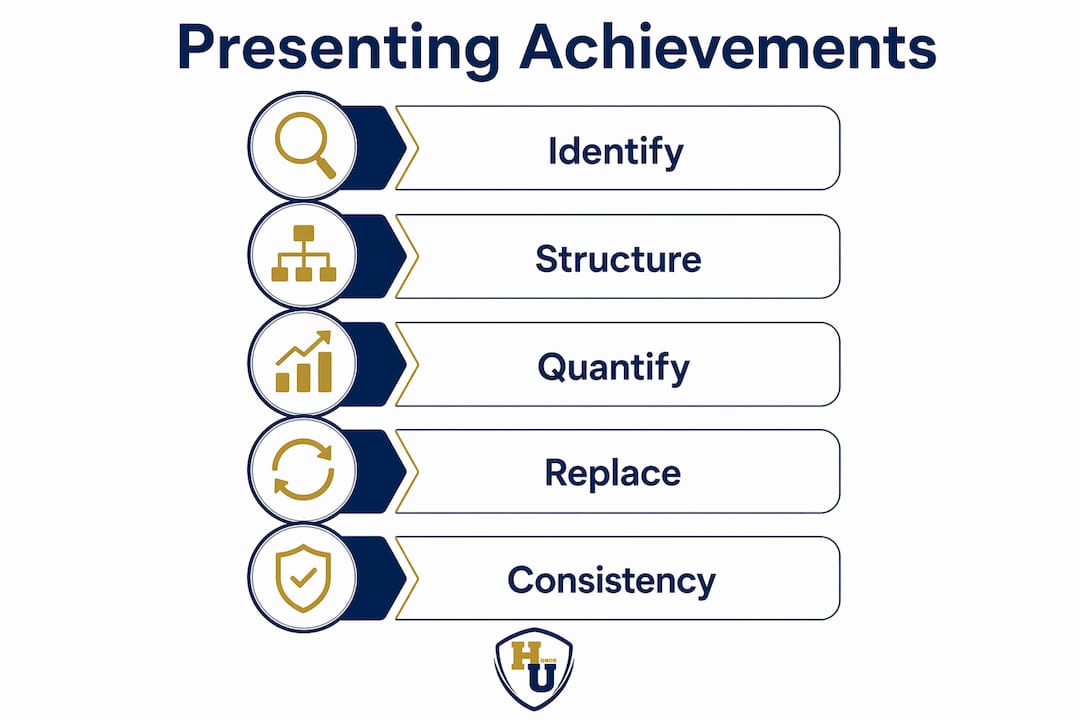
Use quantifiable metrics wherever possible. Specific, quantified results outperform vague claims consistently in recruiter reviews. When you lack a hard number, use scope (team size, budget, account count), frequency (daily, weekly), or a named before-and-after state. “Improved internal communication” is generic. “Created a weekly status template used by four department leads” is evidence.
Replace weak verbs with precise ones. Strong verbs transform vague descriptions into impact statements. Swap “helped with” and “worked on” for “led,” “designed,” “automated,” “migrated,” or “recovered.” The verb is the first signal of ownership.
Tailor your achievements to the audience. A recruiter scanning 200 applications needs outcomes tied to revenue, retention, or efficiency. A direct manager in a performance review responds to team impact and process improvements. A client wants proof of reliability and results. The same achievement can be reframed for each context without changing the facts.
Avoid exaggeration and vagueness equally. Inflated claims collapse under follow-up questions. Vague claims never generate them. Both undermine credibility. Attach evidence-based proof such as dashboards, project links, or published work samples wherever possible. These artifacts are a differentiator that generic applications cannot replicate.
- Share achievements at the right moments: performance reviews, promotion conversations, salary negotiations, and networking introductions.
- Keep achievement statements to two to three sentences in written form; expand to a 90-second story in interviews.
- Match the language of your achievement statements to the keywords in the job description you are targeting.
Pro Tip: Keep a living “brag document,” a running log updated weekly or monthly, capturing the context, metrics, and details of each win while they are still fresh. A regularly updated achievement log is the most reliable source for specific, verifiable accomplishments when you need them under pressure.
For professionals in fields where credentials are displayed publicly, such as healthcare, law, or education, the physical presentation of those achievements carries its own weight. A certificate or diploma housed in a premium cover signals the same care and professionalism as a well-crafted achievement statement. Wehonoru’s guide to achievement presentation explores this connection in detail.
How sharing achievements professionally builds your personal brand
Your personal brand is the reputation you carry before you walk into a room. Presenting your accomplishments consistently and authentically across channels is how that reputation gets built.
Authenticity matters more than polish. Sharing real moments, including challenges and what you learned from them, builds more trust with employers than a curated highlight reel of only perfect outcomes. The goal is not a flawless image. It is a credible one. Professionals who share concrete career content rather than vague inspirational posts build audiences that generate inbound opportunities over time.
Consistency across channels is equally important. Your LinkedIn headline, resume summary, and how you introduce yourself at a networking event should all reflect the same core narrative. Pick two or three documented achievements that best represent your professional identity and repeat them across platforms. Consistent, authentic presentation across LinkedIn, performance reviews, and professional networks builds the kind of visibility that leads to promotions and external opportunities.
For professionals whose communication skills are still developing, particularly those presenting in a second language, mastering authority and clarity in public speaking is a direct investment in how your achievements land with an audience.
Dos and don’ts for sharing achievements publicly:
- Do tie achievements to business outcomes your audience cares about.
- Do update your LinkedIn About section around your three biggest documented impacts.
- Do share lessons from setbacks alongside wins; it signals self-awareness.
- Don’t post overly personal details that shift the tone from professional to private.
- Don’t share achievements without context; a number without a story is just a number.
- Don’t wait until a job search to start documenting. The wins from 18 months ago are the ones you will forget.
Technical excellence alone tends to plateau a career unless paired with the ability to communicate impact beyond your immediate role. The professionals who advance are not always the most skilled. They are the ones who can make their contributions visible, credible, and memorable to the people who decide what comes next.
Key Takeaways
Presenting achievements professionally requires specific outcomes, consistent language, and authentic delivery across every channel where your career reputation lives.
| Point | Details |
|---|---|
| Achievements vs. duties | State what changed because of your work, not just what your role required. |
| CAR structure | Use Context-Action-Result to give every achievement statement clarity and proof. |
| Quantify and verify | Specific, quantified results consistently outperform vague claims in recruiter reviews. |
| Brag document habit | A regularly updated achievement log captures accurate details for resumes, interviews, and negotiations. |
| Authentic personal brand | Consistent, authentic sharing across LinkedIn and networking builds visibility that generates career opportunities. |
FAQ
How do you describe professional achievements?
Use the Context-Action-Result format: briefly state the situation, name the specific action you took, and close with a measurable outcome. Replace weak verbs like “helped” or “worked on” with precise ones like “led,” “designed,” or “automated.”
Why is it important to have documented achievements?
Documented achievements give you specific, verifiable evidence to use in performance reviews, salary negotiations, and interviews. Specific, quantified results consistently outperform vague claims when recruiters evaluate candidates.
How do you present your achievements to your manager?
Frame each achievement around business impact your manager cares about, such as time saved, revenue generated, or process improvements. Arrive at performance reviews with a curated summary from your achievement log rather than reconstructing wins from memory.
How do you answer “What is your greatest professional achievement?”
Pull a documented entry from your brag document that maps to the role’s priorities. Structure your answer using the CAR method: set the context in one sentence, describe your specific action, and close with the measurable result. Keep the full answer to 90 seconds or less.
Every achievement you have earned deserves to be presented with the same care and quality it took to earn it. When the moment calls for a physical credential, Wehonoru’s tent-style diploma covers ship next day with no minimum order, so the presentation is always ready when the recognition moment arrives.