
Premium Certificate Cover Guide 2026: Best Options

TL;DR:
- Choosing the right certificate cover type affects the presentation and long-term preservation of credentials at recognition events.
- Premium covers with archival-grade materials and custom sizing enhance perceived value and prevent document damage over time.
A premium certificate cover is a specialized presentation and protection piece designed to house diplomas, credentials, and awards with the formality those documents deserve. Choosing the right cover for a 2026 graduation, corporate recognition event, or professional certification ceremony directly affects how recipients perceive the value of their achievement. This premium certificate cover guide covers every decision point: cover types, materials, sizing, customization, and long-term care. Whether you are an educational administrator ordering covers for a class of 300 or an individual honoring one graduate, the guidance here applies directly to your situation.
What are the best certificate cover options for 2026?
Premium certificate holders fall into two distinct categories, and selecting the wrong one is a more common mistake than most planners expect. Diploma holders and document holders serve fundamentally different purposes. Choosing between them based on your event type and document format is the first decision to make correctly.
Diploma holders vs. document holders
A diploma holder is designed for a single certificate. Its purpose is formal presentation and long-term archiving. The structure is rigid, the interior is fitted, and the exterior signals prestige. A document holder, by contrast, organizes multiple pages and allows repeated access. It suits corporate onboarding packets, multi-certificate award kits, or conference materials where recipients need to open and review contents more than once.
Diploma holders are designed for single documents to be presented formally and archived. Document holders serve multi-page packets and allow repeated access. Matching the holder type to the document type prevents damage and frustration at the moment of handoff.
| Feature | Diploma holder | Document holder |
|---|---|---|
| Document capacity | Single certificate | Multiple pages or packets |
| Primary purpose | Formal presentation and archiving | Practical organization and access |
| Typical use | Graduation, credentialing, awards | Onboarding, conferences, multi-cert kits |
| Interior design | Fitted, protective lining | Pockets, folders, multi-slot |
| Prestige level | High | Moderate |
| Best audience | Graduates, credential recipients | HR teams, event coordinators |
- Diploma holders work for K–12 graduations, college degrees, professional licenses, and single-award ceremonies.
- Document holders work for employee onboarding packets, multi-certificate training completions, and conference speaker kits.
- Tent-style covers bridge both categories by standing upright on a table, making them ideal for stage handoffs and photography.
Pro Tip: Confirm with your issuing institution whether the certificate is a single page or a multi-page document before ordering. Ordering diploma holders for a multi-page packet is one of the most common and costly planning errors.
A high-quality cover enhances perceived value and the official status of the credential. Recipients and institutions both respond to the quality of the cover as a signal of how seriously the issuing organization takes the achievement.
How do materials and sizes affect certificate cover quality?
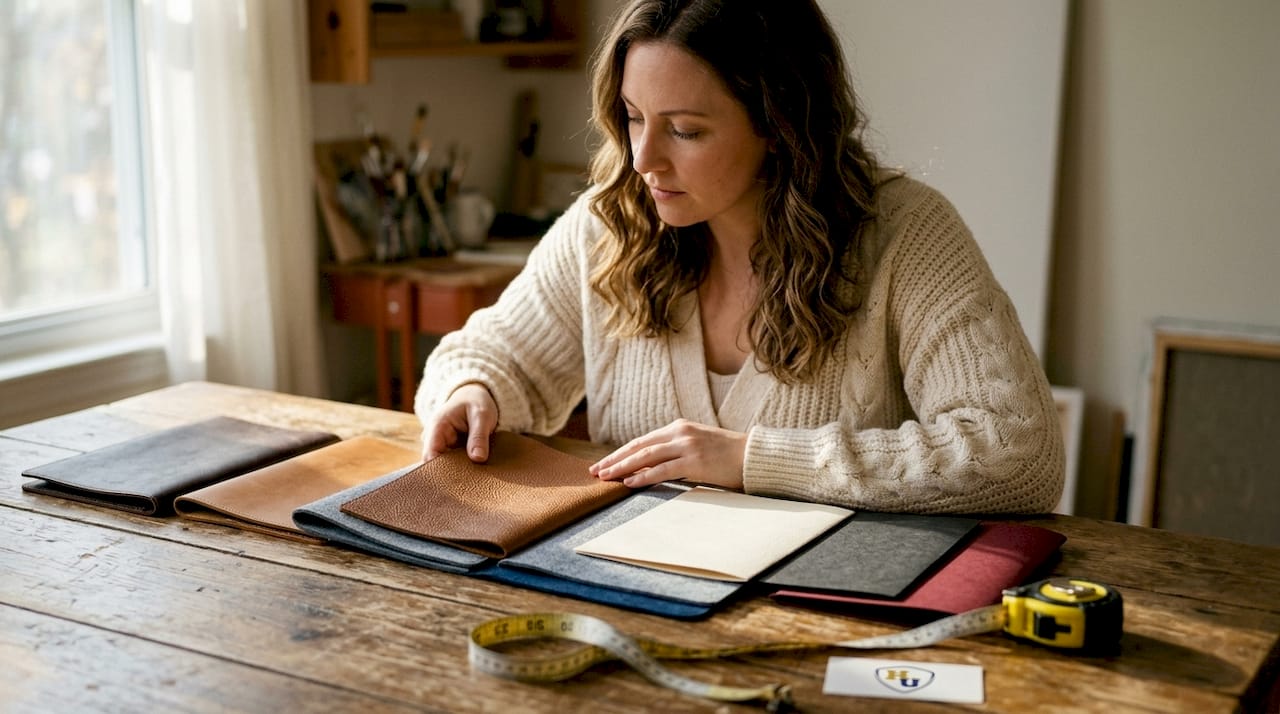
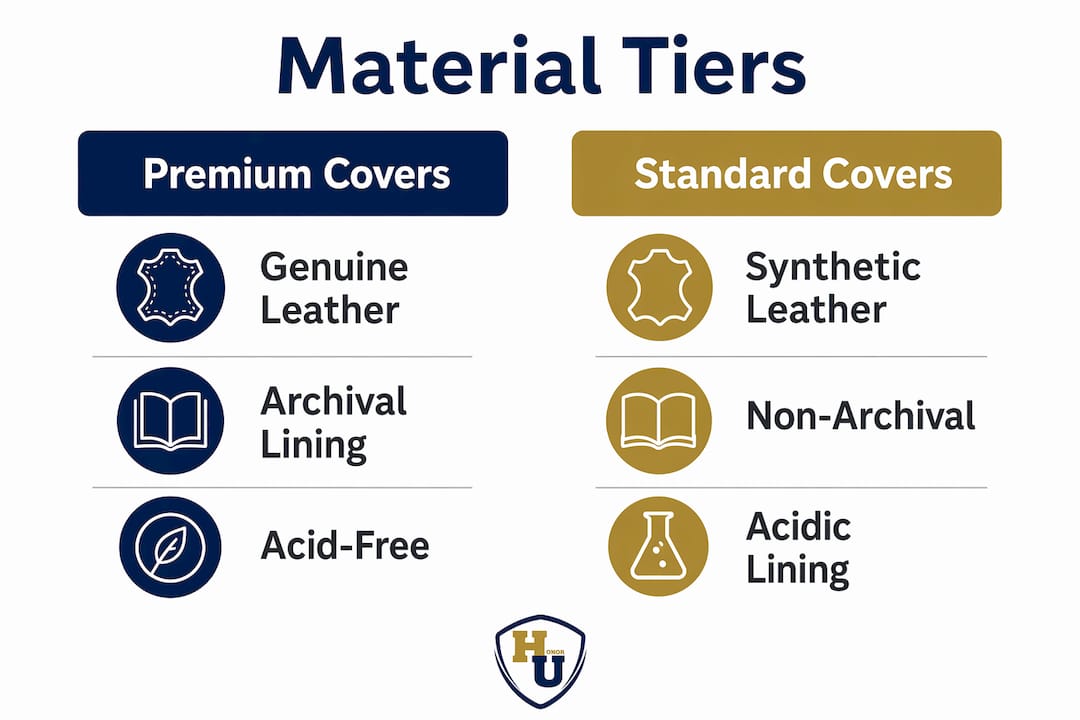
Material selection determines three things: how the cover looks on stage, how long it protects the document, and how much it costs. Premium certificate covers are categorized by price tiers with distinct quality levels. Budget options in the $10–$25 range use faux leather and offer basic protection. Mid-range options at $25–$75 feature better construction and acid-free interiors. Premium covers at $75 and above use genuine leather, hand-stitched artisanal work, and archival-grade materials.
Material tiers and what they mean in practice
The interior lining matters as much as the exterior finish. Acidic interiors in low-quality covers accelerate paper yellowing. Only archival-grade linings guarantee preservation over decades, which is critical for diplomas intended for display or legacy. A certificate stored in a non-archival cover for ten years may show visible yellowing and brittleness. The same certificate in an acid-free interior remains crisp and display-ready.
Color and fabric also carry weight in formal settings. Black, navy, and burgundy are standard premium colors that photograph well and reinforce the formality of recognition events. These colors read as authoritative in both stage photography and framed display.
| Material | Durability | Archival safe | Price range | Best for |
|---|---|---|---|---|
| Faux leather | Moderate | Varies | $10–$25 | Budget ceremonies, short-term use |
| Linen or fabric | Good | Often yes | $20–$50 | Academic and religious events |
| Bonded leather | Good | Yes (mid-grade) | $30–$60 | Corporate awards, HR recognition |
| Genuine leather | Excellent | Yes (archival) | $75+ | Heirloom diplomas, legacy display |
| Metallic foil exterior | High | Yes (with acid-free lining) | $25–$65 | Graduation ceremonies, branded events |
- Acid-free interiors protect against yellowing and deterioration over time, which is the standard for any document intended for long-term display.
- Faux leather is acceptable for short-term use but not for heirloom-quality presentation.
- Genuine leather with hand-stitched edges signals the highest tier of prestige and is appropriate for doctoral degrees, executive awards, and legacy credentials.
Why exact sizing is non-negotiable
Professional certificates must match cover dimensions exactly. A misfit cover causes warping or slipping, which damages the certificate and degrades the presentation moment. Standard sizes are US Letter (8.5 x 11 inches) and A4 (8.27 x 11.69 inches), but many institutions issue diplomas in non-standard dimensions. Always verify the exact diploma size with the issuing authority before placing an order.
Wehonoru offers made-to-fit custom sizing for non-standard documents, which is a capability most standard suppliers do not provide. This matters for military commendations, oversized institutional diplomas, and specialty award formats that fall outside the two common standards. Explore the full document cover selection guide for sizing guidance specific to diplomas and awards.
Pro Tip: Request a physical sample of your diploma from the institution before ordering covers in bulk. Measure the document yourself rather than relying on the institution’s stated size. Printing tolerances and paper stock can shift actual dimensions by up to a quarter inch.
How do you prepare certificate covers for ceremonies and presentations?
Preparation is where most ceremony planners lose points they should never lose. A premium cover that is incorrectly loaded, poorly personalized, or handled carelessly on stage undermines the entire investment. The steps below apply to graduation ceremonies, corporate award events, and professional credentialing presentations.
Inserting and securing certificates
- Lay the cover flat on a clean, dry surface before inserting the certificate. Avoid surfaces with dust, moisture, or debris that can transfer to the document.
- Align the certificate to the interior corners before pressing it into the holder. Crooked placement is visible through the cover window and reads as careless.
- Check the interior retention mechanism. Quality covers use satin corners, ribbon ties, or fitted pockets. Confirm the certificate is held securely before stacking covers for transport.
- Stack covers spine-down in a box or crate for transport. Stacking face-down risks scratching the exterior finish.
- Inspect each cover at the venue before the ceremony begins. Verify the certificate is straight, the cover is clean, and the exterior shows no scuffs or creases.
Customizing covers with embossing, foil, and personalization
Embossing and foil stamping require specialized print shops and heavier card stock. They add tactile and visual prestige that home printing cannot replicate. For high-value certificates, foil stamping with metallic gold or silver is the standard finish for institutional branding. Wehonoru applies metallic foil printing in-house, which keeps turnaround to one business day without sacrificing finish quality.
Customization elements like embossing, foil stamping, and personalization transform basic covers into meaningful keepsakes. They add perceived prestige and memorability for recipients. For corporate HR departments, adding a company logo in metallic foil to each cover reinforces brand identity at the moment of recognition.
- Add the recipient’s name in foil for individual personalization at scale.
- Include the institution’s seal or logo on the cover exterior for brand consistency.
- Choose a foil color that matches the institution’s official color palette.
- For multi-year programs, include the graduation year on the cover to create a collectible quality.
Tent-style covers and ceremony photography
The handoff moment in ceremonies benefits from tent-style covers that stabilize the presentation and improve photography. Tent-style covers stand upright on a table or podium, which means the presenter and recipient both have a clear grip point during the handoff. This reduces fumbling and produces cleaner stage photographs.
Tent-style covers with satin corners provide secure holding and expert finishing that creates a dignified ceremony moment. For events where photography or video capture is part of the program, tent-style is the preferred format. Pairing premium covers with a graduation video editor for ceremony footage creates a complete documentation package for recipients and families.
How do you care for and store premium certificate covers?
A premium cover is an investment in the document it protects. Proper care extends the life of both the cover and the certificate inside it. The most common causes of cover degradation are improper cleaning, poor storage conditions, and exposure to humidity or direct sunlight.
Cleaning and handling by material type
- Faux leather: Wipe with a dry microfiber cloth. Avoid water and solvent-based cleaners, which can crack the surface coating.
- Genuine leather: Use a leather conditioner once or twice a year to prevent drying and cracking. Wipe dust with a soft, dry cloth.
- Linen or fabric covers: Spot-clean with a barely damp cloth. Do not submerge or machine wash.
- Metallic foil exteriors: Wipe gently with a dry cloth. Avoid abrasive materials that scratch the foil finish.
Storage recommendations for long-term preservation
Store covers vertically in a cool, dry location away from direct sunlight. Horizontal stacking under weight causes warping over time, particularly in faux leather and linen covers. Archival, acid-free interiors protect the document from yellowing and deterioration, but the storage environment still matters. Humidity above 60% accelerates paper degradation even inside a quality cover.
When transitioning a certificate from a cover to a frame or display case, handle the document by its edges only. Fingerprints leave oils that accelerate yellowing at the contact point. Use cotton gloves for any heirloom-quality document that will be framed for permanent display.
Pro Tip: Place a silica gel packet inside the cover if you are storing it in a basement, storage unit, or any space with variable humidity. This single step prevents moisture damage that no cover material can fully stop on its own.
Key Takeaways
The right premium certificate cover protects the document, honors the recipient, and reflects the credibility of the institution presenting it.
| Point | Details |
|---|---|
| Match cover type to document | Use diploma holders for single certificates and document holders for multi-page packets. |
| Prioritize archival interiors | Acid-free linings prevent yellowing and are required for any heirloom-quality presentation. |
| Verify sizing before ordering | Confirm exact diploma dimensions with the issuing institution to prevent warping or slipping. |
| Use tent-style for ceremonies | Tent-style covers improve handoff stability and produce cleaner stage photography. |
| Customize for memorability | Foil stamping and embossing transform covers into keepsakes that recipients retain for decades. |
Why physical presentation still defines the recognition moment in 2026
The most underestimated shift in credentialing right now is the move toward hybrid verification. Certificate covers are part of a hybrid ecosystem pairing physical materials with digital verification such as QR codes. This combination enhances legitimacy and makes credentials portable in ways that a physical cover alone cannot achieve. I have seen institutions add QR codes to the interior of covers that link directly to a verified digital credential. The physical cover becomes the anchor, and the digital record becomes the proof.
What surprises most planners is how much the cover itself shapes recipient pride. A graduate who receives a diploma in a well-constructed, foil-stamped cover holds it differently than one who receives a bare document in a paper sleeve. That difference in how recipients handle and display their credentials directly affects how they talk about the institution afterward. Institutional reputation is built in moments like these.
The argument I hear against investing in quality covers is always cost. My response is always the same: the cover is the last physical impression the institution makes on the recipient. Spending $25 on an archival-quality, foil-stamped cover versus $8 on a faux leather sleeve is a decision that costs less than a single line item in most event budgets. The return, measured in recipient satisfaction and institutional perception, is disproportionate to the investment.
The 2026 trend worth watching is custom sizing for non-standard credentials. Online education platforms, trade schools, and professional associations increasingly issue certificates in non-standard dimensions. Institutions that order covers without verifying dimensions end up with misfit covers that damage documents and embarrass presenters. Made-to-fit sizing, which Wehonoru provides without minimum order requirements, solves this problem at the individual and institutional level.
— Manager
Wehonoru’s tent-style covers for 2026 ceremonies
Wehonoru produces tent-style certificate covers with metallic foil printing, archival-safe interiors, and made-to-fit custom sizing for any document format. Orders ship in one business day with no minimum quantity and free shipping on orders over $30.
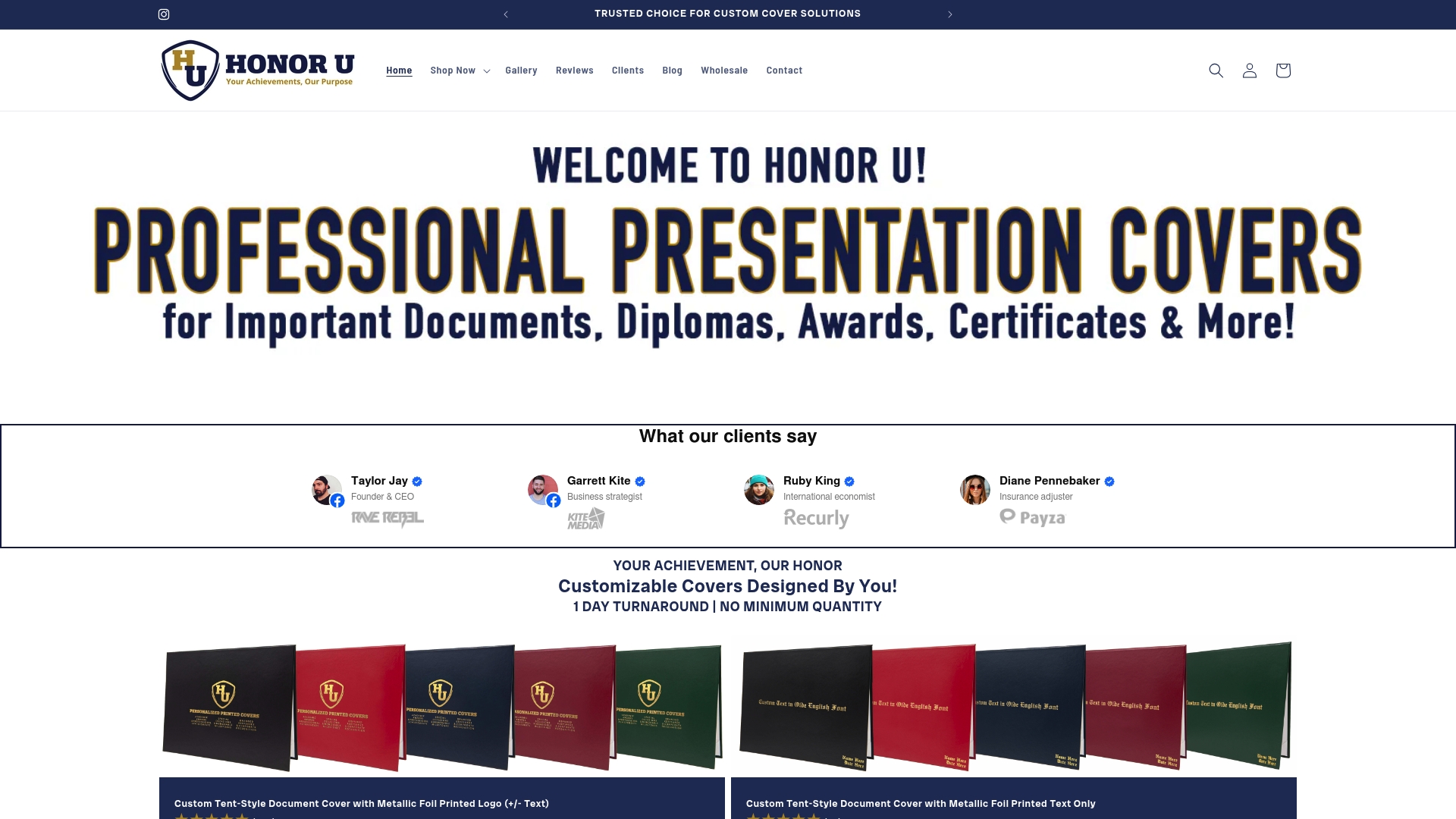
The graduation tent-style document cover is built for stage handoffs, with satin corners and a structured fold that stands upright for photography. The classic diploma tent-style cover suits formal diploma presentations with an elegant finish and archival lining. Both are available with custom foil printing for institutional logos, names, and graduation years. For a full overview of how educators and HR professionals use these covers effectively, visit Wehonoru’s certificate display best practices guide.
FAQ
What is a premium certificate cover?
A premium certificate cover is a structured presentation folder designed to protect and display a diploma or credential with formal, archival-quality materials. It differs from a basic sleeve by offering acid-free interiors, durable exteriors, and customization options like foil stamping.
How do I choose the right size for a certificate cover?
Verify the exact dimensions of the issued certificate directly with the issuing institution before ordering. Standard sizes are US Letter (8.5 x 11 inches) and A4 (8.27 x 11.69 inches), but non-standard dimensions require made-to-fit covers to prevent warping or slipping.
What materials are best for long-term certificate preservation?
Genuine leather exteriors with acid-free, archival-grade interiors offer the best long-term protection. Acid-free linings prevent yellowing and paper deterioration over decades, which is the standard for any diploma intended for display or legacy.
Why are tent-style covers preferred for graduation ceremonies?
Tent-style covers stand upright on a surface, giving both the presenter and recipient a stable grip point during the handoff. This format reduces fumbling on stage and produces cleaner photographs, making it the preferred choice for formal graduation and award events.
Can certificate covers include digital verification features?
Yes. Modern certificate presentation increasingly pairs physical covers with digital verification elements such as QR codes printed on the interior. This hybrid approach links the physical credential to a verified digital record, adding legitimacy and portability to the recognition package.