
Top Certificate Holder Designs 2026: A Professional Guide

TL;DR:
- The best certificate holders in 2026 combine premium materials with expert finishing and practical formats. PU leather, linen-wrapped board, and genuine leather suit different recognition levels and budgets. Minimalist designs with restrained decoration enhance credibility and focus on the certificate’s hierarchy.
The best certificate holder designs for 2026 are defined by the combination of premium materials, expert finishing techniques, and practical format choices that together create a presentation worthy of the achievement inside. Whether you are coordinating a university commencement, a corporate awards ceremony, or a healthcare credentialing program, the holder you choose signals the weight of the recognition before the recipient even opens the cover. This guide covers the top certificate holder designs 2026 professionals are selecting, from material options and finishing methods to format comparisons and full customization strategies, so you can make confident procurement decisions well ahead of your event.
1. What are the leading materials for top certificate holder designs in 2026?
Material choice profoundly impacts ceremony tone and recipient perception. The three dominant materials in 2026 are PU leather, linen-wrapped board, and genuine leather, each suited to a different event tier and budget.
PU leather is the most widely used material for corporate and educational certificate holders at scale. It delivers a premium look and feel at a moderate price point, holds up well through repeated handling, and accepts foil stamping cleanly. PU leather typically requires 18–25 working days for production with customization, making it the practical choice for large graduation classes and annual award cycles.
Linen-wrapped board carries a classic academic character that PU leather cannot replicate. The textured surface gives holders a hardcover book quality that resonates strongly in university and seminary settings. Production lead times for linen run 20–28 working days, slightly longer than PU leather due to the wrapping process.
Genuine leather is reserved for the highest-tier recognitions. It ages with distinction, develops a patina over time, and communicates lasting prestige in a way synthetic materials do not. Lead times extend to 25–35 working days, and cost is significantly higher. Genuine leather suits lifetime achievement awards, board-level recognitions, and military commendations where the holder itself is meant to be kept for decades.
Key material considerations at a glance:
- PU leather: Best for bulk orders, corporate HR programs, and graduation ceremonies; moderate cost; 18–25 working days
- Linen-wrapped board: Best for universities, seminaries, and classic academic settings; mid-range cost; 20–28 working days
- Genuine leather: Best for elite awards, executive recognition, and military honors; highest cost; 25–35 working days
- Color availability: All three materials are available in standard colors including black, navy, burgundy, and forest green; custom colors require additional lead time
- Durability: Genuine leather outlasts PU leather for long-term display; linen is susceptible to moisture and should not be used for mailed certificates without protective packaging
Pro Tip: Order certificate holders with personalization at least six weeks before your ceremony date. Production lead times do not account for shipping transit, and name personalization adds additional days to any material type.
2. What finishing techniques define the best certificate folder styles in 2026?
Foil stamping, blind debossing, silkscreen, and digital UV printing are the four primary finishing methods for certificate holders in 2026. Each serves a different aesthetic and budget purpose.
Foil stamping is the gold standard for prestige presentation. Gold, silver, rose gold, and copper foils catch light and command attention from across a stage or display table. Foil is applied under heat and pressure, bonding a metallic film to the cover surface. The result is sharp, durable, and unmistakably formal.
Blind debossing creates an impression in the cover material without any color or foil. The result is a subtle, tactile effect that reads as understated elegance. Debossing works especially well for institutional crests and secondary text elements where you want presence without visual noise.
“Foil shouts. Debossing whispers. The most sophisticated certificate holders use both.” — Certificate Folder Finishes Guide
Combining foil stamping and blind debossing creates a powerful visual hierarchy on the cover surface. A foil-stamped institution name draws the eye at distance, while a debossed crest or border adds tactile refinement up close. This combination is the preferred approach for university diploma covers and executive award folders in 2026.
Silkscreen printing applies ink directly to the cover and suits multi-color logos where foil is not practical. It is cost-effective for large runs but lacks the dimensional quality of foil or deboss. Digital UV printing goes further, enabling full-color photographic detail and gradients on the cover. UV printing is the right choice when a design includes photography, complex color gradations, or brand assets that cannot be reduced to a single foil color.
Finishing method comparison:
- Gold foil stamping: Highest prestige; best for institution names, seals, and award titles
- Silver foil stamping: Clean and modern; popular for corporate and healthcare programs
- Rose gold foil: Growing in popularity for continuing education and professional development certificates
- Blind debossing: Subtle and tactile; ideal for secondary design elements and borders
- Silkscreen: Multi-color logos at scale; lower cost than foil
- Digital UV printing: Full-color detail; best for complex brand assets and photo elements
3. Which certificate holder formats suit different 2026 ceremonies?
Folders suit stage presentations; rigid boxes suit long-term display. That single distinction drives most format decisions for corporate awards professionals in 2026. The format you choose should match how the holder will be used, not just how it looks in a product photo.
| Format | Best Use | Pros | Cons |
|---|---|---|---|
| Standard bi-fold folder | Stage walk, classroom presentation | Lightweight, easy to carry, cost-effective | Less durable for long-term display |
| Rigid box with lid | Executive awards, lifetime recognition | Premium feel, excellent protection | Higher cost, heavier to transport |
| Certificate wallet with zipper | Mailing, transport, field certifications | Protects document in transit | Less formal for ceremony use |
| Window display holder | Reception desks, lobby displays | Instant visibility without opening | Document exposed to light and dust |
| Easel-back holder | Desk display, office credentialing | Self-standing, no frame required | Limited protection for document |
| Tent-style cover | Graduation ceremonies, table presentations | Stands independently, dual-panel display | Requires flat surface for display |
The tent-style cover deserves particular attention for 2026 graduation and corporate award events. It stands independently on a table or podium, displays the institution name on the front panel, and holds the certificate securely inside. Wehonoru’s tent-style document covers are built specifically for this format, with metallic foil printing options and made-to-fit sizing for non-standard documents.
Pro Tip: For stage ceremonies where recipients walk across a platform, choose a bi-fold folder with a ribbon or elastic closure. It keeps the certificate secure during the handshake moment and photographs cleanly from the audience.
4. How to customize certificate holders for branding and recipient experience
Personalization is the detail that separates a memorable presentation from a generic one. Modern certificate layouts include recipient name as the anchor element, and the holder design should reinforce that hierarchy rather than compete with it.
Effective customization for 2026 certificate holders includes:
- Recipient name personalization: Adds production time but significantly increases perceived value; plan for additional lead time per unit in large batches
- Logo placement: Position the institution or company logo on the front cover using foil stamping for maximum brand visibility; avoid placing logos on the interior where they compete with the certificate itself
- Combined foil and deboss: Use foil for the primary name or logo and debossing for secondary elements like borders or taglines; this creates depth without clutter
- Embossed seals: A raised seal on the front cover adds a tactile credential signal that recipients associate with official documents
- QR code integration: Modern certificate layouts optionally include QR codes for digital verification; the holder can carry a matching QR code on the interior panel to link physical and digital credentials
- Typography alignment: Use a two-font family rule and size the recipient name at 20–50 pt on the certificate itself; the holder design should complement, not override, this hierarchy
Over-decoration reduces certificate credibility in 2026 designs. Clipart-style borders, excessive color fills, and competing graphic elements all diminish the perceived professionalism of the presentation. Structured formality, clear hierarchy, and restrained decoration are the marks of a well-designed holder and certificate combination.
Pro Tip: Before approving a large batch order, request a PDF proof of the personalized layout. Previewing PDF exports catches layout conflicts caused by long names or titles before production begins, saving significant time and cost.
5. What are the top 10 certificate holder designs of 2026?
The following designs represent the most admired and widely adopted certificate holder styles across education, corporate, and professional sectors in 2026. Each entry reflects a distinct combination of material, finish, and format that serves a specific ceremony context.
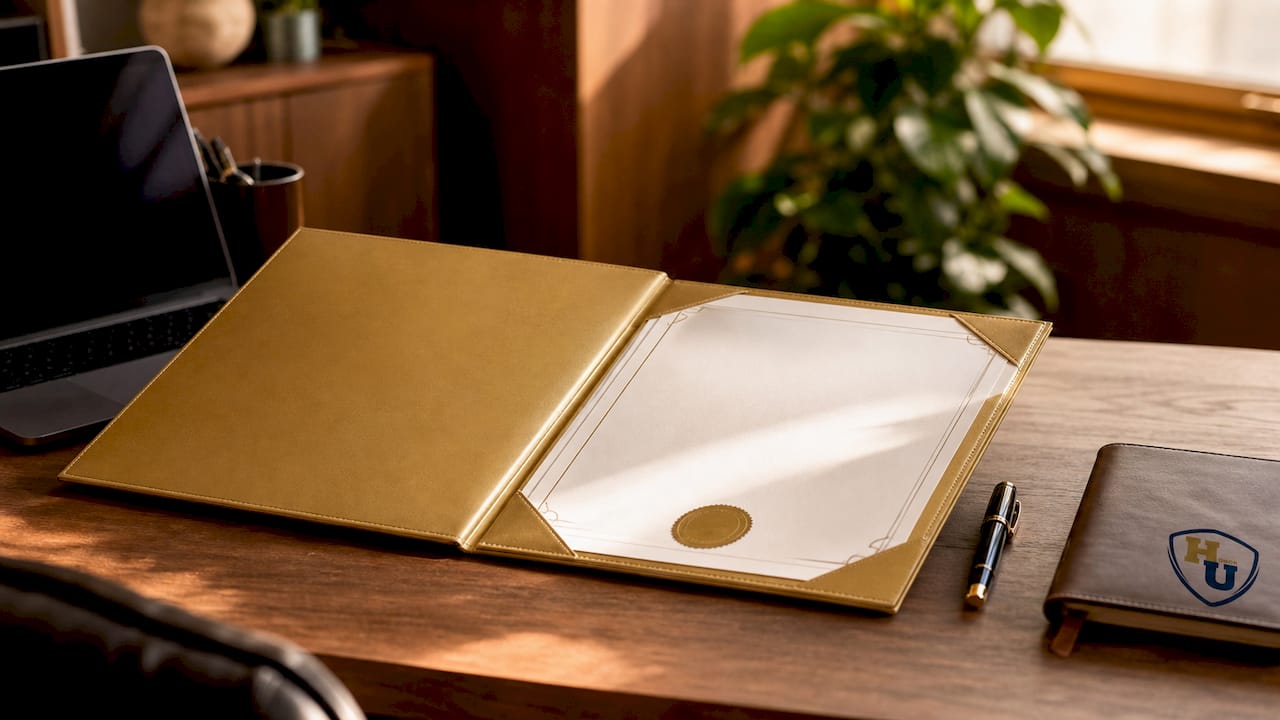
1. Gold foil PU leather bi-fold folder
The gold foil PU leather bi-fold is the most widely used design across university graduation programs. It balances cost, production speed, and visual prestige effectively. The front cover carries a gold foil institution name and crest; the interior holds the diploma on the right panel with a ribbon accent on the left.
2. Silver foil linen hardcover folder
Linen-wrapped board with silver foil stamping is the preferred choice for classic academic institutions that want a hardcover book feel. The texture of the linen surface adds tactile distinction, and silver foil reads as modern and clean against the natural material tone.
3. Tent-style metallic foil document cover
The tent-style format with metallic foil printing stands independently for table and podium presentations. Wehonoru produces this format with five color options and custom logo foiling, making it a strong choice for both graduation ceremonies and corporate award events. The Classic Diploma of Graduation Tent-Style Document Cover is one of the most recognized designs in this category.
4. Rose gold foil continuing education folder
Rose gold foil on a black PU leather cover has become the signature finish for professional development and continuing education programs. The warm metallic tone feels contemporary without being informal, and it photographs well for LinkedIn and social media sharing.
5. Blind deboss linen academic folder
A linen cover with blind debossing only, no foil, delivers maximum restraint and tactile elegance. This design is favored by institutions that want the holder to feel like a heritage object. The debossed crest or seal is visible only in raking light, which creates a refined discovery moment for the recipient.
6. Rigid box with foil-stamped lid
For lifetime achievement awards and board-level recognitions, a rigid clamshell box with a foil-stamped lid is the standard. The box protects the certificate indefinitely and signals that the award is meant to be kept, not filed. Genuine leather or premium faux leather wrapping is standard for this format.
7. Full-color UV print folder
Digital UV printing on a matte cover enables full-color institutional photography, complex brand gradients, and detailed artwork. This design suits trade schools, culinary programs, and fitness certifications where the brand identity is visually rich and cannot be reduced to a single foil color.
8. Certificate wallet with embossed seal
A zippered certificate wallet with an embossed seal on the front cover is the practical choice for certifications that travel. Healthcare providers, real estate agents, and field technicians receive credentials that move between offices and client sites. The wallet protects the document and presents it professionally when opened.
9. Window display folder
A bi-fold folder with a die-cut window on the front panel displays the recipient name or certificate title without opening the cover. This design works well for lobby displays, reception desks, and trade show recognition walls where instant visibility matters.
10. Custom-dimension specialty cover
Non-standard document sizes require made-to-fit covers. Military commendations, oversized architectural certificates, and international credential formats often fall outside standard 8.5 x 11 dimensions. Wehonoru’s custom-dimension capability addresses this gap directly, producing covers to exact specifications with the same foil and material options as standard sizes.
Key takeaways
The most effective certificate holder designs in 2026 pair the right material with the right finish and format for the specific ceremony context, not just the largest budget.
| Point | Details |
|---|---|
| Material drives ceremony tone | PU leather suits scale; linen suits academia; genuine leather suits elite awards. |
| Finishing technique signals prestige | Combine foil stamping and blind debossing for maximum visual and tactile impact. |
| Format must match use case | Bi-fold folders work for stage walks; tent-style and rigid boxes work for display. |
| Personalization requires lead time | Add at least six weeks for custom orders with name personalization and foil printing. |
| Restraint improves credibility | Clear hierarchy and minimal decoration produce more professional results than ornate designs. |
What I have learned about certificate holder procurement after years in this field
The most common mistake I see from procurement managers and event coordinators is treating the certificate holder as an afterthought. The diploma or certificate gets weeks of design attention, and the holder gets ordered in the final two weeks before the ceremony. That sequence almost always creates problems.
Lead times for quality materials are not negotiable. Ordering with personalization requires careful lead-time management, and starting procurement earlier than anticipated is the only reliable way to avoid ceremony delays. I have seen institutions receive beautiful certificates in generic folders because the custom covers did not arrive in time. That mismatch undermines the entire presentation.
The second pattern I observe is over-decoration. Institutions sometimes request elaborate borders, multiple foil colors, and complex interior graphics in an attempt to make the holder feel special. The result is visual noise that competes with the certificate itself. The holders that recipients keep and display for years are almost always the restrained ones: a clean foil name, a debossed crest, and a quality material that ages well.
The shift toward minimalism in 2026 is not a trend driven by cost cutting. It reflects a genuine understanding that certificate credibility relies on clear hierarchy and restrained decoration more than ornate graphics. The institutions that have adopted this approach consistently receive stronger feedback from recipients and faculty alike.
One area worth watching is the integration of digital and physical credentials. Recipients increasingly share their achievements on LinkedIn and other platforms, and digital certificates designed for social media legibility are becoming standard alongside physical holders. The smartest procurement decisions in 2026 account for both: a physical holder that photographs well and a digital credential that shares cleanly. QR codes on the interior panel of a holder are a simple, low-cost way to connect the two.
— Manager
Premium certificate holders for graduation and corporate awards at Wehonoru
Wehonoru offers a full range of custom certificate holders built for graduation ceremonies, corporate award programs, and professional credentialing events in 2026.
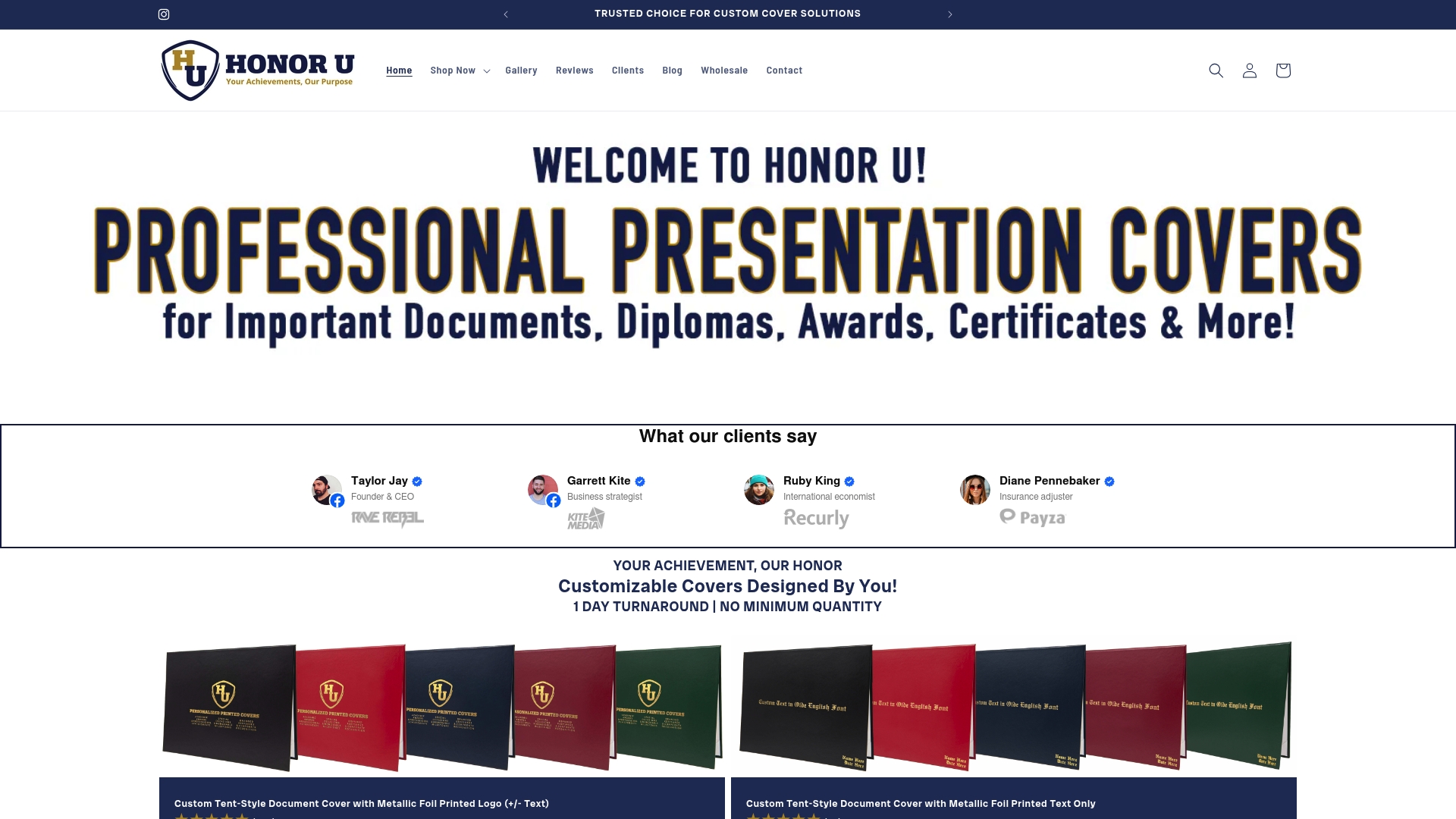
The Classic Diploma of Graduation Tent-Style Document Cover and the Class of graduation tent cover are available with custom logo foiling, five color options, and made-to-fit sizing for non-standard documents. Wehonoru ships orders in one business day with no minimum order quantity and free shipping on orders over $30. Whether you need a single cover for a special recognition or a bulk order for an entire graduating class, Wehonoru’s certificate holder options deliver premium presentation at practical pricing.
FAQ
What materials are best for professional certificate holders in 2026?
PU leather is the top choice for large-scale corporate and educational programs, offering a premium appearance at a moderate cost. Genuine leather is reserved for elite recognitions where long-term display and prestige are the priority.
How far in advance should I order custom certificate holders?
Order at least six weeks before your ceremony date. Production lead times range from 18–35 working days depending on material and personalization, and shipping transit adds additional time beyond production.
What is the difference between foil stamping and blind debossing?
Foil stamping applies a metallic film to the cover surface for high-visibility branding. Blind debossing creates a pressed impression with no color, producing a subtle tactile effect best suited for secondary design elements.
Which certificate holder format works best for stage ceremonies?
A bi-fold folder with a ribbon or elastic closure is the standard for stage presentations. It is lightweight, easy to carry during the handshake moment, and photographs cleanly from the audience.
Can certificate holders include QR codes for digital verification?
Yes. Modern certificate designs optionally include QR codes for credential verification, and the interior panel of a holder can carry a matching code to connect the physical and digital credential in one presentation.