
Document Presentation in Medicine: Building Patient Trust

TL;DR:
- Effective medical document presentation prioritizes organization, visual clarity, and verified credentials to build patient trust. Proper display of credentials and plain-language materials influence patient perceptions, safety, and legal protection. Regular audits and human review ensure compliance and professionalism in healthcare documentation.
Effective document presentation in medicine is defined as the deliberate organization, visual clarity, and professional display of medical credentials, records, and patient-facing materials to communicate competence and build trust. The importance of document presentation in medicine extends well beyond aesthetics. Research confirms that patients form lasting judgments about healthcare providers based on what they see displayed in clinical environments, from board certifications on the wall to the clarity of written discharge instructions. For healthcare professionals and medical administrators, mastering medical document clarity is not optional. It is a core component of patient-centered care, legal protection, and institutional credibility.
How does document presentation influence patient trust and perception?
Patients rely on visual and credential signals as cognitive shortcuts to assess physician competence, since they lack direct clinical skill understanding. This means the physical and visual environment of a healthcare setting carries enormous weight in shaping patient confidence before a single word is spoken.
Patients form lasting first impressions of healthcare environments within 5 minutes, heavily influenced by document clarity, signage, and professional information displays. That window is shorter than most intake processes. A cluttered waiting room with outdated or poorly mounted certificates signals disorganization, even when the clinical care is excellent.
The trust signals patients respond to most are specific and verifiable. Board certification is viewed by 82% of parents as a critical indicator of physician competence and ongoing professional development. That figure reflects a broader pattern: patients across demographics use displayed credentials as proxies for clinical quality.
Reputation compounds this effect. Patients over 51 years old are 4.19 times more likely to trust physicians with strong reputations, and peer recommendations double that effect. Visible, well-presented credentials reinforce reputation before any conversation begins.
Key trust signals patients look for in a clinical environment include:
- Board certifications displayed in clear, professional frames or covers in patient-facing areas
- Accreditation notices from recognized bodies such as The Joint Commission, positioned at entry points
- Organized signage that guides patients through the facility without confusion
- Legible, structured patient documents including consent forms, discharge summaries, and care instructions
- Staff credentials displayed consistently across departments, not just in executive offices
Well-organized visual information also reduces patient anxiety. When a patient can quickly locate relevant information, understand their care team’s qualifications, and read instructions without decoding jargon, their confidence in the facility rises measurably.
What are the best practices for presenting medical documents?
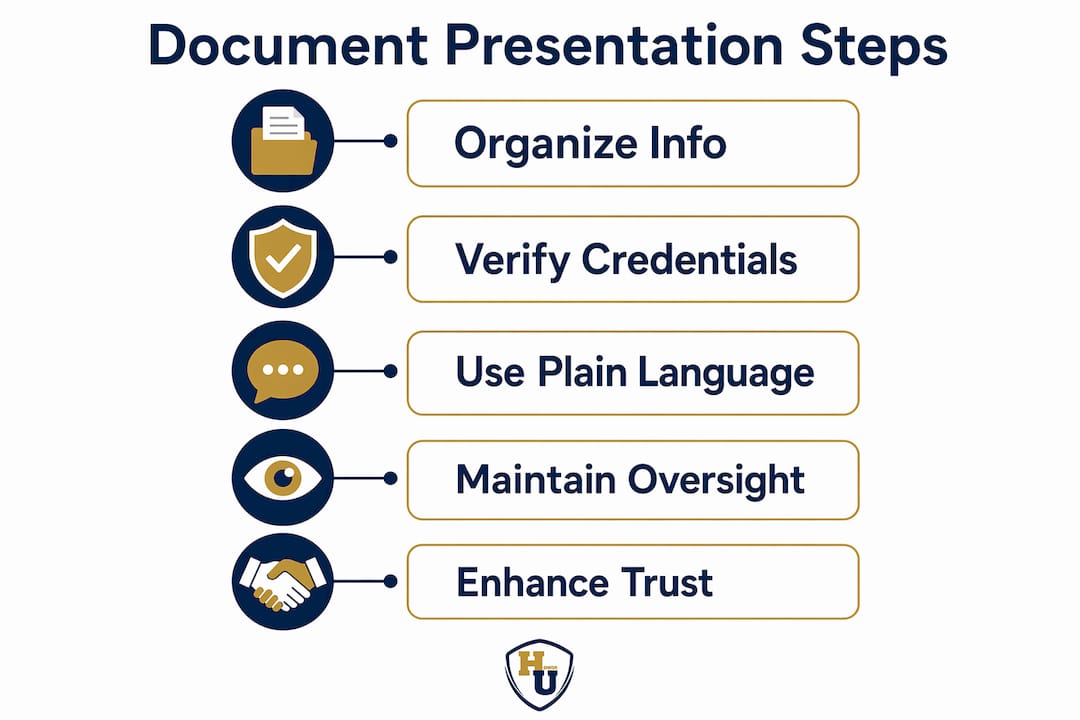
The best practices for presenting medical documents combine organizational discipline, verified credential display, plain language, and human oversight in document preparation. Each element addresses a distinct failure point that erodes trust.
Organize documents around the reader’s needs
Document organization in healthcare must prioritize the reader, not the institution. Patient-facing documents should follow a clear hierarchy: the most critical information appears first, supporting details follow, and contact information closes every document. Administrative documents shared among clinical teams benefit from standardized templates that reduce interpretation errors.

The role of documentation in medicine also includes how credentials are physically presented. A medical diploma or board certification displayed in a worn folder or an ill-fitting cover undermines the credibility it is meant to project. The physical condition and quality of the display matter as much as the credential itself.
Display only verifiable credentials
Pay-to-play awards or vanity certifications damage physician credibility. Only peer-reviewed, verifiable awards build durable trust. This is a critical distinction for medical administrators managing credential display programs across a facility.
Accredited organizations achieve measurable improvements in patient outcomes linked to trust-based engagement and clear visual signals. The standard is straightforward: if a credential cannot be independently verified by a patient or their family, it should not occupy prime display space in a patient-facing area.
Use plain language in public-facing documents
| Document Element | Common Mistake | Best Practice |
|---|---|---|
| Physician credentials | “Board Eligible” without explanation | “Currently completing board certification process” |
| Consent forms | Dense legal and clinical terminology | Plain-language summaries with key terms defined |
| Discharge instructions | Abbreviations and clinical shorthand | Step-by-step instructions in plain English |
| Accreditation notices | Regulatory code references only | Named accrediting body with brief explanation |
| Certification display | Certificates stored in files or drawers | Mounted in professional covers in patient-facing areas |
Maintain human oversight in document preparation
95% of patients consider human review important when AI is used to prepare clinical research documents, and 62.4% want transparency about AI usage. Healthcare administrators integrating AI tools into document workflows must build explicit human review steps into every process.
Pro Tip: Before publishing any patient-facing document prepared with AI assistance, assign a licensed clinician or trained administrator to review it for accuracy, tone, and plain-language compliance. Document that review step in your quality log.
For guidance on certificate display best practices applicable across professional settings, including healthcare, the principles of visibility, authenticity, and consistent formatting apply directly.
How does effective document presentation support legal safety and operational efficiency?
Proper document presentation protects both the provider and the patient while keeping clinical operations running without friction. These two benefits are inseparable in practice.
From a legal standpoint, a well-maintained medical record is the primary defense in any dispute about care quality or informed consent. Courts and licensing boards evaluate not just what was documented but how clearly and completely it was organized. Ambiguous formatting, missing dates, or illegible entries create legal exposure that clear documentation eliminates.
Operationally, document organization in healthcare directly affects how quickly clinical teams can access and act on information. A nurse who spends three minutes locating a medication allergy record in a poorly organized chart is three minutes delayed in delivering care. Multiply that across a facility and the cost in time, safety risk, and staff frustration becomes significant.
Regulatory bodies including The Joint Commission set explicit standards for documentation practices in accredited facilities. Meeting those standards is the baseline. Exceeding them through superior clarity and organization is what separates facilities that merely pass audits from those that earn patient loyalty.
The following steps maintain document integrity and clarity across a healthcare organization:
- Standardize templates. Use uniform formats for all clinical and administrative documents so staff can locate information in the same position every time.
- Date and sign every entry. Every document must carry a clear date, time, and the name and role of the person who created or reviewed it.
- Audit credential displays quarterly. Verify that all displayed certifications are current, correctly attributed, and presented in professional covers or frames.
- Train staff on plain-language standards. Require that all patient-facing documents pass a readability review before distribution.
- Log document revisions. Maintain a clear revision history for any document that changes after initial creation, particularly consent forms and care plans.
- Secure sensitive records appropriately. Physical documents containing patient information must be stored and disposed of in compliance with HIPAA. HIPAA-compliant document handling includes proper recycling and destruction protocols for printed materials.
These steps address both the legal record and the operational workflow, making compliance and quality mutually reinforcing rather than competing priorities.
What challenges and misconceptions exist around medical document presentation?
The most persistent challenge in medical document presentation is the gap between what providers believe patients understand and what patients actually comprehend. Professional terminology that is second nature to a clinician can be genuinely confusing to a patient or family member.
The term “board eligible” is a clear example. Simplified language in credential presentation is more effective for patient understanding than professional jargon like “board eligible.” Surveys confirm that the public routinely misinterprets this phrase, sometimes assuming it signals full certification when it does not. Displaying “board eligible” without explanation in a patient-facing area creates a credibility risk, not a trust signal.
A second misconception is that meeting regulatory compliance thresholds automatically builds patient trust. Research shows the opposite pattern.
Healthcare facilities often meet compliance standards but fail to achieve patient-perceived quality, creating a compliance-perception gap. Regulatory thresholds define the floor, not the ceiling. Facilities that treat compliance as the endpoint miss the opportunity to build the kind of visible, felt trust that drives patient loyalty and referrals.
This gap requires a deliberate shift from compliance-driven documentation to perception-oriented presentation. The standard must be: “Does this document communicate clearly and professionally to the person reading it?” not “Does this document satisfy the audit checklist?”
A third challenge involves AI-generated documents. Clear and transparent communication about AI’s role in document creation enhances patient trust, even among digitally experienced populations. Hiding AI involvement does the opposite. Administrators should treat AI transparency as a trust-building tool, not a liability to conceal.
Pro Tip: Add a brief, plain-language disclosure to any patient communication prepared with AI assistance. A single sentence noting that the document was reviewed by a licensed clinician before distribution satisfies both the transparency expectation and the human oversight requirement.
Addressing these challenges requires ongoing staff education, periodic patient feedback surveys, and a willingness to revise documents based on what patients actually report understanding. The impact of presentation on patient care is cumulative. Each improvement compounds over time into measurably stronger trust.
Key Takeaways
Effective medical document presentation builds patient trust, supports legal protection, and drives operational efficiency when it combines verified credentials, plain language, and consistent human oversight.
| Point | Details |
|---|---|
| First impressions are fast | Patients form lasting judgments within 5 minutes based on document clarity and credential display. |
| Verified credentials matter most | Only peer-reviewed, independently verifiable awards and certifications build durable patient trust. |
| Plain language is non-negotiable | Terms like “board eligible” confuse patients; public-facing documents must use clear, simple explanations. |
| Compliance is the floor, not the ceiling | Meeting regulatory standards does not guarantee patient-perceived quality; presentation must go further. |
| Human oversight protects trust | 95% of patients want human review of AI-prepared documents; transparency about AI use strengthens confidence. |
What I’ve learned about document presentation that most guides miss
After working closely with healthcare organizations on credential and document display programs, the pattern I see most often is this: administrators invest heavily in earning credentials and almost nothing in presenting them well. A board certification earned after years of training gets slipped into a generic plastic sleeve and tacked to a wall. The credential is real. The presentation undermines it.
Patient expectations in 2026 are more sophisticated than they were a decade ago. Patients research providers before appointments. They arrive having already formed opinions based on online profiles, reviews, and digital credential listings. When they walk into a facility and see credentials displayed carelessly, it creates a dissonance that erodes the trust they brought through the door.
The facilities that get this right treat document presentation as an extension of clinical quality. They apply the same rigor to how a diploma is displayed as they do to how a procedure is documented. That consistency is what patients feel, even when they cannot articulate why one facility feels more trustworthy than another.
Technology adds a new layer of responsibility. AI tools can produce polished, well-formatted documents quickly. But polish without accuracy is a liability in medicine. The human review step is not bureaucratic overhead. It is the mechanism that keeps document quality aligned with clinical reality.
My practical recommendation: audit your credential display program this quarter. Walk through your facility as a patient would. Note every credential that is faded, poorly mounted, or displayed in a cover that does not match the professionalism of your practice. Then fix it. The investment is modest. The trust signal it sends is not.
— Manager
Professional document covers for healthcare credentials
Healthcare professionals invest years earning the credentials that define their practice. Those credentials deserve a presentation that reflects their significance.
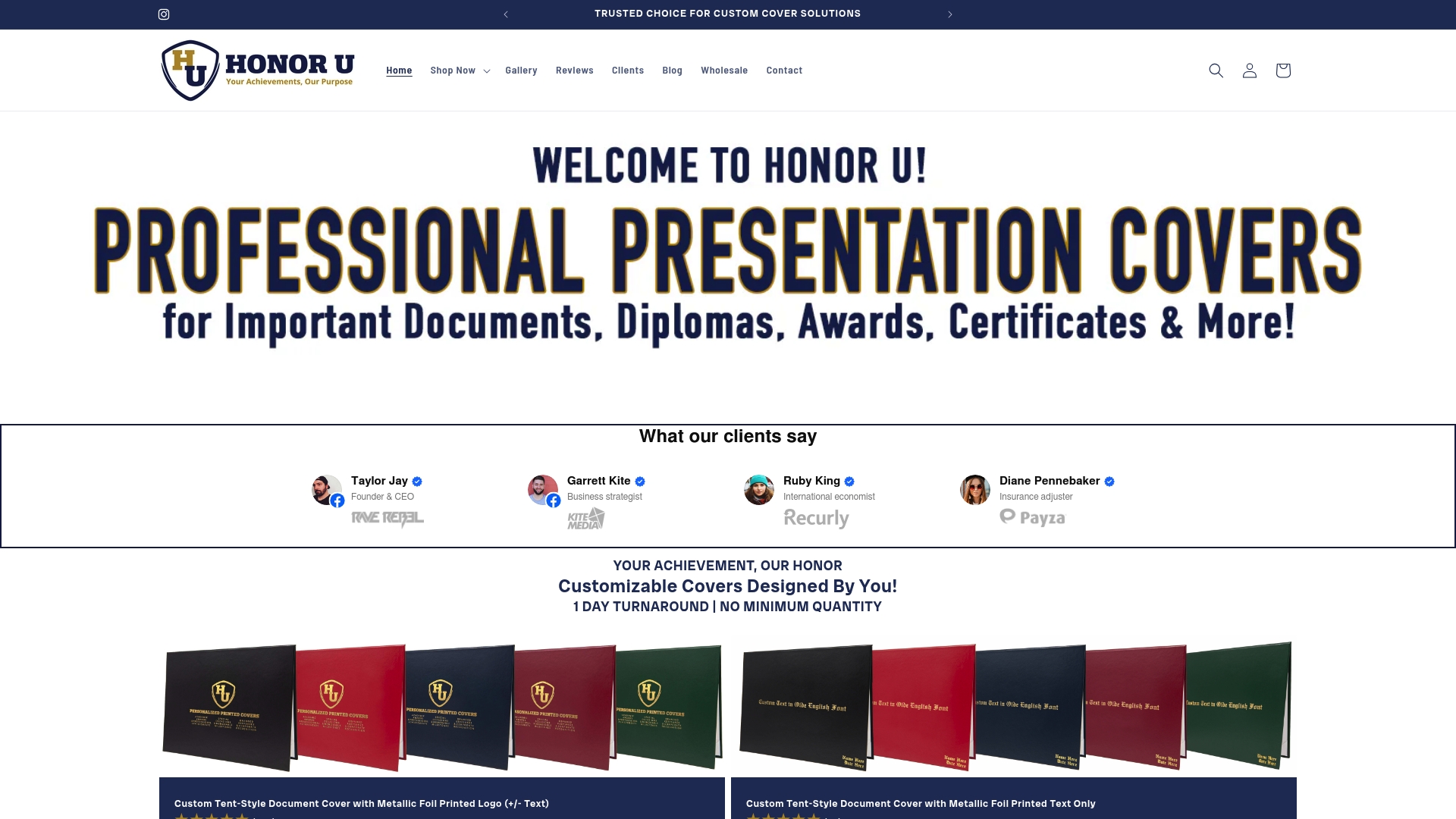
Wehonoru specializes in premium, custom document covers designed for exactly this purpose. The classic tent-style diploma cover is built to display medical diplomas, board certifications, and state licenses with the professionalism they represent. Metallic foil printing, durable materials, and made-to-fit sizing mean your credentials are protected and presented with an heirloom quality that reinforces trust every time a patient sees them. Orders ship in one business day with no minimum quantity required, making it straightforward to update credential displays across an entire facility or for a single provider.
FAQ
Why does document presentation matter in healthcare settings?
Document presentation in medicine directly shapes patient trust and provider credibility. Patients form lasting first impressions within 5 minutes based on the clarity and professionalism of what they see displayed.
What credentials should be displayed in patient-facing areas?
Only peer-reviewed, independently verifiable credentials should be displayed, including board certifications, state licenses, and accreditations from recognized bodies such as The Joint Commission. Vanity or pay-to-play awards damage credibility rather than build it.
How should medical facilities handle AI-generated documents?
Every AI-generated patient document requires human review by a licensed clinician or trained administrator before distribution. Transparency about AI involvement, stated clearly in plain language, strengthens rather than undermines patient trust.
What does “board eligible” mean and should it be displayed?
“Board eligible” means a physician has completed training requirements but has not yet passed the board certification examination. Displaying this term without explanation confuses patients. Facilities should replace it with a plain-language description of the physician’s current credentialing status.
How often should credential displays be audited?
Credential displays should be audited at least quarterly to verify that all certifications are current, correctly attributed, and presented in professional-quality covers or frames. Outdated or poorly maintained displays signal disorganization regardless of the underlying clinical quality.