
Why Recognize Achievements: Motivation, Trust, and Culture

TL;DR:
- Recognizing achievements activates the brain’s reward system, boosting motivation, trust, and social bonds. Consistent, specific, and sincere recognition leads to lower turnover, higher engagement, and stronger team cohesion. Proper presentation and peer acknowledgment amplify these effects, fostering a lasting recognition culture.
Recognizing achievements is defined as the deliberate, meaningful acknowledgment of an individual’s or team’s contributions to reinforce positive behavior and sustain motivation. The question of why recognize achievements matters more than most organizations realize. Weekly meaningful recognition increases manager trust by 11.5x, belonging by 9x, and productivity by 2.6x compared to infrequent acknowledgment. That single data point reframes recognition from a “nice to have” into a core performance driver. Neuroscience adds another layer: recognition triggers dopamine and oxytocin release, creating neurological rewards that reinforce effort, build trust, and strengthen social bonds. The organizational benefits extend further still, touching retention, engagement, inclusion, and long-term culture health.
Why recognize achievements: the psychological and neurological case
Recognition activates the brain’s reward system in two distinct and measurable ways. First, it triggers dopamine release, the neurotransmitter that signals pleasure and motivates people to repeat the behavior that earned the reward. Second, it prompts oxytocin production, which builds trust and deepens social bonds between people.
Neuroscientist Paul Zak found that recognition triggers oxytocin, building trust and social connection more powerfully than financial rewards alone. That finding is counterintuitive to most managers who default to bonuses as their primary motivational tool. Verbal and social recognition, when delivered specifically and sincerely, often outperforms cash in sustaining long-term motivation.
The specificity of recognition matters enormously. Generic praise (“great job”) produces a weaker neurological response than recognition tied to a named behavior or outcome (“your presentation to the board was clear, confident, and changed the outcome of that decision”). Specific recognition tells the brain exactly which behavior to repeat. It also signals that the person giving recognition was genuinely paying attention, which amplifies the oxytocin effect.
Self-esteem, hope, and persistence all rise when recognition is consistent and authentic. People who feel seen for their contributions develop a stronger sense of identity tied to their work. That psychological safety makes them more willing to take on difficult challenges and recover from setbacks.
- Dopamine effect: Reinforces the specific behavior that earned recognition, making repetition more likely.
- Oxytocin effect: Builds trust between the giver and receiver, strengthening team cohesion.
- Specificity multiplier: Named, behavior-linked recognition produces stronger neurological and emotional responses than generic praise.
- Peer recognition advantage: Peer-to-peer recognition activates social belonging circuits more strongly than manager recognition alone, boosting engagement across the team.
- Persistence benefit: Consistent acknowledgment builds psychological safety, which increases willingness to attempt difficult tasks.
Pro Tip: When recognizing someone, name the specific action and its impact in the same sentence. “You caught that billing error before it reached the client, which saved us a significant relationship” lands far more powerfully than “thanks for your attention to detail.”
What are the organizational benefits of recognizing achievements?
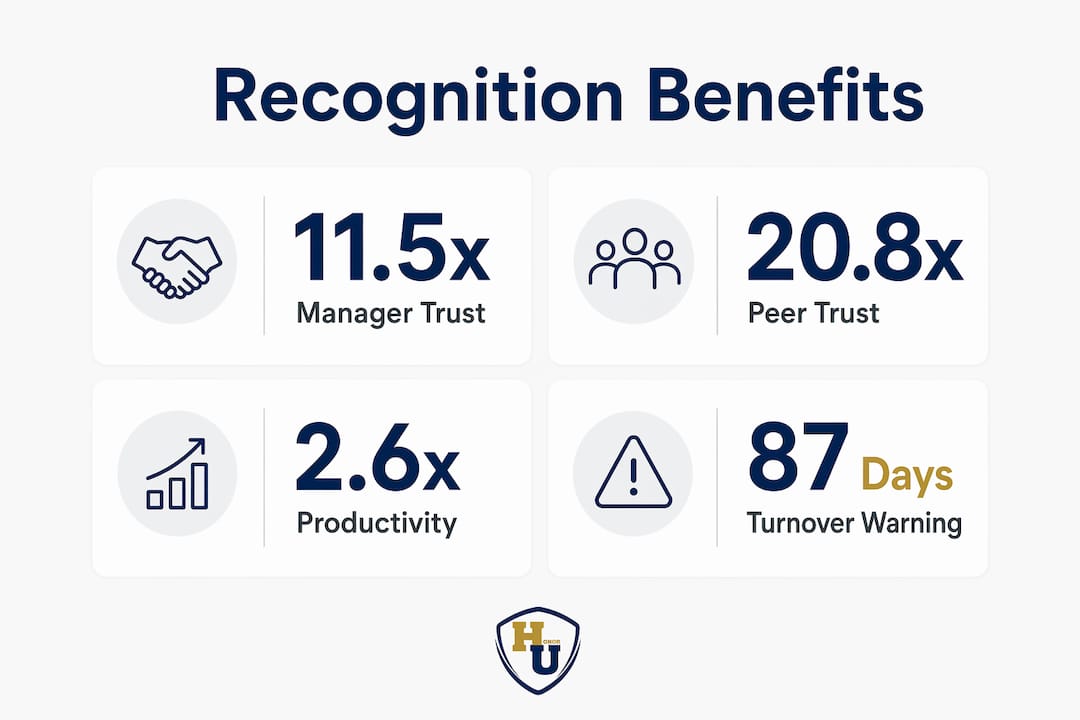
The organizational case for recognition is built on hard numbers, not sentiment. Organizations with sustained recognition habits show 40% lower turnover rates, saving roughly $480,000 annually per 100 employees. That figure accounts for recruiting, onboarding, and lost productivity costs. It means a recognition program that costs a fraction of that figure pays for itself many times over.

The trust multiplier is equally striking. Employees who both give and receive recognition show 20.8x higher trust rates than those in low-recognition environments. Trust is the foundation of every high-performing team. Without it, collaboration slows, information hoarding increases, and managers spend more time managing conflict than driving results.
| Organizational Outcome | Impact of Consistent Recognition |
|---|---|
| Manager trust | Increases 11.5x with weekly meaningful recognition |
| Sense of belonging | Increases 9x with weekly meaningful recognition |
| Productivity | Increases 2.6x with weekly meaningful recognition |
| Employee turnover | 40% lower in high-recognition organizations |
| Annual cost savings | Roughly $480,000 per 100 employees retained |
| Trust rates | 20.8x higher among employees who give and receive recognition |
Recognition also functions as an early warning system. Recognition frequency predicts turnover up to 87 days before an employee resigns. That lead time is far more valuable than exit interviews, which capture data after the loss has already occurred. Organizations that monitor recognition patterns can identify disengaged individuals and intervene while there is still time to act.
Inclusion is another direct benefit. Recognition builds connection in diverse and remote teams by making every member feel their contribution is visible and valued. In distributed workplaces where casual hallway acknowledgment disappears, formal and informal recognition programs fill a critical social gap.
Financial rewards alone do not replicate these effects. Verbal recognition often increases knowledge workers’ willingness to contribute more than financial incentives, which can sometimes dampen intrinsic motivation. Pay signals that a task has a market value. Recognition signals that the person performing it has personal value. Those are fundamentally different messages, and the brain processes them differently.
Pro Tip: Track recognition frequency by team or department as a monthly metric alongside engagement scores. A sudden drop in peer recognition within a specific team is often the first signal of a cultural problem, not the last.
What are best practices and pitfalls in recognizing achievements effectively?
Recognition done poorly can backfire. Research shows that excessive or inauthentic recognition negatively impacts employee affect and task performance, following a U-shaped relationship. Too little recognition leaves people feeling invisible. Too much, especially when it feels performative or unearned, erodes credibility and creates cynicism. The goal is calibrated, genuine acknowledgment.
Effective recognition follows four principles: timeliness, specificity, variety, and authenticity. Timeliness means recognizing the achievement close to when it happened, not weeks later at an annual review. Specificity means naming the exact behavior and its impact. Variety means not relying on a single format or a single person to deliver all recognition. Authenticity means the recognition reflects genuine observation, not a checkbox exercise.
- Make it timely. Acknowledge achievements within 24–48 hours of the event. Delayed recognition loses emotional resonance and weakens the neurological reinforcement loop.
- Be specific and behavioral. Name the action, the context, and the outcome. Avoid vague superlatives like “amazing work” that could apply to anyone.
- Vary the source. Manager recognition carries authority, but peer recognition carries social proof. Both matter. Build systems where colleagues can acknowledge each other without waiting for leadership approval.
- Balance recognition with performance pay thoughtfully. Balancing recognition intensity with performance-based pay is key to avoiding motivational backlash. When recognition feels tied only to financial outcomes, it loses its social and psychological power.
- Keep participation voluntary. Recognition programs are more effective when voluntary and intrinsically motivated rather than mandatory. Forced participation reduces authenticity and diminishes the impact of every recognition moment.
- Use technology to amplify social reach. Digital recognition platforms allow acknowledgment to be visible across a team or organization, multiplying the social belonging effect beyond the immediate relationship.
Pro Tip: Avoid “recognition inflation” by reserving your highest-visibility acknowledgments for genuinely significant achievements. If every task earns a public shoutout, the signal loses meaning. Reserve peer-wide recognition for moments that reflect real effort, growth, or impact.
How can you build a lasting culture of recognition?
A recognition culture does not emerge from a single program launch. It builds through repeated, consistent habits embedded in daily routines. The most durable recognition cultures treat acknowledgment as a practice, not an event.
Start by identifying recognition champions within your organization or community. These are the people who naturally notice and celebrate others’ contributions. Give them visibility and tools. Their behavior models the norm for everyone else, and social modeling is one of the most powerful drivers of cultural change.
- Embed recognition into existing rituals. Start team meetings with a brief acknowledgment of a recent win. Add a recognition moment to monthly reviews. These micro-habits compound over time into a culture where appreciation is expected, not exceptional.
- Recognize small wins, not just major milestones. Acknowledging incremental progress sustains motivation between large achievements. A student who improves their grade by one letter, a nurse who handled a difficult patient interaction with exceptional care, or a volunteer who showed up consistently for three months all deserve acknowledgment. Waiting for the finish line misses most of the race.
- Tailor recognition to individual preferences. Some people value public acknowledgment. Others prefer a private, written note. Asking people how they prefer to be recognized is itself an act of respect and inclusion. It signals that the recognition is for them, not for the organization’s optics.
- Use presentation quality to reinforce the weight of the moment. A certificate handed over in a plain manila envelope communicates something very different from one presented in a premium, custom-printed cover. The physical presentation of an achievement shapes how the recipient and their peers perceive its significance. Resources on recognition presentation practices offer practical guidance on how to align the physical format with the emotional weight of the occasion.
- Monitor recognition frequency as a culture metric. Track how often recognition occurs across teams and over time. Drops in frequency are early warning signals for disengagement, as research confirms that recognition patterns predict turnover up to 87 days in advance. Treat this data with the same seriousness as absenteeism or productivity metrics.
- Build recognition into your achievement presentation planning. Ceremonies, award events, and graduation presentations are high-visibility recognition moments. Investing in their quality sends a clear message about how much the organization values the people it is honoring.
Recognition cultures also require psychological safety to thrive. People must feel that giving recognition to a peer will not be perceived as favoritism or political maneuvering. Leaders set this tone by modeling peer recognition themselves and by celebrating it when they observe it happening organically.
Key Takeaways
Consistent, specific, and voluntary recognition is the single most cost-effective tool for building trust, reducing turnover, and sustaining motivation across any organization or community.
| Point | Details |
|---|---|
| Recognition drives measurable outcomes | Weekly recognition increases trust 11.5x, belonging 9x, and productivity 2.6x. |
| Turnover drops significantly | High-recognition organizations see 40% lower turnover, saving roughly $480,000 per 100 employees annually. |
| Specificity amplifies impact | Naming the exact behavior and its outcome produces stronger neurological and emotional responses than generic praise. |
| Peer recognition is underused | Peer-to-peer acknowledgment activates social belonging circuits more powerfully than manager recognition alone. |
| Presentation quality signals value | The physical format of an award or certificate shapes how recipients and peers perceive the significance of the achievement. |
Recognition is more powerful than most organizations admit
I have spent years watching organizations pour resources into compensation benchmarking while their recognition practices remain an afterthought. The research is unambiguous: verbal and social recognition outperforms financial incentives for sustaining intrinsic motivation, especially among knowledge workers and students. Yet most institutions still treat a certificate or an award as a formality rather than a meaningful act.
What I find most underappreciated is the early warning function of recognition. When recognition frequency drops within a team, it almost always precedes a wave of departures. That 87-day lead time is a gift. Most organizations ignore it because they are not measuring recognition at all.
The other thing I want to push back on is the assumption that more recognition is always better. The U-shaped effect is real. When recognition becomes performative or mandatory, it loses the authenticity that makes it work neurologically. The oxytocin response requires genuine social connection. You cannot manufacture that with a weekly automated “kudos” notification.
The organizations and communities that get this right share one trait: they treat recognition as a skill, not a policy. They train people to give specific, timely, sincere acknowledgment. They create conditions where peer recognition flows naturally. And they invest in the physical presentation of achievements, because the moment of handing someone a beautifully presented diploma or certificate is itself an act of recognition. That moment is remembered long after the event ends.
, Manager
Recognition products that honor every achievement
Every achievement deserves a presentation that matches its significance. The physical quality of how you present a diploma, certificate, or award shapes the lasting impression it leaves on the recipient and everyone who witnesses it.

Wehonoru’s Classic Diploma of Graduation Tent-Style Document Cover combines durable construction with elegant metallic foil printing to give every achievement the presentation it has earned. Orders ship next day with no minimum quantity required, making it practical for a single graduation or a full class of 500. Whether you are honoring one student or an entire cohort, Wehonoru delivers the quality and speed that recognition moments demand.
FAQ
Why does recognizing achievements improve motivation?
Recognition triggers dopamine and oxytocin release in the brain, reinforcing the behavior that earned the acknowledgment and building trust between people. Specific, timely recognition produces stronger motivational effects than generic praise or financial rewards alone.
How often should achievements be recognized?
Weekly meaningful recognition produces the strongest outcomes, increasing trust by 11.5x and productivity by 2.6x compared to infrequent acknowledgment. Recognition frequency also predicts employee turnover up to 87 days in advance, making it a critical culture health metric.
Does peer recognition matter as much as manager recognition?
Peer-to-peer recognition activates social belonging circuits more powerfully than manager recognition alone. Both forms matter, but peer acknowledgment carries unique social proof that reinforces team cohesion and belonging.
Can too much recognition be harmful?
Yes. Excessive or inauthentic recognition follows a U-shaped relationship with performance, meaning both too little and too much can reduce motivation and task performance. Calibrated, genuine acknowledgment tied to specific behaviors produces the best results.
How does the physical presentation of an award affect recognition?
The quality of how an achievement is presented shapes how the recipient and their peers perceive its significance. A premium, custom-printed certificate cover signals that the organization values the accomplishment, reinforcing the emotional and social impact of the recognition moment.
Recommended
Taylor Pace writes Honor U guides. Blair Black reviews them. Honor U sells empty covers and holders.