
What Is a Made-to-Fit Cover for Diplomas?

TL;DR:
- A made-to-fit diploma cover is custom manufactured to match exactly the measurements of a specific document. It provides superior protection by preventing shifting, bunching, and damage over time. Unlike generic covers, it guarantees a precise, long-lasting fit suitable for archival storage and professional presentation.
A made-to-fit cover is a custom-manufactured protective case crafted to match the exact dimensions and contours of a specific diploma or certificate, eliminating excess material and delivering a flawless, secure presentation. Unlike generic options that rely on elastic bands or adjustable straps, a true custom fit cover is engineered to precise measurements, often using 3D digital mapping or hand templating to capture every detail of the document. The result is a cover that protects without shifting, bunching, or leaving gaps. For graduates, institutions, and organizations that treat their documents as lasting records of achievement, this level of precision is the difference between a cover that preserves and one that merely conceals.
What is a made-to-fit cover and how does it differ from standard options?
A made-to-fit cover, also called a custom-dimension cover or exact-fit document cover in the presentation products industry, is defined by one core principle: the cover is built around the document, not the other way around. Standard industry terminology uses “made-to-fit” and “made-to-order” interchangeably when referring to covers produced from a document’s specific measurements rather than a preset template.
The distinction matters most for diplomas and certificates. Academic documents vary widely in size. A standard high school diploma may measure 8.5 by 11 inches, while a university degree parchment can reach 11 by 14 inches or larger. Specialty certificates from trade programs, military commendations, and religious institutions often fall outside every standard size category entirely. A made-to-fit cover accounts for all of these variations, including corner radius and document thickness, which generic covers never address.
Wehonoru specializes in exactly this capability. The company produces custom-dimension diploma covers for non-standard document sizes, serving schools, universities, corporate HR departments, government agencies, and individual graduates who need a cover that fits their specific document rather than a close approximation.
How are made-to-fit diploma covers measured and manufactured?
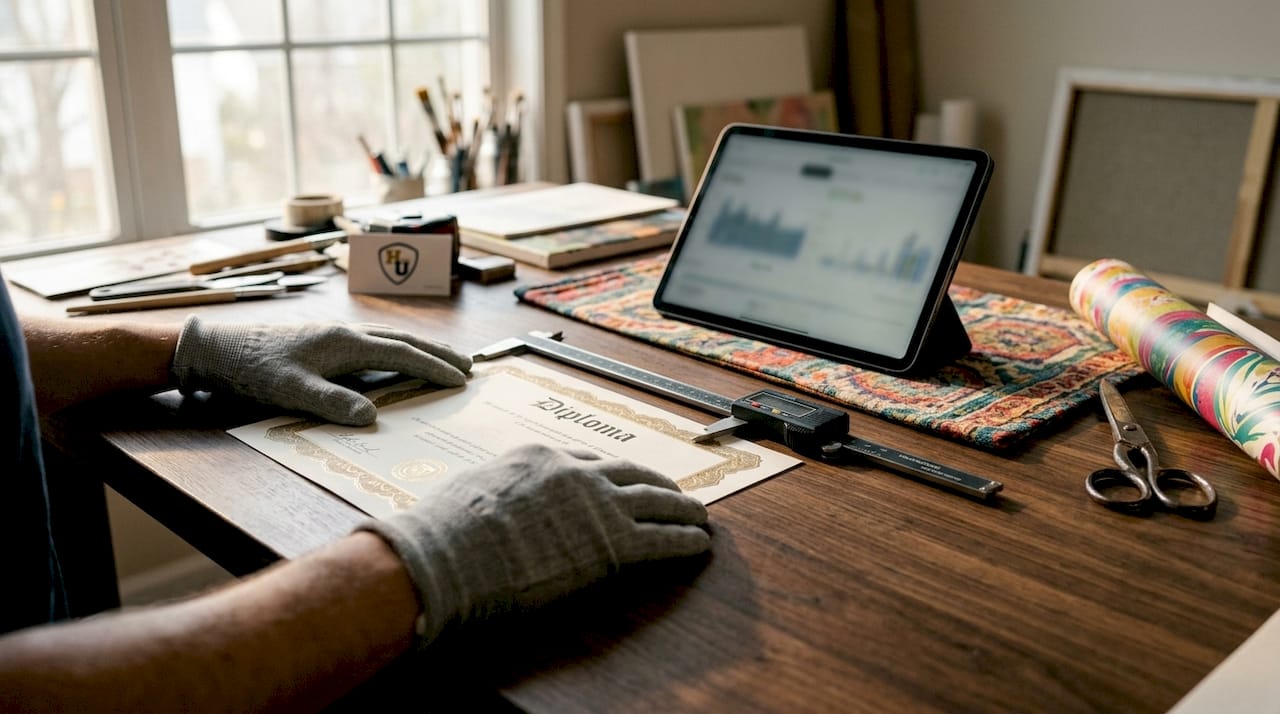
Precision manufacturing begins with precise measurement. A cover that fits correctly starts with capturing every relevant dimension of the document it will protect. The process follows a clear sequence.
-
Record all primary dimensions. Measure the document’s width and height to the nearest millimeter. Do not round up or down. Even a few millimeters of discrepancy can cause sagging or pressure points that accelerate wear over time.
-
Measure document thickness. A single sheet of parchment and a multi-page bound certificate have very different thickness profiles. Accounting for thickness prevents the cover from being too tight at the spine or too loose at the edges.
-
Check corner radius. Diplomas with rounded corners require a cover pattern that mirrors that curvature. A cover cut for sharp corners will gap at the edges of a rounded document, leaving those areas exposed.
-
Create a digital or physical template. Manufacturers use this template to cut cover material with accuracy. Digital tooling, including 3D mapping software, translates measurements into cutting patterns that account for seam allowances and fold lines.
-
Select archival-grade materials. The material must be durable enough to resist abrasion and environmental exposure while remaining safe for long-term contact with paper. Acid-free linings and moisture-resistant outer materials are the standard for quality diploma covers.
-
Cut, assemble, and finish. Seams are placed at positions that do not create pressure ridges against the document surface. Finishing processes, such as metallic foil printing, are applied after the cover structure is complete.
Pro Tip: Before submitting measurements to any cover manufacturer, place your diploma on a flat surface and measure it twice with a steel ruler rather than a fabric tape. Fabric tapes can stretch slightly, introducing errors that compound during production.
Digital mapping and precise measuring ensure the cover installation is easy, pressure-free, and does not cause deformation or warping of delicate paper. This is particularly important for older parchment diplomas, which are more susceptible to edge damage during insertion and removal.
What benefits do made-to-fit covers offer over universal options?
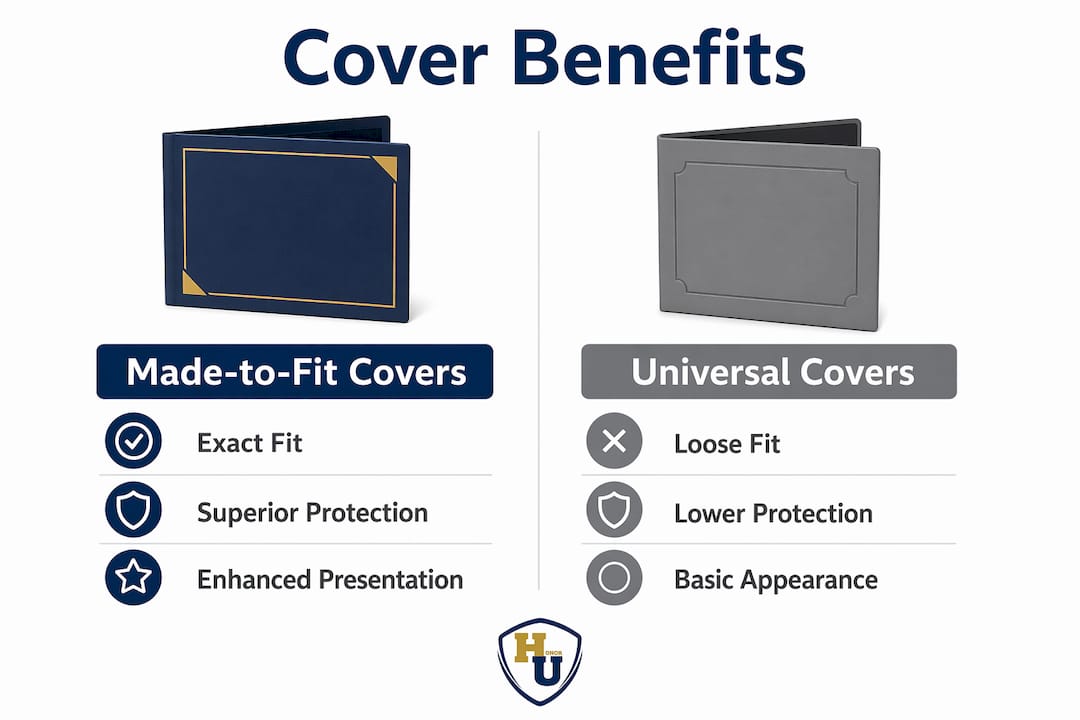
The advantages of a tailored fit cover over a universal or loosely fitted alternative are concrete and measurable across three categories: protection, appearance, and longevity.
Protection from physical and environmental damage
Made-to-fit covers minimize micro-scratches and environmental degradation, preserving document value for long-term archival or display. A cover that fits snugly prevents the document from shifting inside the case. Shifting is the primary cause of edge abrasion, corner wear, and surface micro-scratches on diplomas stored or transported over time. A loose cover also traps moisture between the fabric and the document surface, which accelerates yellowing and paper degradation.
Appearance and presentation quality
A made-to-fit cover presents a factory-style, wrinkle-free appearance that a universal cover cannot replicate. Universal covers rely on elastic bands and adjustable straps to span a wide range of sizes, which inevitably leaves bunching and gaps. For graduation ceremonies, award presentations, and professional credentialing events, the visual quality of the cover reflects directly on the institution or organization presenting it.
Longevity and return on investment
- Extended lifespan. Custom-fit covers increase product lifespan by 30–50% compared to universal alternatives. Universal covers often require replacement within 12 months due to abrasion from loose movement against the document surface.
- Reduced replacement costs. A cover that lasts years rather than months reduces the total cost of document protection, particularly for institutions managing large volumes of certificates annually.
- Archival compliance. Precision fit supports archival preservation standards by preventing the warping and pressure-point damage that misaligned covers cause over time.
- Consistent branding. For organizations using custom foil printing, a cover that fits correctly displays logos and text exactly as designed, without distortion from bunching or misalignment.
Pro Tip: If you are ordering covers for an institutional archive rather than a single ceremony, specify archival-safe lining materials explicitly. Not all manufacturers default to acid-free options, and the difference becomes visible within a few years of storage.
What is the difference between made-to-fit, tailor-made, and universal covers?
These three terms describe distinct product categories with meaningful differences in fit quality, protection level, and cost. Understanding each category helps buyers choose the right option for their specific document and use case.
| Cover Type | Fit Method | Production Approach | Protection Level | Best Use Case |
|---|---|---|---|---|
| Universal | Elastic bands, adjustable straps | Mass-produced in broad size ranges | Low. Gaps and bunching common | Temporary storage, low-value documents |
| Tailor-made | Pre-set templates for popular sizes | Mass-produced for standard dimensions | Moderate. Better than universal, less than custom | Standard-size diplomas, short-term display |
| Made-to-fit | Exact measurements of the specific document | Custom-produced per order | High. Snug fit, no shifting, archival-grade options | Non-standard sizes, long-term preservation, prestige presentation |
Universal covers offer the lowest cost and fastest availability, but their loose fit creates ongoing friction against the document surface. That friction causes more cumulative damage than having no cover at all over a multi-year period. This is not a theoretical concern. Loose covers damage items more than no cover at all over time, because the constant movement of loose fabric acts as an abrasive.
Tailor-made covers fit a subset of popular standard sizes but are generally mass-produced, offering a middle ground between universal and fully custom options. They work well for the most common diploma dimensions but fail when documents fall outside standard size categories. A military commendation, a trade school completion certificate, or a marriage certificate from a religious institution rarely matches a standard template.
Made-to-fit covers, by contrast, are engineered as a second skin, not merely adjustable. The cover conforms to the document’s exact profile, including corner curvature and thickness, eliminating every gap where damage can begin. For anyone preserving a document with long-term significance, this is the only category that delivers reliable archival protection.
How to choose and order the right custom cover for your diploma
Selecting the right cover requires clear decisions across four areas: measurement accuracy, material selection, style and customization, and supplier communication.
Measurement accuracy
Accurate dimensions are the foundation of a well-fitting cover. Measure your document in the following order:
- Width and height. Use a steel ruler on a flat, hard surface. Measure to the nearest millimeter.
- Thickness. Stack the document with any inserts or backing boards it will be stored with, then measure the combined thickness.
- Corner type. Note whether corners are sharp (90-degree) or rounded, and estimate the radius if rounded.
- Any raised elements. Embossed seals, ribbons, or attached certificates add to the profile and must be accounted for in the cover’s interior depth.
Ignoring fine dimensional details like thickness or document edge curvature during ordering leads to covers that are tight in some areas but sag elsewhere, accelerating wear. Submit all four measurements to your cover supplier, not just width and height.
Material and style considerations
Archival safety is the primary material criterion for long-term storage. Look for acid-free interior linings, moisture-resistant outer materials, and UV-resistant finishes if the cover will be displayed in a lit environment. For presentation purposes, metallic foil printing adds a prestige quality that plain covers cannot match. Wehonoru offers custom foil printing options across multiple colors, allowing institutions to incorporate logos, class years, and institutional names directly onto the cover surface.
Understanding lead times and ordering logistics
Standard custom cover production typically requires 5–10 business days at most suppliers. Wehonoru’s production that starts the next business day, with most orders finished in 1 to 2 business days is a notable exception, making it the practical choice for last-minute ceremony orders. Confirm whether your supplier charges setup fees for custom dimensions. Many traditional suppliers charge $50–$150 in setup fees per custom order. Wehonoru charges no setup fees, regardless of order quantity.
Communicating clearly with your supplier
Provide a written specification sheet rather than verbal instructions. Include all four measurements, material preferences, any foil printing details, and the intended use (display, archival storage, or ceremony presentation). A good supplier will confirm measurements before production begins. If a supplier proceeds without confirmation, that is a signal to reconsider.
Pro Tip: Order one sample cover before committing to a bulk institutional order. Verify the fit on your actual document before approving production of 50 or 500 units. This single step prevents costly reprints.
For guidance on choosing the right document cover based on document type and intended use, Wehonoru’s resource library covers the full range of diploma and certificate cover decisions in practical detail.
Key Takeaways
A made-to-fit cover is the only cover type that delivers reliable archival protection for diplomas and certificates, because precision fit eliminates the shifting and abrasion that damage documents over time.
| Point | Details |
|---|---|
| Definition of made-to-fit | A custom cover built from exact document measurements, not a preset template or adjustable strap system. |
| Measurement requirements | Record width, height, thickness, and corner radius before ordering to prevent sagging and pressure-point damage. |
| Lifespan advantage | Custom-fit covers increase product lifespan by 30–50% compared to universal alternatives. |
| Cover type distinctions | Universal covers gap and bunch; tailor-made covers fit standard sizes; made-to-fit covers match any document exactly. |
| Ordering best practice | Submit all four dimensions in writing and request a sample before approving bulk institutional production. |
Why precision fit is the only standard worth accepting
I have seen institutions spend considerable budgets on ceremony production, venue logistics, and printed programs, then hand graduates a diploma inside a cover that visibly sags or bunches at the edges. That detail lands harder than most people expect. The cover is the last physical impression of the institution’s standards, and a loose fit communicates carelessness regardless of everything else done well.
The misconception I encounter most often is that “close enough” is acceptable for diploma covers because the document inside is what matters. That reasoning ignores how documents actually degrade. A cover that shifts even slightly during storage acts as a slow abrasive against the document surface. Over five or ten years, that movement produces micro-scratches, edge fraying, and surface dulling that cannot be reversed. The document that “matters” ends up visibly damaged precisely because the cover was treated as an afterthought.
The other misconception is that made-to-fit covers are prohibitively expensive or require large minimum orders. That was true of the traditional supply chain. It is no longer true. Wehonoru produces exact-fit diploma covers with no minimum order quantity and no setup fees, which means a single graduate with a non-standard parchment size has access to the same precision product as a university ordering 500 units.
The investment in a properly fitted cover is modest relative to the significance of the document it protects. A diploma represents years of work and a credential that may be presented professionally for decades. It deserves a cover built to the same standard of care.
, Manager
Wehonoru’s made-to-fit diploma covers: precision built for every document
Wehonoru produces custom-dimension diploma and certificate covers designed to match your document’s exact measurements, with no minimum order quantity and no setup fees. Every cover ships within one business day of order placement.
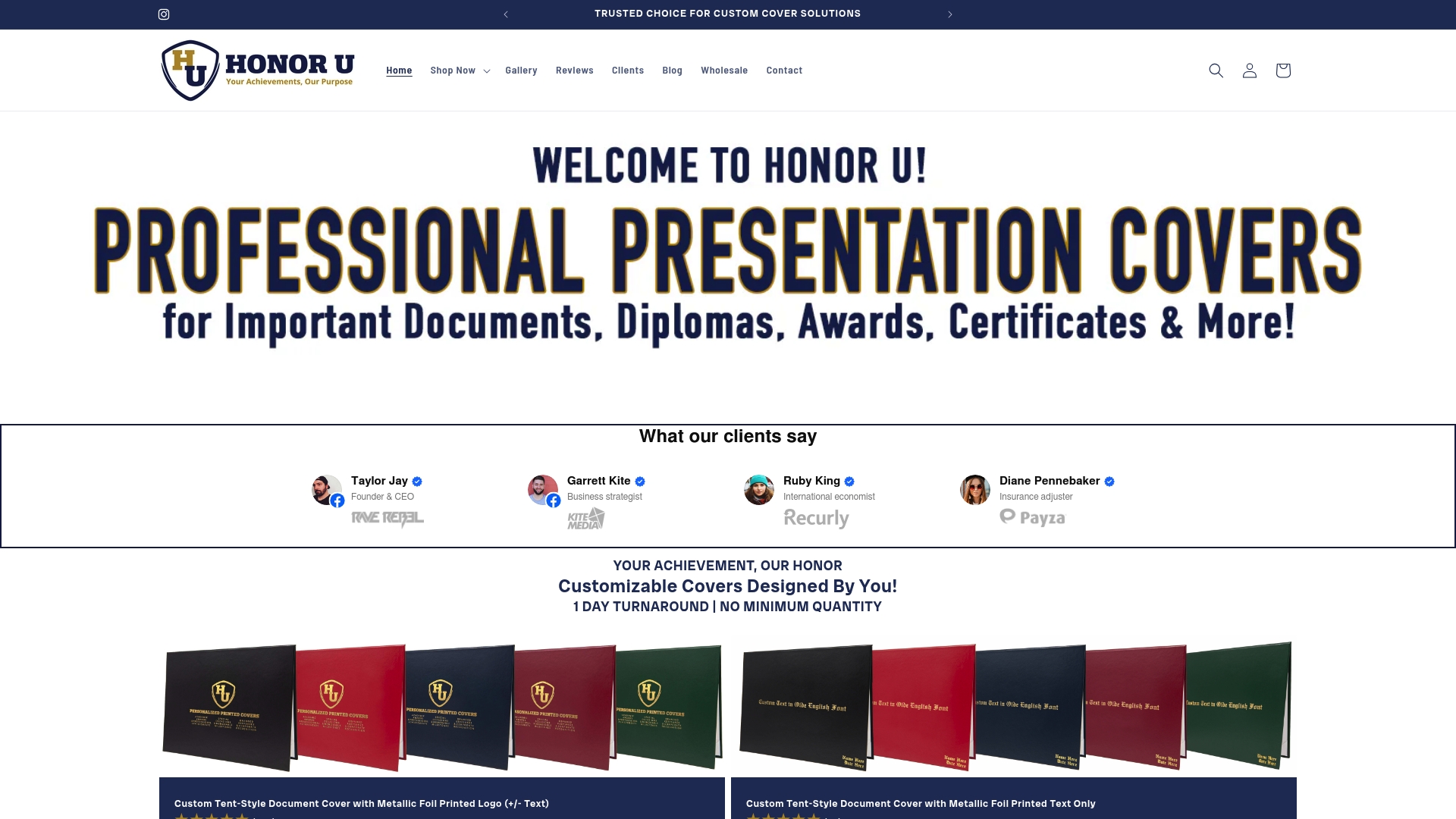
The Classic Diploma of Graduation tent-style cover is available in custom dimensions with metallic foil printing for institutional logos, names, and class years. For graduating classes, the Class of graduation cover offers the same precision fit with year-specific customization. Both products ship free on orders over $30. Reach Wehonoru at 804-223-4339 or contact@wehonoru.com, Monday through Friday, 9:00 AM–5:00 PM EST.
FAQ
What is a made-to-fit cover for a diploma?
A made-to-fit cover is a custom-manufactured protective case built from the exact measurements of a specific diploma or certificate, eliminating excess material and preventing the shifting that causes document damage over time.
How do made-to-fit covers differ from tailor-made covers?
Tailor-made covers are mass-produced to fit popular standard sizes, while made-to-fit covers are produced from the specific dimensions of your individual document, including thickness and corner radius.
What measurements do I need to order a custom fit cover?
Provide the document’s width, height, thickness, and corner type (sharp or rounded with estimated radius) to your cover supplier before production begins.
Are made-to-fit diploma covers worth the cost for a single document?
Yes. Investment in made-to-fit covers is justified by enhanced preservation, particularly for documents intended for long-term archival display or professional presentation over many years.
Can institutions order made-to-fit covers in bulk without large minimums?
Wehonoru accepts orders of any quantity, from a single cover to institutional bulk orders, with no setup fees and a one-business-day production turnaround.
Recommended
More on sizes
The size chart and Made-to-Fit answers stay on the FAQ.
Taylor Pace writes Honor U guides. Blair Black reviews them. Honor U sells empty covers and holders.