
Understanding Award Documents: A Complete Guide

TL;DR:
- Award documents certify recognition, funding, or employment conditions, requiring careful interpretation and management. They include core components like recipient name, award title, issuing authority, and terms, with formats varying by purpose such as recognition certificates or federal notices. Proper presentation and regular review of award documents ensure their lasting value and compliance.
Award documents are formal instruments that certify recognition, confirm funding, or establish binding employment conditions for recipients and issuing organizations alike. Understanding award documents is the first step toward managing the obligations and opportunities they create. Whether you are a school administrator preparing graduation certificates, a nonprofit navigating a federal grant, or an HR professional classifying employees under a labor standard, every award document carries specific terms that demand careful reading. This guide covers the core components, interpretation strategies, presentation standards, and management best practices that apply across all major award document types.
What are the core components and formats of award documents?
Award documents share a consistent set of structural elements regardless of their purpose. Recognizing these elements makes interpreting award documents faster and reduces the risk of missing a critical obligation.
Standard components found in every award document
Every well-formed award document includes the following elements:
- Recipient name: The full legal name of the individual or organization receiving the award, grant, or certification.
- Award title: The formal name of the honor, grant program, or employment classification being conferred.
- Issuing authority: The name of the institution, agency, employer, or organization granting the award.
- Effective date: The date the award takes effect, which triggers compliance timelines for grants and employment awards.
- Authorized signatures: Signatures from officials with authority to bind the issuing organization legally.
- Terms and conditions: The specific obligations, restrictions, and reporting requirements attached to the award.
- Award amount or scope: For financial awards, the total funding authorized; for employment awards, the classification level and pay rate.
Presentation standards affect document durability and ceremony prestige, which is why physical formatting matters as much as content accuracy.
How award document formats vary by type

The table below summarizes the four most common award document categories and their distinguishing features.
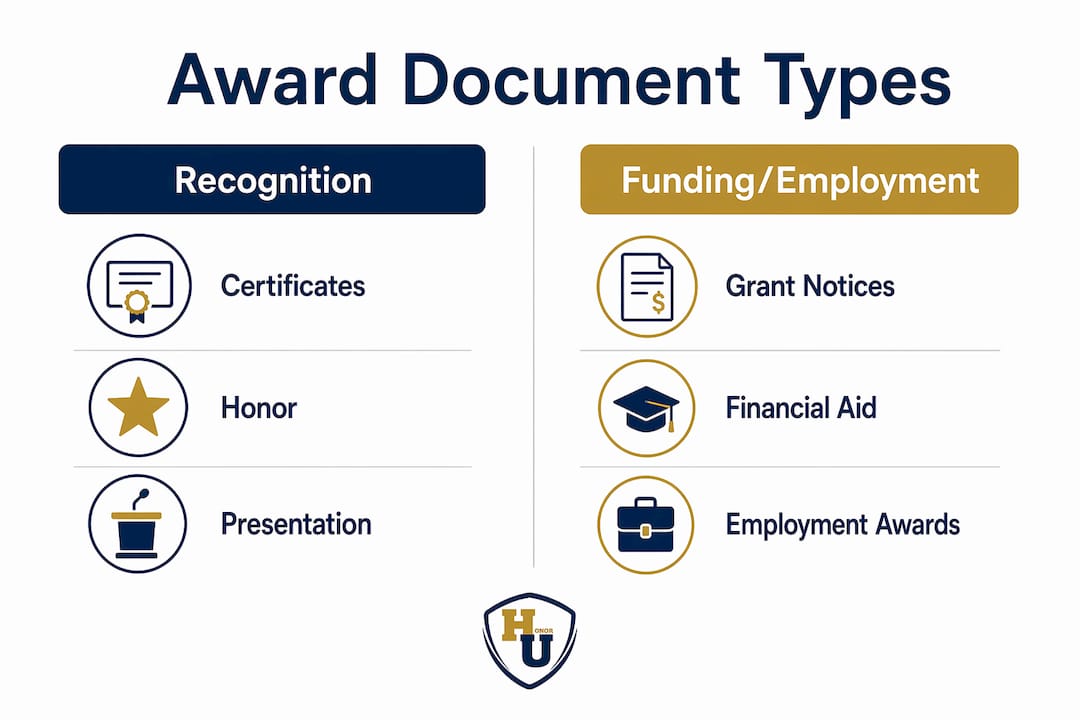
| Document Type | Primary Purpose | Key Distinguishing Feature |
|---|---|---|
| Recognition certificate | Honor an achievement or milestone | Recipient name, award title, issuing seal |
| Financial aid award letter | Communicate college funding package | Breakdown of grants, loans, and work-study |
| Notice of Award (NoA) | Confirm federal grant funding | Binding legal terms, budget authorization |
| Employment modern award | Set minimum pay and conditions | Role classification, penalty rates, roster rules |
A federal Notice of Award is a binding legal document that confirms grant funding and commits recipients to reporting, budget, and compliance obligations. That binding nature separates it sharply from a ceremonial certificate, which carries no legal obligation beyond the honor itself.
Financial aid award letters occupy a middle ground. They communicate real dollar figures but often combine grants, loans, and work-study into a single “Total Aid” figure that can obscure the true cost of attendance. Employment modern awards, used widely in regulated labor markets, prescribe minimum pay, penalty rates, and conditions by industry classification.
Formatting and paper quality standards
Physical formatting signals the credibility and permanence of an award document. Professional certificates use acid-free paper stock, embossed or foil-printed seals, and formal typefaces to convey authority. For ceremonies, document cover selection directly affects how recipients and audiences perceive the value of the recognition. A certificate handed over in a plain envelope communicates something very different from one presented in a premium tent-style folder with metallic foil printing.
How to interpret the terms and conditions in award documents
Reading an award document for its terms requires a different mindset than reading it for its headline recognition. The terms section is where obligations, restrictions, and compliance requirements live.
Interpreting federal grant notices of award
A federal Notice of Award is not a congratulatory letter. Initial grant award notices allow negotiation before acceptance, but once a recipient accepts, the legal obligations are fixed and modifications require formal prior approval. Recipients must manage grants in compliance with federal standards to avoid penalties or being flagged in SAM.gov. That means reading every condition attached to the award before signing, not after.
The most common terms in a federal NoA include:
- Budget period and project period: The authorized spending window and the full duration of the grant.
- Allowable costs: Categories of expenses the funding agency permits; unallowable costs must be covered by other sources.
- Reporting requirements: Scheduled progress and financial reports with specific due dates.
- Prior approval requirements: Activities or budget changes that require agency sign-off before proceeding.
- Termination conditions: Circumstances under which the agency can end the award and recover funds.
Decoding financial aid award letters
Financial aid letters often mask true cost by combining grants, loans, and work-study into a single “Total Aid” figure. That number is not the amount the institution is giving you. Freshman federal direct loans are capped at $5,500, and work-study represents potential earnings, not guaranteed income. The figure that matters is the net price: total cost of attendance minus grants and scholarships only.
Award letters use inconsistent, confusing terminology across institutions, which makes direct comparison difficult. One school may label a loan as “financial assistance” while another labels it clearly as “Direct Unsubsidized Loan.” Reading the fine print on each line item is the only reliable method for comparing offers.
Pro Tip: When analyzing award notifications from multiple colleges, build a simple spreadsheet with columns for grants only, loans only, work-study, and net price. Ignore the “Total Aid” figure entirely.
Employment award interpretation
Employment modern awards legally prescribe minimum pay, penalties, and conditions by industry, with employer obligations to classify roles by actual duties rather than job titles alone. The Fair Work Ombudsman provides guidance on proper classification, and employers must maintain appropriate records to demonstrate compliance. Misclassifying an employee under the wrong award classification creates financial risk and legal exposure. Proper classification requires reviewing actual work and roster patterns, not just reading a job description.
How to prepare and present award documents for ceremonies
Preparation and presentation are where the meaning of an award document becomes visible to the recipient and the audience. A well-prepared ceremony communicates institutional pride and respect for the achievement being recognized.
Choosing the right document covers and folders
The physical cover or folder that houses an award document is the first thing a recipient touches. Using high-quality award folders protects certificates and adds prestige to recognition events. Tent-style diploma covers are a traditional and effective choice because they allow the document to stand upright for display immediately after presentation. Metallic foil printing on the cover reinforces institutional branding and signals that the organization values the achievement.
Key selection criteria for document covers include:
- Material durability: Covers should protect against bending, moisture, and fading over years of display.
- Size compatibility: The cover must fit the actual document dimensions precisely; ill-fitting covers look unprofessional.
- Customization options: Institutional logos, foil colors, and pre-phrased text reinforce brand identity and ceremony theme.
- Quantity flexibility: For small ceremonies or individual awards, ordering without a minimum quantity requirement prevents waste.
Wehonoru produces tent-style certificate covers with metallic foil printing and ships orders the next business day, with no minimum order quantity. That combination makes it practical for both a school honoring 200 graduates and a nonprofit recognizing a single volunteer.
Best practices for bulk award preparation
Bulk preparation introduces logistical complexity that individual orders do not. Bulk certificate preparation requires organizing documents by recipient name in the order they will be called, verifying spelling on every certificate before printing, and storing completed documents flat in labeled folders until the ceremony. A single transposed name on a certificate can undermine the dignity of the moment for that recipient.
Pro Tip: Print one test certificate on your final paper stock before running the full batch. Verify alignment, font size, and name spelling on the physical print, not just on screen.
Security and authenticity considerations
Official award documents, particularly those with legal or professional implications, require security features that deter fraud. Embossed seals, watermarked paper, and sequential document numbers are standard methods for authenticating certificates in healthcare, legal, and government contexts. Diploma holders protect documents against physical damage and unauthorized reproduction. For high-value awards, storing originals in archival-quality covers and issuing certified copies for display is the most reliable long-term strategy.
Ceremony setup for maximum impact
Ceremony setup should reinforce the formality of the award document itself. Presenters should hold covers upright and face them toward the recipient during handoff. A brief verbal statement of the award title and the recipient’s name, spoken clearly before the handoff, gives the moment weight. For large ceremonies, pre-staging covers in presentation order at a designated table eliminates fumbling and keeps the program moving.
What are common challenges and best practices in managing award documents?
Award document management does not end at the ceremony. Ongoing compliance, record-keeping, and communication between issuers and recipients are all part of responsible stewardship.
Frequent errors that create compliance risk
The most costly errors in award document management fall into three categories:
- Misclassification in employment awards: Assigning an employee to the wrong award classification based on job title rather than actual duties. This leads to underpayment, back-pay liability, and regulatory penalties.
- Misreading financial aid totals: Treating the “Total Aid” figure in a financial aid letter as free money, when it includes loans that must be repaid with interest.
- Missing grant compliance deadlines: Failing to submit required reports or request prior approval for budget changes, which can trigger grant termination or fund recovery.
Misinterpreting award terms leads to compliance risks, and regular audits and proactive reviews are the recognized best practice for managing award documents over time.
The importance of regular document reviews
Award documents are living compliance tools, not static records. Employers must treat award interpretation as an ongoing process subject to change, not a one-time setup, to avoid costly errors that accumulate silently over time.
Employment awards change when regulatory bodies update classification standards or pay rates. Grant terms can be amended mid-project. Financial aid packages are often recalculated each academic year based on enrollment status and academic progress. Organizations that treat award documents as set-and-forget records accumulate compliance risk with every passing cycle.
Strategies for clear communication between issuers and recipients
The issuer carries responsibility for making award terms understandable. Award letters that use plain language, define technical terms on first use, and separate binding obligations from informational content reduce misinterpretation. Recipients, in turn, should confirm their understanding of key terms in writing before accepting any award that carries financial or legal obligations. For federal grants, this confirmation is built into the acceptance process. For employment awards and financial aid, recipients often need to ask explicitly for clarification.
Key takeaways
Award documents carry binding obligations that require active management long after the initial recognition moment.
| Point | Details |
|---|---|
| Know the document type | Certificates, grant notices, financial aid letters, and employment awards each carry different obligations. |
| Read terms before accepting | Federal grant notices allow negotiation before acceptance; once signed, modifications require formal approval. |
| Calculate net price, not total aid | Financial aid letters combine grants and loans; only grants and scholarships reduce your actual cost. |
| Match cover to document size | Ill-fitting or low-quality covers undermine the prestige of any award presentation. |
| Audit award terms regularly | Employment and grant award conditions change; annual reviews prevent costly compliance errors. |
What I’ve learned from watching organizations misread their own award documents
The most consistent mistake I see is treating an award document as a finish line rather than a starting point. Recipients open the envelope, feel the pride of the moment, and file the document away without reading the conditions attached. That pattern is expensive in every context where it occurs.
For grant recipients, the post-award period is when the real work begins. Post-award compliance requires a shift from celebration to management, and organizations that do not make that shift quickly find themselves out of compliance before the first reporting deadline arrives.
For HR teams, the assumption that a job title determines an award classification is the single most common source of underpayment liability. I have seen organizations run the same payroll setup for years without realizing that a role’s actual duties had drifted into a higher classification tier. The financial exposure compounds quietly.
The presentation side of award documents gets underestimated in the opposite direction. Organizations spend significant effort on the content of a certificate and then hand it to a recipient in a generic folder that communicates nothing about the institution’s values. The physical presentation of an award document is part of the message. A premium tent-style cover with institutional foil printing tells the recipient that the organization considered every detail of the moment. That matters more than most administrators realize.
My recommendation for any organization issuing award documents regularly: build a standard review cycle into your calendar, assign a named owner for compliance tracking, and invest in presentation materials that match the quality of the achievement being recognized. These are not separate concerns. They are all part of what it means to honor someone properly.
, Manager
Professional document covers that match the quality of your awards
Every award document deserves a presentation that reflects its significance. Whether you are preparing certificates for a graduation ceremony, recognizing employee milestones, or presenting grant completion acknowledgments, the cover is the first physical impression the recipient receives.
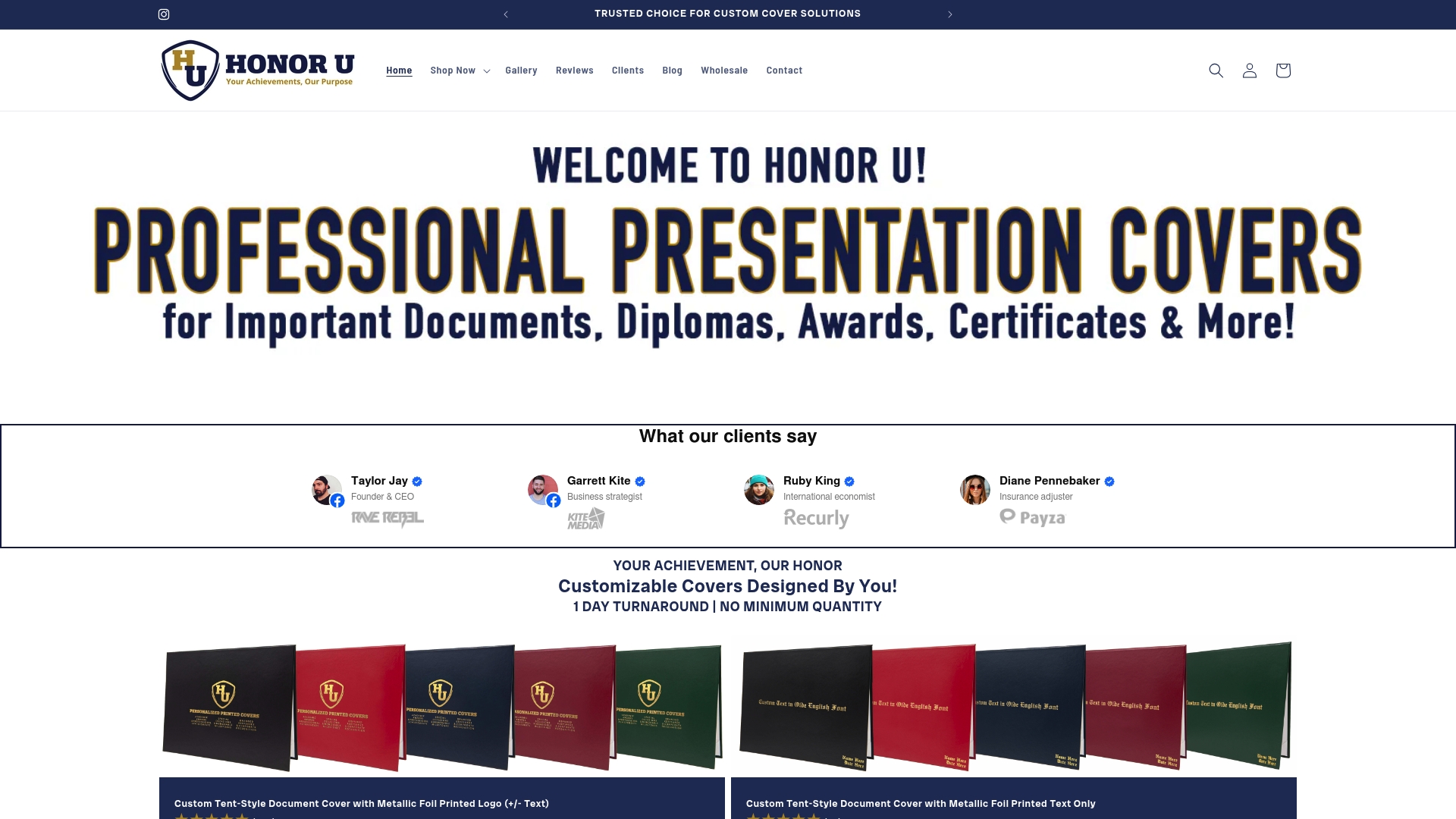
Wehonoru’s tent-style diploma covers ship the next business day with no minimum order quantity, metallic foil printing options, and made-to-fit sizing for non-standard documents. From a single certificate to a bulk order for an entire graduating class, Wehonoru delivers professional-grade presentation materials at practical prices. Free shipping applies to orders over $35, and custom institutional branding is available with no setup fees.
FAQ
What is an award document?
An award document is a formal certificate, letter, or notice that certifies recognition, confirms funding, or establishes employment conditions. Common types include recognition certificates, federal grant Notices of Award, financial aid letters, and employment modern awards.
What does a Notice of Award mean for grant recipients?
A Notice of Award is a binding legal document that confirms grant funding and commits the recipient to specific reporting, budget, and compliance obligations. Recipients should read all attached terms before accepting, since modifications after acceptance require formal prior approval.
How do I calculate the real value of a financial aid award letter?
Subtract loans and work-study from the “Total Aid” figure and compare only grants and scholarships against the total cost of attendance. Financial aid letters often inflate aid totals by combining free money with debt, so the net price calculation is the only accurate measure.
Why does employee classification under a modern award matter?
Employers must classify employees based on actual job duties, not job titles. Misclassification under the wrong award tier leads to underpayment, back-pay liability, and regulatory penalties from oversight bodies like the Fair Work Ombudsman.
What type of cover is best for presenting award certificates at ceremonies?
Tent-style document covers are the standard choice for ceremonies because they allow the certificate to stand upright for display immediately after presentation. Covers with metallic foil printing and precise document sizing add prestige and protect the certificate from physical damage over time.
Recommended
Taylor Pace writes Honor U guides. Blair Black reviews them. Honor U sells empty covers and holders.