
Medical Certification Display Tips for Clinical Settings

What US regulations and best practices require for credential display
Displaying medical certifications correctly is a legal obligation in most US states, not a courtesy. Physicians, dentists, chiropractors, optometrists, and nurses in independent practice must post their credentials where patients can see them during the course of care. The American Nurses Credentialing Center (ANCC) and The Joint Commission set recognized standards for credential ordering and verification, while state licensing boards define the specific format and placement rules that govern compliance.
The underlying purpose is patient safety. Visible, legible display of licenses lets patients verify credentials quickly, reducing the risk of unauthorized practice. A license stored in a desk drawer or administrative folder does not satisfy any state’s definition of “display,” regardless of whether it is technically on the premises.
- Hang the original wall certificate at eye level in a patient-accessible area such as a waiting room or exam room.
- Frame the document under glass or in a clear protective sleeve to prevent fading, water damage, or torn edges that render it illegible.
- Display your name, license type, license number, and expiration date so any patient or inspector can verify status at a glance.
- Post individual credentials for every provider in a multi-provider practice. One establishment permit does not cover the practitioners working under it.
- Keep the display current. An expired certificate on the wall creates the same compliance problem as no display at all.
Pro Tip: Use a UV-protective glass frame and mount it at 57–60 inches from the floor, the standard gallery height that puts the center of the document at average adult eye level. This single choice satisfies both the legibility standard and the “accessible to patients” language used by most state boards.
How state laws differ on certification display requirements
State mandates vary considerably in their specifics, and assuming your home state mirrors a neighboring one is a common source of violations. California Business and Professions Code Section 680.5 is among the most detailed in the country: it requires healthcare practitioners to communicate their name, state-granted license type, and highest academic degree to patients either in writing at the initial visit or through a prominent office display. When the written format is used, the disclosure must appear in at least 24-point font. Physicians certified by an American Board of Medical Specialties member board must also disclose that board certification by the same methods.
Nevada regulations specify that original certificates must be framed and hung in a patient-accessible area. Pocket cards, which many boards issue as portable proof of licensure, do not satisfy display requirements in any state reviewed here. They serve a different purpose: carrying proof when you are away from your primary practice location.
Key display mandates across prominent states:
- California: At least 24-point font for written disclosures; name, license type, highest degree, and board certification required.
- Nevada: Original certificate must be framed and displayed in a patient-accessible area; storage behind a desk does not qualify.
- Most states: Mandate visible display for physicians, dentists, chiropractors, optometrists, and independent-practice nurses; display requirements apply to each individual practitioner, not just the practice entity.
- General rule: The document must show the practitioner’s full legal name, license number, license type, and expiration date at minimum.
State law is the floor, not the ceiling. Accreditation bodies and employer policies often add requirements on top of what your state mandates. Confirm requirements with your specific licensing board before purchasing display materials.
How to sequence credentials for maximum professional clarity
The ANCC credential display hierarchy provides the clearest patient understanding by placing permanent academic degrees before licensure and certifications. The recommended order is:
- Highest earned degree (e.g., PhD, DNP, MSN), listed first because it is permanent and cannot be revoked under ordinary circumstances.
- Licensure (e.g., RN, APRN), required to practice; comes immediately after the degree.
- State designations or requirements, any state-specific titles or practice designations.
- National certifications (e.g., FNP-BC, MEDSURG-BC from ANCC), often voluntary, reflecting specialized competency beyond basic licensure.
- Awards, honors, and other recognition, always voluntary; listed last.
Practical sequencing rules worth knowing:
- List the highest degree first. If you hold a doctorate and a master’s, omit the baccalaureate entirely.
- When two degrees are in different fields, list the highest non-nursing degree first, then the highest nursing degree (e.g., MBA, MSN, RN).
- Multiple national certifications may be ordered by relevance to your current practice or by date obtained, most recent first.
- Non-nursing certifications always appear last in the sequence.
- On legal documents such as prescriptions, use only the credentials your state requires for your practice area.
This ordering communicates a clear professional narrative: permanent academic foundation, legal authority to practice, and then voluntary achievements that demonstrate depth of expertise.
What The Joint Commission and CMS require from institutions
Institutional credential management operates on a different track from individual license display. The Joint Commission’s HR.11.01.03 standard requires hospitals to verify credentials at the time of hire and again at each renewal, using primary sources. These records are maintained in secure administrative files, not posted in clinical rooms.
CMS hospital privileging requirements place the responsibility squarely on the governing body. The Medical Staff must conduct individual appraisals of each practitioner no less frequently than every 24 months, evaluating current work practice, education, quality of specific work, patient outcomes, and appropriate licensure. Board certification alone is not sufficient grounds to grant privileges; the institution must assess demonstrated competencies for each specific task or procedure requested.
Key organizational compliance points:
- Credential files must document primary-source verification of licensure, certification, or registration at hire and renewal.
- The Joint Commission requires identity verification by viewing a current picture ID or government-issued photo ID. A notation of that verification goes into the credentials file; a copy of the ID does not, due to identity theft risk.
- CMS governs privileging under 42 CFR §482.12 and §482.22. The governing body must approve the privileging process and ensure the Medical Staff bylaws describe it in full.
- Institutional compliance focuses on documented verification and periodic appraisal, while individual license display addresses patient-facing transparency. Both obligations coexist and neither substitutes for the other.
Best practices for presenting credentials effectively in clinical settings
Effective medical certification display comes down to four factors: legibility, placement, currency, and cultural awareness. Each one has a direct effect on whether patients trust what they see and whether an inspector finds the display compliant.
- Legibility: Use the original wall certificate, not a photocopy. Where state law specifies font size (California’s 24-point minimum is the clearest example), verify that any supplemental written disclosure meets that standard.
- Placement: Frame and hang at eye level in the waiting room or exam room. A certificate mounted behind the front desk where patients cannot read it from their seat does not satisfy most state definitions of “accessible display.”
- Currency: Remove expired certificates immediately upon renewal. Post the renewed certificate the same day it arrives. For practitioners who rotate between locations, duplicate certificates from the licensing board are the standard solution; fees typically run $25–$75 per duplicate, with turnaround ranging from a few business days to several weeks depending on the state.
- Cultural sensitivity: In multilingual patient populations, consider posting a brief translated note alongside the credential explaining what the license represents. Patients unfamiliar with US credentialing systems benefit from that context, and it reinforces the transparency the display is meant to provide.
Common compliance violations to avoid:
- Storing the license in a desk drawer or filing cabinet and claiming it is “on the premises.”
- Using a pocket card as a substitute for the wall certificate.
- Allowing a frame to cover any portion of the printed text, including the expiration date.
- Assuming one establishment license covers all individual practitioners in the practice.
- Failing to update the display after a license renewal or name change.
Pro Tip: For providers who work across multiple locations, check whether your state board allows a current printout from its online verification system as a temporary substitute while a duplicate certificate is in transit. Some states permit it; others do not. Confirm with your board before relying on a printout. For nurses preparing for specialty certification, resources like CCRN exam preparation can also inform how credentials are earned before they are displayed.
Choosing the right display solution for your clinical environment
The display product you choose affects both compliance and the professional impression your credentials make on patients. Durability and protection are the baseline requirements; a certificate that fades, warps, or tears within a year creates a recurring compliance problem and a poor reflection on the practice.
- Framed certificates under glass remain the gold standard for permanent display locations. UV-protective glass prevents sun fading, which is the most common cause of illegibility in exam rooms with natural light.
- Protective certificate sleeves work well for secondary display locations or for documents awaiting a permanent frame. They protect against moisture and handling damage while keeping the document fully visible.
- Tent-style certificate covers are practical for training rooms, conference presentations, or rotating display situations where a wall-mounted frame is not appropriate. They stand independently on a surface and present credentials at a readable angle.
- Custom-sized covers matter when your state-issued license does not match a standard 8.5 x 11 or 11 x 14 format. Forcing a non-standard document into a standard frame risks covering text at the edges, which is a citation-triggering violation.
When ordering display materials, verify your state board’s size requirements before purchasing. Match the display style to your clinical decor so the credential reads as a professional fixture rather than an afterthought. For practices managing multiple providers or multiple locations, bulk ordering with consistent branding across all frames or covers presents a unified, institutional quality that reinforces patient confidence. Wehonoru’s tent-style document covers ship the next business day with no minimum order quantity, making them a practical choice for practices that need one cover or one hundred.
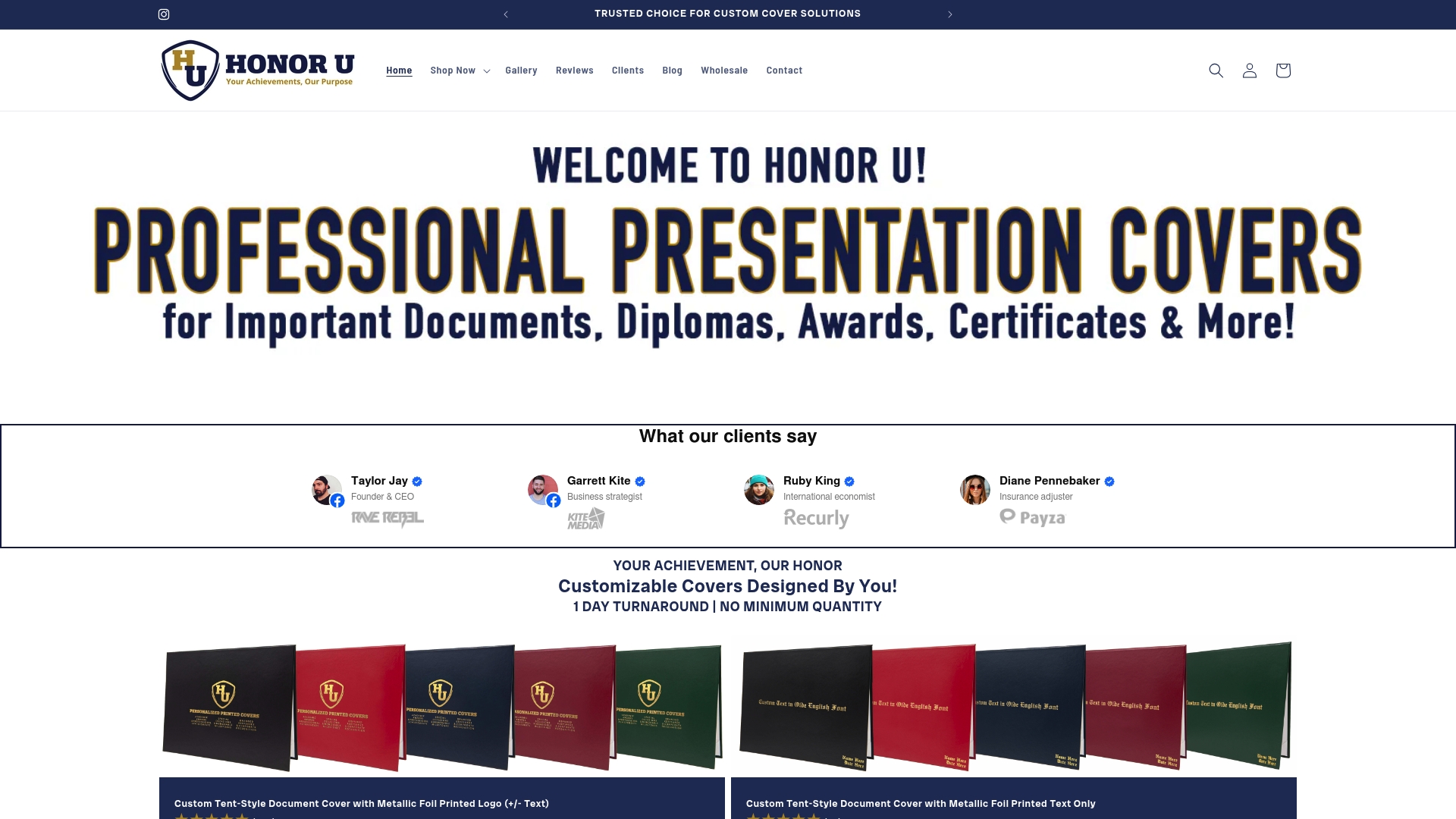

Wehonoru also offers classic diploma-style covers suited for wall-mounted or desk display in clinical environments, with custom sizing available for non-standard license documents. For a deeper look at presentation standards specific to healthcare settings, the certificate covers buying guide covers compliance considerations and material options in detail.
Key Takeaways
Displaying medical credentials correctly requires meeting both state-specific legal mandates and institutional verification standards, with legibility, placement, and currency as the non-negotiable foundations.
| Point | Details |
|---|---|
| State law sets the floor | Most states mandate visible display for physicians, dentists, chiropractors, optometrists, and independent-practice nurses. |
| California’s 24-point rule | California BPC 680.5 requires written credential disclosures to patients to be prominently displayed in at least 24-point font to ensure readability. |
| ANCC credential order | Display highest degree first, then licensure, state designations, national certifications, and awards. |
| CMS privileging cycle | CMS requires individual practitioner appraisals to be conducted periodically, within a timeframe defined by applicable regulations, generally around every two years. |
| Duplicate certificates for multiple sites | Licensing boards charge fees for duplicate certificates, which vary by state; one original certificate does not meet display requirements at multiple locations. |
FAQ
What does “displaying” a medical license actually mean legally?
Regulators define display as the original wall certificate hung at eye level in a patient-accessible area. A license stored in a drawer, filing cabinet, or behind the front desk does not qualify, even if it is technically on the premises.
Can a pocket card substitute for the wall certificate?
No. Pocket cards serve as portable proof of licensure when a provider is away from their primary location. They do not satisfy display requirements in any state that mandates a posted wall certificate.
How often must displayed credentials be updated?
Replace the displayed certificate immediately upon renewal. CMS requires institutional appraisals of individual practitioners no less frequently than every 24 months, but state license renewal cycles vary and govern when a new wall certificate must be posted.
What credential order does ANCC recommend?
The ANCC recommends: highest earned degree, licensure, state designations, national certifications, then awards and honors. If you hold a doctorate and a master’s, omit the baccalaureate from the display sequence.
What should a provider do when practicing at more than one location?
Order a duplicate certificate from your licensing board for each additional location. Duplicate fees typically range from $25 to $75, with turnaround varying by state. Some states allow a current printout from the board’s online verification system as a temporary substitute while the duplicate is in transit, but confirm this with your specific board before relying on it.
Recommended
Taylor Pace writes Honor U guides. Blair Black reviews them. Honor U sells empty covers and holders.