
Certificate Covers for Medical Licenses: 2026 Buying Guide

TL;DR:
- Certificate covers for medical licenses are specialized, acid-free displays essential for protecting and presenting legally required credentials. Selecting the correct size, material, and customization options—aligned with credentialing hierarchy—ensures professional credibility and long-term document integrity. Standardized, quality covers ordered in bulk and maintained regularly reflect institutional authority and facilitate accurate credential verification.
Certificate covers for medical licenses are specialized protective and display products designed to fit exact document dimensions, use archival-safe materials, and meet professional credentialing standards in clinical settings. In the healthcare industry, these products are more commonly called certificate holders or document presentation folders, and both terms describe the same category of product. Whether you are a hospital administrator procuring covers for an entire department or a physician displaying a newly issued state license, choosing the right cover protects your credential and communicates professional credibility to every patient and colleague who sees it.
Medical licenses are not decorative items. They are legally required credentials, and their physical presentation carries real institutional weight. Certificate holders provide professional, acid-free protection ideal for documents like medical licenses that require long-term display and preservation. This guide covers every decision point: size specifications, material standards, customization strategies for institutions, display best practices, and a step-by-step purchasing process.
What sizes and materials should you look for in medical license certificate covers?
The correct size is the single most important specification when selecting certificate covers for medical licenses. Most U.S. state medical licenses and board certifications are issued on standard 8.5" x 11" paper, which means the cover’s internal pocket must accommodate that full sheet without folding or compressing the document. A 9.38" x 12" external cover fits an 8.5" x 11" certificate and is acid-free and lignin-free, which is the industry-standard specification for this document size. The external dimensions are larger than the document itself to allow clean insertion and a finished presentation edge.

Non-standard licenses do exist. Fellowship certificates from institutions like the American College of Surgeons or continuing medical education (CME) completion documents sometimes arrive in 8.5" x 14" legal format or even custom dimensions. For these, a made-to-fit cover is the only correct solution. Ordering a standard-size cover for an oversized document forces the paper to fold at the edges, which creates permanent creases and signals careless presentation in a patient-facing environment.
Material standards that protect long-term
Material quality determines how long your license remains legible and undamaged. Acid-free and lignin-free materials prevent long-term paper degradation and fading, which is the baseline standard for any credential intended for permanent display. Lignin is a naturally occurring compound in wood-based paper products that causes yellowing over time. A cover made from lignin-containing stock will transfer that degradation to the document inside it.
For wall-mounted displays, UV-protective glazing or UV-filtering plastic sleeves add another layer of preservation. Offices with direct sunlight exposure can fade ink on a medical license within two to three years without UV protection. Archival backing materials and UV filtering are critical when framing, because backing boards and adhesives inside covers contribute significantly to long-term paper degradation if they are not archival grade.
Size and material quick-reference table
| Document size | Recommended cover external size | Material standard | UV protection needed |
|---|---|---|---|
| 8.5" x 11" (standard license) | 9.38" x 12" | Acid-free, lignin-free | Recommended for sunny offices |
| 8.5" x 14" (legal format) | 9.38" x 15" | Acid-free, lignin-free | Recommended for sunny offices |
| Custom dimensions | Made-to-fit | Acid-free, lignin-free | Recommended for sunny offices |
| 11" x 14" (oversized certificate) | 12" x 15" | Acid-free, lignin-free | Required for direct sunlight |
Pro Tip: Measure your actual issued license before ordering any cover. State licensing boards occasionally change their document dimensions between renewal cycles, and a cover that fit your 2022 license may not fit your 2026 renewal.
How can healthcare institutions handle customization and bulk ordering?
Healthcare institutions face a procurement challenge that individual practitioners do not: they need covers for dozens or hundreds of providers, often across multiple departments, specialties, and credential types. Managing that volume without a clear strategy leads to inconsistent presentation, excess inventory, and repeated reordering costs. The most operationally sound approach is to standardize first, then customize within that standard.
Standardizing certificate cover colors aligned with your institution’s brand colors limits ordering complexity and helps meet minimum order quantities more efficiently. Hospitals benefit operationally by standardizing cover colors and limiting variation to foil text, which reduces multiple order re-quoting and eases visual verification of license authenticity. A large health system might choose navy blue covers with gold foil text across all departments, then vary only the department name or provider title in the foil imprint.
Key customization options for medical institutions
When working with a supplier on custom certificate covers, the following options are the most relevant for healthcare procurement:
- Foil imprinting: Metallic foil printing of institution names, logos, or department titles gives covers a polished, authoritative appearance without adding significant cost per unit at volume.
- Color selection: Most suppliers offer five or more cover stock colors. Aligning cover color with institutional branding creates a cohesive credential display across all patient-facing areas.
- Pre-phrased text: Covers pre-printed with phrases like “Certificate of Completion” or “Medical License” reduce the need for individual customization per provider.
- Custom sizing: Institutions with non-standard document formats, such as fellowship certificates or international credential translations, benefit from made-to-fit covers that eliminate the risk of document damage.
- Logo placement: Institutional logos foil-printed on the cover front reinforce organizational identity and add a layer of authentication that plain covers cannot provide.
Minimum order quantities affect cost per unit significantly. Typical MOQ for custom certificate folders may be 50 pieces with a per-color minimum of 25 units. This means a hospital ordering two color variants needs at least 50 covers total, with at least 25 in each color. Understanding this structure before you request quotes prevents budget surprises and helps procurement teams plan batch ordering cycles.
Pro Tip: Order covers in batches aligned with your credentialing renewal calendar. Most state medical licenses renew on two-year cycles, so scheduling a bulk order six weeks before your institution’s peak renewal period gives you sufficient lead time without holding excess inventory.
For institutions that want to avoid minimum order constraints entirely, Wehonoru accepts orders with no minimum quantity requirement, which is particularly useful for smaller practices or departments testing a new cover style before committing to a full institutional order. Guidance on bulk ordering without surprises covers the vendor evaluation process in detail.
What are best practices for displaying medical licenses using certificate covers?
Displaying a medical license correctly is not just an aesthetic decision. The American Nurses Credentialing Center (ANCC) provides specific guidance on credential display hierarchy, and that framework applies broadly across healthcare professions. ANCC credential display hierarchy places education first, licensure second, and national certifications after, so the physical placement of your license cover in an office or clinical space should reflect that order of prominence.
The following numbered sequence represents the recommended approach for displaying credentials in a patient-facing clinical environment:
- Position the highest earned degree first. A framed diploma or degree certificate should occupy the most prominent wall position, typically centered and at eye level.
- Place the medical license directly below or adjacent to the degree. The license is the legally required credential, and its visibility confirms active authorization to practice. Use a professional license cover or frame for medical license display that matches the style of the degree cover.
- Add board certifications and specialty credentials in descending order of authority. Certifications from bodies like the American Board of Internal Medicine (ABIM) or the American Board of Surgery (ABS) follow the license in the display hierarchy.
- Use consistent cover styles across all displayed credentials. Mismatched frames, colors, or cover materials create visual noise and reduce the overall credibility of the display. A unified set of document holders for medical certificates signals institutional attention to detail.
- Mount at eye level in patient consultation rooms or reception areas. Credentials displayed above 6 feet or behind furniture are effectively invisible to patients. The purpose of display is verification and trust, and that requires legibility.
- Label each cover clearly if multiple credentials are displayed. In busy clinical environments, patients and administrators benefit from clear identification of each document, particularly when multiple licenses or certifications are grouped together.
Beyond wall mounting, desktop tent-style certificate covers serve a practical function in administrative offices where wall space is limited. A tent-style cover stands independently on a desk or counter, displaying the credential at a readable angle without requiring hardware installation. This format is particularly useful in temporary clinical spaces, mobile health units, or shared offices where permanent wall mounting is not feasible.
The physical condition of the cover itself communicates as much as the credential inside it. A cracked plastic sleeve, a faded cover, or a cover that does not fit the document properly undermines the professional authority the license is meant to convey. Treat the cover as part of the credential’s presentation, not as an afterthought.
How to purchase and maintain certificate covers for medical licenses effectively
Selecting and ordering the right cover requires a clear process. The following comparison table outlines the key decision factors between the two primary display formats available for medical license covers.
| Feature | Tent-style document cover | Wall-mount frame for medical license |
|---|---|---|
| Installation required | No | Yes (hardware, wall anchors) |
| Portability | High | Low |
| Best for | Desks, counters, shared offices | Permanent clinical or consultation rooms |
| Material options | Cardstock, foil-printed covers | Wood, metal, archival mat board |
| Custom sizing available | Yes | Yes, but at higher cost |
| Bulk ordering ease | High | Moderate |
| Cost per unit | Lower | Higher |
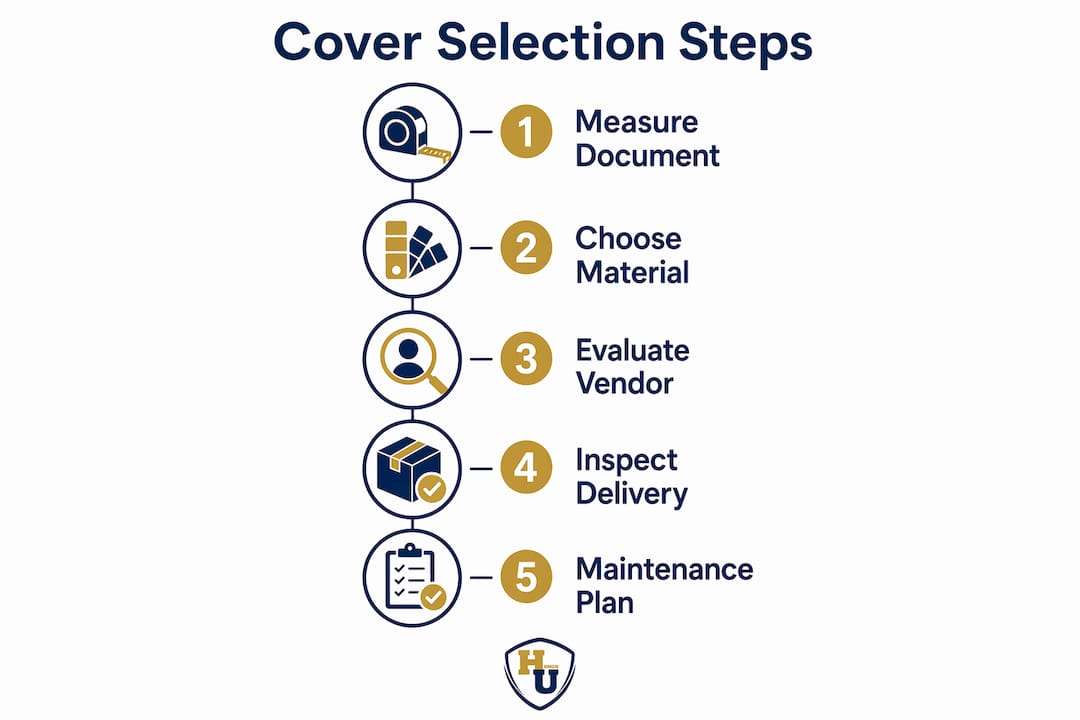
Once you have selected your format, the purchasing process follows five clear steps.
Step 1: Measure your document. Do not assume your license is 8.5" x 11". Measure the actual issued document, including any border or seal area that must remain visible.
Step 2: Select your material standard. Specify acid-free and lignin-free construction. For wall-mounted displays in offices with natural light, add UV-protective glazing or a UV-filtering sleeve as part of your specification.
Step 3: Evaluate your vendor. DIY framing risks document damage; professional-grade covers use archival materials and dust-free finishes that are essential for medical licenses. Confirm that your supplier can provide documentation of material standards, not just marketing language.
Step 4: Inspect covers on delivery. Check that the internal pocket dimensions match your specification, that foil imprinting is sharp and correctly positioned, and that the cover stock shows no warping or discoloration. Reject and return any covers that do not meet spec before distributing them to providers.
Step 5: Establish a maintenance schedule. Wipe covers with a dry microfiber cloth quarterly to remove dust. Replace covers that show yellowing, cracking, or fading. For licenses renewed every two years, align cover replacement with the renewal cycle so the document and its presentation are always current.
Pro Tip: When evaluating vendors, ask specifically whether their covers are made with acid-free backing boards, not just acid-free cover stock. The backing board is in direct contact with your document and is the most common source of long-term degradation in lower-quality products.
For institutions managing custom sizing for document covers, a detailed guide on non-standard dimensions and ordering specifications is available through Wehonoru’s resource library.
Key takeaways
Certificate covers for medical licenses require acid-free, lignin-free materials in correctly sized formats, with display placement following established credentialing hierarchy to protect both the document and the professional’s credibility.
| Point | Details |
|---|---|
| Size specification is non-negotiable | A 9.38" x 12" cover fits a standard 8.5" x 11" license; measure before ordering. |
| Material quality determines longevity | Acid-free, lignin-free construction prevents yellowing and paper degradation over time. |
| Institutions should standardize first | Aligning cover color and style institution-wide reduces ordering complexity and meets MOQ thresholds. |
| Display hierarchy matters | ANCC guidance places licensure second after highest degree; physical placement should reflect this order. |
| Maintenance extends cover life | Quarterly cleaning and renewal-cycle replacement keep credentials looking authoritative and current. |
Why most healthcare institutions get this wrong the first time
The most consistent mistake I observe in healthcare procurement is treating certificate covers as a commodity purchase. A department administrator orders whatever is cheapest and available, the covers arrive in a color that clashes with the institution’s brand, and the internal pocket is a quarter-inch too small for the actual license document. The result is a credentialing wall that looks improvised rather than intentional.
The second mistake is ignoring the display hierarchy entirely. I have seen clinical offices where a CME completion certificate occupies the most prominent wall position while the actual state medical license sits in a drawer. That inversion is not just aesthetically wrong. It misrepresents the credential structure to patients who rely on visible licensure as a basic trust signal.
What actually works is treating the cover selection as part of a credential information architecture, where every displayed document has a defined position, a consistent presentation format, and a material standard that matches the document’s legal and professional significance. Institutions that approach it this way, typically large health systems with centralized credentialing offices, produce displays that communicate authority without any additional explanation.
The good news is that the operational investment required is modest. Standardizing on one cover style, one color, and one supplier eliminates most of the recurring complexity. From there, the only variable is foil text, which can be customized per provider at no significant additional cost when ordered in volume. That is a solvable problem, and it is worth solving correctly.
— Manager
How Wehonoru can supply your medical license covers
Wehonoru produces tent-style document covers and certificate holders built to the specifications healthcare professionals and institutions need. Every cover is available in acid-free construction, with metallic foil printing for institutional logos, provider names, or department titles. Orders ship in one business day, with no minimum order quantity, so a single-provider practice and a 500-bed hospital system can both order exactly what they need without excess inventory.
For institutions ready to standardize their credential display, Wehonoru’s classic tent-style document covers are available in multiple colors with custom foil imprinting. Made-to-fit sizing is available for non-standard license dimensions, and bulk pricing discounts apply automatically at checkout. Free shipping applies to orders over $30, and the Wehonoru team is available Monday through Friday at 804-223-4339 to assist with institutional procurement specifications.
FAQ
What size cover fits a standard medical license?
A cover with a 9.38" x 12" external dimension fits a standard 8.5" x 11" medical license. Always measure your actual issued document before ordering, as some state licenses and board certifications use non-standard dimensions.
What materials should certificate covers for medical licenses use?
Covers should be made from acid-free and lignin-free materials to prevent paper degradation over time. For wall-mounted displays in offices with natural light, UV-protective glazing or a UV-filtering sleeve is also recommended.
How should medical licenses be displayed in a clinical setting?
ANCC credential display guidance places licensure second in the hierarchy, after the highest earned degree. Mount the license at eye level in a patient-facing area using a consistent cover style that matches other displayed credentials.
Can healthcare institutions order custom certificate covers in bulk?
Yes. Custom certificate folders typically carry a minimum order quantity, often around 50 pieces with per-color minimums. Suppliers like Wehonoru offer no-minimum ordering, which is useful for smaller practices or institutions testing a new cover style before committing to a full institutional order.
Do physical certificate covers matter for credential verification?
Physical display matters beyond aesthetics. Healthcare license verification for immigration and credentialing purposes requires authentic, unrestricted licenses, and the physical cover must correspond accurately to the official issued document without obscuring any identifying information.