
Graduation Presentation Workflow: Your 2026 Ceremony Guide

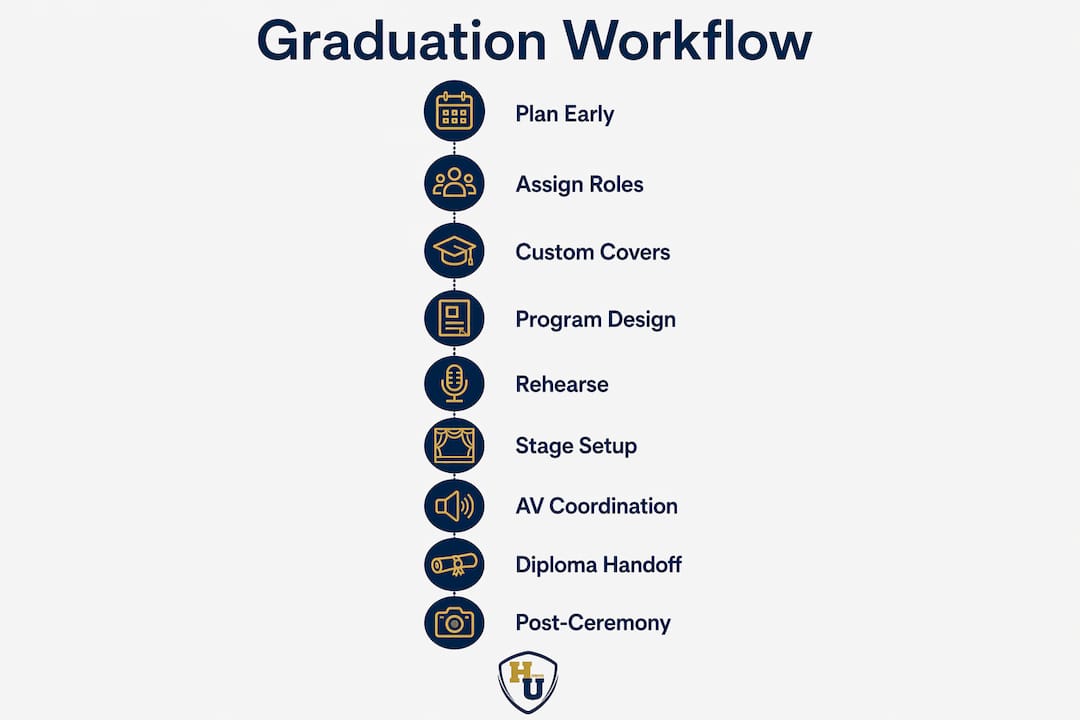
A well-executed graduation presentation workflow is the difference between a ceremony that feels polished and purposeful and one that loses the audience halfway through diploma distribution. The core phases are planning, role assignment, preparation and rehearsal, communication, on-stage execution, and post-ceremony follow-up. Custom diploma and certificate covers sit at the center of that execution, serving as the physical symbol of achievement that every graduate carries off the stage.
The essential components of a complete graduation presentation workflow:
- Initial planning: Lock the date, venue, and vendor contracts 9–12 months before commencement
- Team role assignment: Designate a coordinator, announcer, diploma handlers, line-up supervisors, and a dedicated problem solver
- Custom cover selection: Order and personalize diploma and certificate covers with institutional branding, foil color, and correct sizing
- Rehearsal: Run at least 3–4 full rehearsals covering processional, stage flow, and diploma handoff
- Communication: Send spaced updates to staff, graduates, and families well before the event
- Contingency planning: Prepare backup venues, technical redundancies, and emergency protocols
- On-stage execution: Manage timing, name pronunciation, photography, and diploma handoff in sequence
- Post-ceremony follow-up: Verify all graduates received their documents, debrief the team, and thank vendors
Table of Contents
- How the graduation presentation workflow unfolds step by step
- Communication and contingency strategies that keep ceremonies on track
- Why Wehonoru is the right partner for custom diploma and certificate covers
- Best practices to keep your ceremony on schedule and professional
- Key Takeaways
- FAQ
How the graduation presentation workflow unfolds step by step
1. Build your planning timeline early
Effective ceremony planning begins 9–12 months before commencement day. That window allows time for venue booking, vendor contracts, diploma ordering, and program design without the pressure of a looming deadline. Monthly planning meetings in the 6–9 month range shift to weekly sessions in the final month as operational details multiply.
2. Assign every role before the first rehearsal
A clear team structure prevents the most common ceremony failures. Roles to fill include a ceremony coordinator, an announcer trained in name pronunciation, diploma handlers stationed at the presentation table, line-up supervisors managing graduate queues, a technology coordinator overseeing audiovisual systems, and a photographer liaison. Each person needs a written description of their duties before rehearsal begins.
Pro Tip: Assign a dedicated problem solver who is separate from the main coordinator. This person handles technical glitches and minor emergencies on the spot, freeing the coordinator to maintain overall ceremony flow without interruption.
3. Order and customize diploma and certificate covers
Diploma covers should be ordered with enough lead time to allow for proofing, corrections, and delivery before rehearsal. Custom sizing matters when your institution uses non-standard document dimensions. Metallic foil printing with your school’s name, seal, or logo gives each cover a premium, heirloom quality that reflects the significance of the moment. Covers should be pre-sorted in the exact order graduates will cross the stage, reducing handoff errors to near zero.
4. Design the ceremony program with timing in mind
A printed or digital program does more than inform guests. It removes the need to read biographical details or award descriptions aloud, which preserves ceremony pace and keeps the audience engaged. Programs may be distributed as printed copies or accessed via QR code. Include all graduate names, speaker biographies, award recipients, and the full ceremony order so nothing needs to be narrated from the stage.
5. Conduct thorough rehearsals for every role
Rehearsal is critical not just for graduates but for every staff member involved. Line-up supervisors, diploma handlers, and announcers all need role-specific practice. Name pronunciation drills are particularly valuable; collecting phonetic spellings from graduates in advance and running them with the announcer during rehearsal eliminates the most visible ceremony errors. A fully timed run-of-show document should guide every rehearsal session.
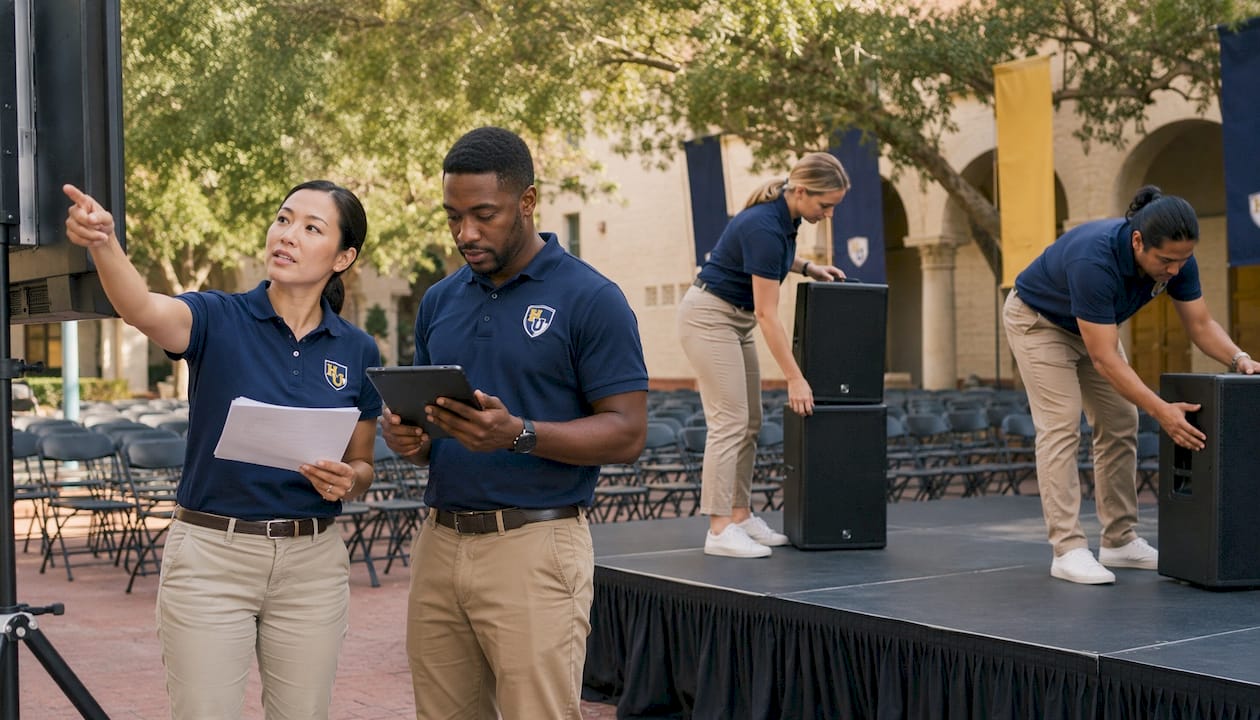
6. Configure the stage for smooth graduate movement
Stage layout should establish a clear traffic pattern: graduates enter from one side, walk to center for diploma receipt and photography, then exit the opposite side. Avoid any configuration that creates a bottleneck at the presentation table. Designated entry and exit points, a clearly marked diploma area, and accessible ramps or steps for all graduates are non-negotiable elements of a professional stage setup.
7. Coordinate audiovisual and photography logistics
Sound, lighting, and display screens require testing in the actual venue before ceremony day. Large screens showing graduate names and photos as each student crosses the stage add a personalized touch without extending the program. Digital displays synchronized with name announcements create individual moments for each family while keeping the ceremony moving efficiently. Assign a dedicated staff member to manage the technology team and resolve any issues without interrupting the coordinator.
8. Execute diploma handoff with precision
Diploma presentation requires coordination among the announcer, the diploma presenter, the photographer, and the stage manager. The announcer reads the name, the graduate approaches, the presenter offers a handshake and the cover, the photographer captures the moment, and the graduate exits. Allowing 10–15 seconds per graduate is a reliable planning benchmark; 100 graduates at that pace requires roughly 17–25 minutes for the diploma segment alone.
9. Complete post-ceremony procedures
After the recessional, verify that every graduate received their diploma cover. Collect borrowed regalia, gather remaining programs, and conduct a venue walkthrough. A brief team debrief within a few days of the ceremony captures what worked and what needs adjustment for the following year. Thank volunteers, vendors, and staff in writing.
Communication and contingency strategies that keep ceremonies on track
The most common source of ceremony disruption is not a technical failure. It is information that arrived too late or through too few channels. Spaced communication over weeks and months, rather than a single comprehensive announcement the week before, gives staff and graduates time to absorb details and ask questions before they become problems on ceremony day.
Key communication and contingency tactics:
- Send a save-the-date to students and faculty at least 75 days before the event, with full details following 30 days out
- Use multiple channels: email, text alerts, your school website, and social media, because not every family checks the same platform
- Loop in teachers and office staff so they can answer family questions consistently
- Confirm speaker attendance 3–5 days before the ceremony, with a brief reconfirmation 24 hours prior
- Prepare a backup venue for outdoor ceremonies and document it in the contingency plan
- Assign a staff member to manage technical redundancies: backup microphones, spare presentation files, and an alternate livestream link
- Distribute a “know before you go” message to graduates one week out, covering arrival times, dress code, parking, and ticket policies
Rehearsals serve a dual purpose in the communication strategy. They clarify roles and timing for staff, and they reduce graduate anxiety by making the ceremony sequence familiar before the actual day. When every participant rehearses their specific role, the margin for unpredictable errors shrinks considerably.
Why Wehonoru is the right partner for custom diploma and certificate covers
The physical diploma cover is the one element every graduate takes home from the ceremony. Its quality reflects directly on your institution. Wehonoru produces custom diploma covers with in-house metallic foil printing in a 1-business-day turnaround, a production speed that most institutional suppliers cannot match.
What sets Wehonoru apart:
- 1-day production turnaround: Orders ship the next business day, capturing last-minute ceremony needs without premium surcharges
- No minimum order quantities: Schools with small graduating classes or organizations honoring a single recipient order exactly what they need
- Made-to-fit custom sizing: Non-standard document dimensions are accommodated, a capability most suppliers do not offer
- Metallic foil printing: Institutional logos, names, and custom text are applied with precision in multiple foil colors
- Over 400 five-star customer reviews: Consistent ratings across product lines reflect reliable quality and fulfillment
- Free shipping on orders over $30: Accessible threshold for single-event and bulk orders alike
- Transparent bulk pricing: Automatic tiered discounts apply at checkout without requiring a quote process

Wehonoru’s tent-style covers are available in pre-phrased and fully custom formats, making them suitable for K-12 schools, colleges, corporate training programs, healthcare organizations, and government agencies. For institutions planning the 2026 ceremony season, the Class of 2026 graduation cover is available with year-specific foil printing and same-day production capability.
Best practices to keep your ceremony on schedule and professional
Ceremony delays rarely come from a single failure. They accumulate from small inefficiencies: an announcer who stumbles on names, a stage configuration that creates congestion, or biographical details read aloud that belong in the printed program. Addressing each of these in advance keeps the event moving with the dignity the occasion deserves.
Pro Tip: Design your stage flow so graduates enter from one side and exit the opposite side without crossing paths. This single choreographic decision eliminates the most common congestion point during diploma distribution and keeps the line moving at a consistent pace.
Actionable steps for a professional, on-schedule ceremony:
- Limit speeches to 2–3 maximum, with clear time guidelines (10–15 minutes for the keynote, 5–7 minutes for student speakers)
- Train announcers with pronunciation drills before the ceremony and keep phonetic name cards at the podium
- Use printed or digital programs to display award descriptions and speaker biographies rather than reading them aloud
- Use digital displays showing graduate photos synchronized with name announcements to add personalization without extending the ceremony time.
- Pre-sort diploma covers in processional order before the ceremony begins
- Assign two simultaneous presentation lines for large graduating classes to cut diploma distribution time
- Brief all staff on their specific duties one week before the ceremony and again on the morning of the event
For additional ideas on creating a memorable graduate project showcase, Wehonoru’s resource library covers presentation design, cover selection, and ceremony coordination from an institutional perspective.
Key Takeaways
A complete graduation presentation workflow integrates early planning, defined roles, custom diploma covers, thorough rehearsal, and spaced communication to deliver a ceremony that honors every graduate with precision and dignity.
| Point | Details |
|---|---|
| Start planning 9–12 months out | Lock venue, vendors, and diploma cover orders well before commencement to avoid last-minute gaps. |
| Assign a dedicated problem solver | A separate troubleshooter frees the main coordinator to maintain ceremony flow during unexpected issues. |
| Pre-sort diploma covers by processional order | Organizing covers before the ceremony begins reduces handoff errors and keeps the stage moving. |
| Use programs to replace read-alouds | Printed or digital programs display award details and biographies, preserving ceremony pace. |
| Choose Wehonoru for 1-day turnaround | Custom metallic foil covers ship next business day with no minimums and over 400 five-star reviews. |
FAQ
How far in advance should diploma covers be ordered?
Order diploma covers at least 4–6 weeks before the ceremony to allow time for proofing and corrections. Wehonoru’s 1-business-day production turnaround accommodates last-minute needs, but earlier ordering removes all delivery risk.
What roles are required for a smooth diploma presentation?
Effective diploma presentation requires an announcer, a diploma presenter, a photographer, and a stage manager working in coordinated sequence for each graduate crossing the stage.
How many rehearsals does a graduation ceremony need?
Protocol standards recommend at least 3–4 graduation rehearsals, covering processional, stage procedures, diploma handoff, and name pronunciation for all staff and graduates.
How do you prevent name mispronunciation during the ceremony?
Collect phonetic spellings from every graduate in advance, run pronunciation practice sessions with the announcer before ceremony day, and keep phonetic name cards at the podium as a backup reference.
What is the ideal total length for a high school graduation ceremony?
High school graduation ceremonies typically last enough time to include processional, speeches, diploma presentation, and recessional, with individual presentations averaging about 10–15 seconds per graduate.