
Bulk Diploma Cover Buying Guide for Administrators

TL;DR:
- Ordering diploma covers in bulk requires precise measurement and early planning to prevent costly errors. Selecting appropriate materials, colors, and customization details enhances institutional pride and professionalism. A structured process including proof approval and timely delivery ensures a smooth experience for recognition events.
Ordering diploma covers in bulk sounds straightforward until you are standing in front of a room full of graduates and realize the covers are too small, the logo is off-center, or the shipment arrived two days late. This guide to bulk diploma covers is written specifically for educational administrators and corporate HR professionals who need to get it right the first time. You will find concrete guidance on measuring diplomas accurately, selecting the right materials, preparing artwork for customization, and managing the full ordering and delivery process without costly surprises.
Table of Contents
- Key takeaways
- Your guide to bulk diploma covers: sizing first
- Selecting materials and styles for bulk orders
- Customizing bulk diploma covers effectively
- The step-by-step bulk ordering process
- Troubleshooting common bulk order problems
- My perspective on getting bulk orders right
- Order with confidence through Wehonoru
- FAQ
Key takeaways
| Point | Details |
|---|---|
| Measure every diploma first | There is no universal diploma size, so physical measurement before ordering is mandatory to avoid expensive sizing errors. |
| Choose materials by event type | Smooth leatherette is the most popular choice for bulk orders, balancing a professional look with a reasonable per-unit cost. |
| Submit vector artwork only | High-resolution vector files (.AI, .EPS, vector .PDF) are required for sharp foil imprinting; JPEG files produce blurry results. |
| Order 2 to 3 months early | Placing bulk orders well in advance reduces the risk of production delays and shipping problems near ceremony dates. |
| Approve digital proofs before printing | Reviewing proofs catches typos, logo placement errors, and color mismatches before an entire production run is committed. |
Your guide to bulk diploma covers: sizing first
The single most consequential decision in any bulk order is sizing. Get this wrong and every other decision you made becomes irrelevant. There is no universal diploma size; common dimensions include 8.5x11, 11x14, 12x15, 11.75x16, and 14x17 inches, and many institutions use custom dimensions that fall outside every standard category.
The variation exists because universities, high schools, trade programs, and corporate training departments all issue documents on paper or cardstock of their own choosing. A four-year university might issue degrees on 11x14 parchment while the same institution’s continuing education certificates are printed on standard 8.5x11. Ordering covers based on assumption rather than measurement is a frequent and costly error in bulk purchasing.
How to measure correctly
Before placing any bulk order, collect a physical sample of the actual diploma or certificate that will be presented. Measure both the height and the width in inches, and confirm the orientation.
- Portrait (taller than wide): The most common orientation for traditional diplomas
- Landscape (wider than tall): Frequently used for corporate certificates and continuing education completions
- Near-square formats: Less common but used by some professional associations and trade programs
Covers that are too large will allow the document to slide and shift inside; covers that are too small will crease or damage the diploma when it is inserted. Neither outcome is acceptable at a ceremony where the presentation moment carries real weight for the recipient.
| Common diploma size | Typical use |
|---|---|
| 8.5 x 11 in | Corporate certificates, continuing education, trade completions |
| 11 x 14 in | College and university degrees |
| 12 x 15 in | Some graduate and professional school diplomas |
| 11.75 x 16 in | Oversized university formats |
| 14 x 17 in | Large-format honorary and professional degrees |
Pro Tip: Request two or three sample diplomas from the issuing department rather than relying on past year documents. Paper stock, printer settings, and layout changes occasionally shift the printed area, which can affect how a cover fits even when the paper dimensions stay the same.
If your institution issues diplomas in multiple formats across departments or degree levels, group them by size before ordering. Ordering separate cover batches by size costs less than ordering one oversized cover for every recipient, and it produces a far more polished result.
Selecting materials and styles for bulk orders
Once sizing is confirmed, material selection shapes the overall impression your covers make and determines a significant portion of your per-unit cost. The right material for a 500-student commencement differs from what works for a 15-person corporate leadership certification cohort.

The leading material options
Smooth leatherette is the material used by the vast majority of bulk buyers, and the reasons are practical. It has a professional appearance that photographs well, holds foil imprinting cleanly, and resists minor scuffs and handling during distribution at ceremonies. It is also priced to work within institutional budgets, especially when ordered in quantity.
Padded leatherette adds a softer, more substantial feel that conveys added prestige. It is well-suited for graduate-level programs, executive education completions, or corporate recognition events where the cover is also meant to function as a keepsake with an heirloom feel. The per-unit cost is higher, typically by 20 to 40 percent over standard leatherette, but recipients notice the difference.
Vinyl covers represent the most economical option for very high-volume orders where budget is the primary constraint. They are durable and functional but do not carry the same weight or finish quality as leatherette. Many administrators use vinyl for internal training certificates and reserve leatherette for formal graduation ceremonies.
Color and style decisions
Leatherette covers are available in a range of colors including black, navy, royal blue, forest green, and burgundy. Black remains the most requested color for bulk institutional orders because it is neutral, authoritative, and aligns with most school and corporate color schemes. That said, matching your institution’s primary brand color creates a noticeably more cohesive presentation and is worth the effort of confirming the closest available color match.
Style-wise, the primary decision in bulk orders is between flat covers and tent-style covers. Tent-style covers stand upright on a flat surface, making them suitable for tabletop display after the ceremony. They are particularly popular for corporate recognition events where the cover will sit on a desk or shelf as an ongoing reminder of the achievement.
Pro Tip: If you are ordering for both a formal ceremony and a subsequent display context, tent-style covers with foil imprinting cover both needs in a single product. You avoid the cost of purchasing a separate display holder later, and the recipient receives a genuinely functional keepsake.
A useful way to think through material selection is this comparison:
| Material | Appearance | Durability | Best for | Relative cost |
|---|---|---|---|---|
| Smooth leatherette | Professional, polished | High | Graduation ceremonies, formal awards | Moderate |
| Padded leatherette | Luxurious, heirloom quality | Very high | Graduate-level, executive, keepsake events | Higher |
| Vinyl | Clean, functional | Moderate | Internal training, high-volume low-budget orders | Lower |
Customizing bulk diploma covers effectively
Customization is where bulk orders most often go wrong, and it is also where they create the most visible institutional value when done correctly. A diploma cover bearing your institution’s name, seal, and colors in crisp metallic foil communicates pride and professionalism from the moment the graduate opens it. Getting to that result requires careful preparation before a single cover is produced.
Preparing your artwork
Submitting artwork in a high-resolution vector format is not optional. Vector files (.AI, .EPS, or vector .PDF) scale to any size without losing definition. JPEG and PNG files are pixel-based, and when they are scaled to fit a diploma cover imprint area, the edges of logos and text become soft or blurry. That kind of imprecision undermines the prestige of the document it is presenting.
Along with the file format, provide your official Pantone (PMS) color codes when specifying foil colors. This is the only reliable way to guarantee that the gold, silver, or colored foil on your covers matches your brand standards exactly rather than approximating them.
Choosing your imprint method
The two primary imprint methods for custom diploma covers in bulk are foil stamping and embossing. Foil stamping applies a metallic or colored foil to the cover surface through heat and pressure, creating a bright, reflective finish that is immediately associated with prestige and ceremony. Embossing creates a raised impression in the cover material without added color, producing a subtle, tactile effect that reads as sophisticated in low-volume or premium applications. For bulk institutional orders, foil stamping is the more widely used choice because it is legible at a distance and photographs clearly.
Managing text and personalization
- Confirm your institution’s official name as it should appear on the cover. Abbreviations, punctuation, and capitalization matter and should be pulled from your official style guide.
- Decide whether to include the graduation year. Year-specific covers add relevance but reduce reuse potential if you maintain a cover inventory between cycles.
- Specify any class designation or program title that belongs on the cover alongside the institution name.
- Determine whether individual recipient names will be printed on covers. Per-name personalization increases cost and production time substantially, so many administrators reserve this for smaller cohorts or executive-level programs.
- Confirm seal or logo placement, typically centered on the front face of the cover, though some institutions place their seal on the spine.
Bulk volume lowers per-unit customization cost significantly. A complex design that costs $6 per unit at 25 pieces might fall to $3 per unit at 250 pieces. This economies-of-scale effect makes full customization far more accessible for mid-to-large institutional orders than many administrators initially expect.
Pro Tip: Always request a digital proof before approving production on any bulk order. Proofs catch typos, logo placement issues, and color mismatches before an entire run is committed. The 24 to 48 hours a proof review takes is a fraction of the time and cost involved in reprinting hundreds of covers.
For guidance on selecting and customizing the cover format that best fits your institutional needs, Wehonoru’s resource on diploma folder selection covers the key decision points in detail.
The step-by-step bulk ordering process
With sizing confirmed, materials selected, and artwork prepared, the ordering process itself follows a clear sequence. Working through it methodically protects you from the most common bulk order failures.
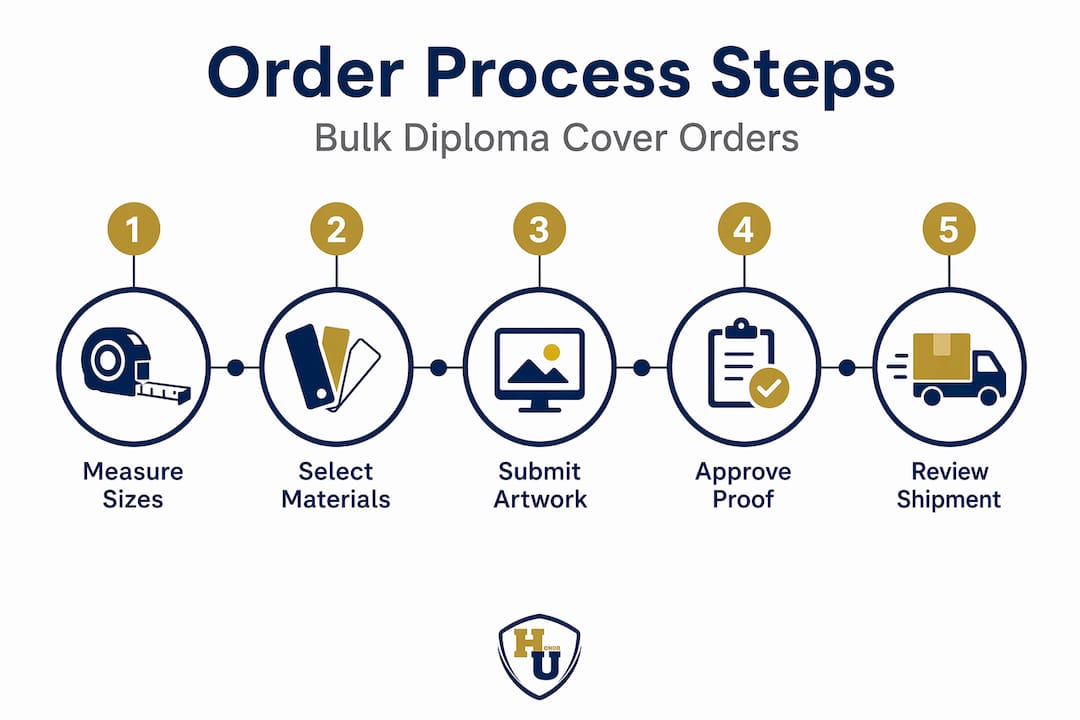
Preparing your order details
Before contacting any supplier or placing an order online, compile the following in a single reference document:
- Exact diploma dimensions (height x width, with orientation confirmed)
- Total quantity needed, plus a 5 to 10 percent overage buffer for last-minute additions or damaged pieces
- Material and color specifications
- Artwork files in vector format with PMS color codes
- Delivery address and required delivery date
Having all of this information ready before you begin the ordering process prevents delays caused by back-and-forth communication during production.
Timing your order
Placing bulk orders 2 to 3 months before your event is the standard recommendation, and it holds for good reason. Production time for custom covers typically runs 5 to 10 business days at standard turnaround. Shipping for large quantities adds additional time, especially for cross-country deliveries. Proof review cycles, particularly when institutional approval chains are involved, can add another week or more if revisions are required.
The table below shows a practical planning timeline for a May ceremony:
| Milestone | Target date |
|---|---|
| Confirm diploma dimensions and quantities | Early February |
| Submit artwork and place order | Late February |
| Review and approve digital proof | First week of March |
| Production completion | Mid-March |
| Expected delivery | Late March |
| Buffer for corrections or reorders | April |
| Ceremony | May |
Avoiding common pitfalls
- Relying on last year’s order specs without re-measuring: Diploma formats change. Always verify current dimensions.
- Skipping the proof: Even experienced administrators occasionally find errors only at the proof stage. This step is not optional.
- Ordering exact quantities with no buffer: A 5 percent overage is cheap insurance against last-minute enrollment additions or cover damage during handling.
- Ignoring packaging requirements: Confirm with your supplier how covers will be packed for shipping. Covers shipped loose in a large box are more likely to arrive with creases or damage.
Pro Tip: Coordinate with your receiving department before placing the order. Large shipments of diploma covers often arrive on pallets or in multiple boxes. If your receiving staff are not expecting the delivery, covers can sit in a loading dock or be misrouted, creating unnecessary stress in the days before a ceremony.
For a more detailed look at bulk certificate holder best practices, Wehonoru’s dedicated resource covers institutional ordering workflows from a procurement perspective.
Troubleshooting common bulk order problems
Even well-planned orders occasionally run into issues. Knowing how to respond quickly and correctly makes the difference between a minor inconvenience and a ceremony-day failure.
Sizing mismatches are the most frequently reported problem. If covers arrive and they do not fit correctly, contact your supplier immediately with the physical measurement of the diploma and the dimensions you ordered. Reputable suppliers will expedite a corrected order, particularly if the error is traceable to incorrect size specifications on the production file. A supplier with a short production turnaround, like Wehonoru’s one-business-day standard, can often turn around a correction order quickly enough to meet an event date even when the problem is discovered late.
Proof approval delays are a common source of timeline compression. If your institution requires sign-off from multiple departments before a proof is approved, build that into your planning calendar explicitly. Assign one person as the single point of contact for proof review to prevent approval chains from stalling production.
Customization errors, such as a misspelled institution name or incorrect graduation year, are correctable before production if you catch them at the proof stage. After production begins, corrections require a new run and additional cost. This is precisely why the proof review step carries so much practical weight.
- If an error makes it through to the finished covers, document the discrepancy with photographs and contact the supplier with a clear written description. Most suppliers will work with you on a resolution.
- If you have leftover covers after an event, store them flat in a cool, dry space. Smooth leatherette covers hold up well in storage and can often be reused the following year if they are not year-specific.
Ordering blank or non-year-specific covers for a portion of your bulk quantity gives you a reusable inventory buffer that significantly reduces per-ceremony costs over multiple years.
Pro Tip: If you are evaluating a new supplier for the first time, request a sample before committing to a full bulk order. Holding a physical sample lets you assess material quality, foil clarity, and construction before your institutional budget is on the line.
For a thorough review of how to avoid the most common surprises in large certificate and diploma cover orders, Wehonoru’s guide on ordering bulk certificate holders addresses the most frequent pain points with direct solutions.
My perspective on getting bulk orders right
I have seen administrators approach bulk diploma cover ordering the same way they approach ordering office supplies, and that almost always creates problems. The difference is that office supply errors are invisible. A missing ream of paper is fixed quietly. A diploma cover that creases the degree, carries a blurry logo, or bears the wrong graduation year is noticed by everyone in the room, including the graduate’s family.
What I have found works consistently is treating the diploma cover order as a formal procurement process with defined checkpoints, not a one-click transaction. In my experience, the two decisions that separate smooth orders from stressful ones are measuring the actual diploma document personally (not trusting historical records) and insisting on a digital proof with a mandatory internal sign-off before production begins. Those two steps alone eliminate the majority of problems I have seen.
The materials conversation also deserves more attention than it typically gets. Administrators frequently default to the lowest-cost option to satisfy budget constraints, and I understand that pressure. But the cover is the first physical thing a graduate touches when they receive their diploma. Padded leatherette at a modest price premium communicates something different from a thin vinyl folder, and that perception matters to recipients and to the institution’s image. The cost savings from smart bulk buying often create room for a material upgrade that would otherwise seem out of reach.
My practical advice: plan your order timeline backward from the ceremony date, not forward from when you feel ready to order. Lock in your buffer, assign a single person to manage the proof approval, and build a supplier relationship rather than re-bidding every year. Consistency with a reliable supplier produces better results than chasing the lowest quote each cycle.
, Manager
Order with confidence through Wehonoru
Wehonoru specializes in exactly the kind of orders this guide describes: bulk diploma cover options for institutions and HR teams that need professional quality, reliable delivery, and customization that reflects institutional pride. The product line includes classic tent-style diploma covers with metallic foil imprinting, available in a range of colors with no setup fees and automatic bulk discounts applied at checkout. For graduation-specific orders, the Class of graduation cover incorporates year-specific personalization that adds ceremony relevance without complicating the production process.
Every order includes a digital proof before production, and Wehonoru’s one-business-day turnaround means that even administrators who are working against a tight event timeline have a reliable path to a professional result. Free shipping applies on orders over $35, and there is no minimum order quantity, making it practical to order for any cohort size. Explore the full range of customizable diploma covers to find the right fit for your next recognition event.
FAQ
What sizes are available for bulk diploma covers?
Common diploma cover sizes include 8.5x11, 11x14, 12x15, 11.75x16, and 14x17 inches, but there is no universal standard. Always measure the actual diploma before ordering.
What file format should I submit for custom foil imprinting?
Submit artwork as a high-resolution vector file (.AI, .EPS, or vector .PDF). Pixel-based files like JPEGs produce blurry results when scaled for cover imprinting.
How far in advance should I place a bulk diploma cover order?
Order at least 2 to 3 months before your event to allow time for production, proof review, shipping, and a correction buffer if any issues arise.
Do bulk orders require a minimum quantity?
Minimum order requirements vary by supplier. Wehonoru accepts orders with no minimum quantity, which makes it practical for small cohorts and large institutional orders alike.
How do bulk discounts work for diploma covers?
Bulk volume reduces per-unit cost automatically as order quantities increase. Complex customization costs less per cover at higher volumes, making full institutional branding accessible at scale.
Recommended
More on bulk orders
Minimums, school pricing, and how to order a set are on the FAQ.
Taylor Pace writes Honor U guides. Blair Black reviews them. Honor U sells empty covers and holders.