
Bulk certificate holders: Best practices for administrators and HR

TL;DR:
- Properly defining “bulk certificate holders” as presentation products prevents costly ordering errors that could delay recognition events.
- Careful planning of distribution logistics, procurement, and customization ensures a seamless recognition experience for both on-site ceremonies and post-event mailing.
When planning a graduation ceremony or employee recognition event, even experienced administrators can stumble on a surprisingly common terminology trap. The phrase “bulk certificate holders” means something very specific in the world of academic and corporate recognition — a physical presentation cover that protects and elevates a certificate or diploma — yet the same phrase appears in postal and regulatory contexts that have nothing to do with honoring achievements. That confusion, however innocent it seems, can send an internal order request to the wrong department, delay a ceremony, or leave a room full of graduates holding flimsy paper with no protective cover in sight.
Table of Contents
- Clarifying the meaning: What are bulk certificate holders?
- Distribution logistics: Ceremony vs. post-event mailing
- Planning and ordering: Avoiding common pitfalls in bulk purchasing
- Choosing the right certificate holder for your event
- The overlooked details: Why seamless bulk certificate holder operations matter
- Make your next recognition event seamless with the right certificate holders
- Frequently asked questions
Key Takeaways
| Point | Details |
|---|---|
| Clarify terminology | Misunderstanding certificate holders versus postal forms can disrupt event planning. |
| Segment distribution | Split bulk orders for ceremonies and post-event mailings to manage timelines effectively. |
| Double-check details | Prevent mix-ups by clearly communicating holder types and quantities with all teams involved. |
| Order with a buffer | Always order extra certificate holders to handle last-minute changes and ensure a smooth event. |
| Choose holders to match the occasion | Customized certificate holders add value and enhance the recognition experience for recipients. |
Clarifying the meaning: What are bulk certificate holders?
Before placing any order or briefing a vendor, it is essential to align your team on a single, precise definition. In the educational and corporate HR context, bulk certificate holders are physical presentation products — folders, covers, or cases designed to house an award document, diploma, or training certificate for formal presentation at ceremonies or for mailing to recipients who were not present.
These products are entirely unrelated to the USPS Certificate of Bulk Mailing, which is a postal verification form used to confirm that items were sent in bulk. Mixing up these two concepts inside an institution can have real operational consequences: a purchasing request routed to the mailroom instead of a presentation products vendor, or a ceremony coordinator spending valuable time clarifying terminology when the event is days away.
Understanding the full spectrum of certificate holder types is equally important. Review the comparison table below to see how the most common formats differ:
| Holder type | Best use case | Material | Customization |
|---|---|---|---|
| Tent-style fold-over cover | Graduation ceremonies, award nights | Premium board stock, foil print | Logo, text, foil color |
| Soft vinyl presentation folder | Corporate HR, training completions | Flexible vinyl or leatherette | Embossed logo, color |
| Hard-bound document case | High-prestige diplomas, military commendations | Rigid board, fabric | Full custom |
| Mailing sleeve or flat cover | Post-ceremony delivery by mail | Lightweight board | Minimal |
Common formats in the school and HR setting include:
- Tent-style covers: Self-standing, fold-over presentation covers with metallic foil printing that elevate the moment of presentation
- Soft-bound folders: Flexible covers well-suited for corporate recognition events where recipients carry them to their seats
- Hard-bound cases: Premium, rigid covers that project prestige for doctoral graduates, law school completions, or senior leadership awards
- Custom-size specialty covers: Made-to-fit solutions for documents that fall outside standard 8.5 x 11 dimensions
“Distinguishing certificate holders for ceremonies from certificate mailing forms prevents mistakes in processes that affect entirely different teams, budgets, and timelines.”
For administrators who are still uncertain about the structural differences between common product formats, a side-by-side review of a diploma cover vs folder is a practical first step. Similarly, HR teams navigating certificate programs for employee training will benefit from reviewing the differences between a certificate cover vs folder before finalizing their vendor requirements.
Distribution logistics: Ceremony vs. post-event mailing
With a firm understanding of what certificate holders actually are, the next critical planning step is mapping out how they will reach recipients. Distribution logistics for bulk certificate holders typically split into two distinct tracks, and confusing them is one of the most common sources of last-minute stress for event coordinators.
Track 1: On-site ceremony distribution
Certificates and their holders are assembled in advance, organized by department, college, or employee cohort, and staged at the venue. Recipients walk across a stage or step forward at a podium and receive their holder during a formal presentation. The logistics here center on accurate alphabetical or cohort-based sorting, backup holders for last-minute additions, and physical staging of materials so they flow efficiently during the event.

Track 2: Post-event mailing
As Carnegie Mellon University’s graduation process documentation makes clear, mailing diplomas or certificates to those who were not present is a distinct process with its own fulfillment obligations, including managing returned mail and maintaining records of undelivered items. Recipients in this track need their holder delivered safely through postal channels, which means the packaging choice must prioritize protection during transit rather than ceremonial visual impact.
The following numbered workflow is a practical starting point for institutions managing both tracks simultaneously:
- Compile separate recipient lists at least four to six weeks before the event, distinguishing attendees from absentees who require mailing.
- Assign a dedicated coordinator to each distribution track so accountability is clear and tasks do not overlap.
- Prepare ceremony holders sorted alphabetically by department at least 48 hours before the event to allow time for corrections.
- Package mailing-track holders in protective sleeves or rigid mailers designed to prevent bending or moisture damage during transit.
- Establish a returned-mail protocol that logs undeliverable certificates, flags them for follow-up, and stores holders safely while updated contact information is obtained.
- Conduct a post-event audit comparing distributed counts against your recipient list to identify gaps before finalizing records.
A practical data overview of how preparation timelines typically break down for mid-size institutions is shown below:
| Task | Recommended lead time | Responsible party |
|---|---|---|
| Finalize recipient list | 6 weeks before event | Registrar or HR |
| Place bulk certificate holder order | 4 to 5 weeks before event | Purchasing |
| Receive and inspect order | 2 to 3 weeks before event | Event coordinator |
| Sort and stage ceremony holders | 48 hours before event | Ceremony staff |
| Prepare mailing track packages | Within 3 days post-event | Fulfillment team |
| Resolve returned mail | Ongoing for 30 days | Records office |
For institutions seeking a more detailed walkthrough of this workflow, the graduation folder workflow guide offers a structured reference. Teams who are also navigating custom branding decisions alongside their distribution plan will find the process of customizing diploma folders equally useful.
Pro Tip: Create a simple spreadsheet with two tabs — one for ceremony recipients and one for mail recipients — and link it directly to your order form data. This single habit eliminates the most common cause of mismatched holder quantities and distribution errors on the day of the event.
Planning and ordering: Avoiding common pitfalls in bulk purchasing
Once your distribution logic is mapped out, the actual purchasing process deserves its own careful attention. Bulk certificate holder orders introduce a set of risks that do not exist when buying single items, and experienced administrators know that the details matter far more than most people anticipate.
The most common ordering mistakes include:
- Failing to separate presentation and mailing quantities in the initial purchase order, which leads to using ceremonial covers for mailing (an expensive choice) or mailing-grade sleeves for the ceremony stage (an embarrassing one)
- Conflating certificate holder product types with regulatory or postal documentation, which misdirects internal purchase requests to entirely the wrong vendor or department
- Ordering a single uniform quantity without accounting for expected attrition from damaged holders, last-minute RSVP additions, or VIP recipients who deserve a premium-grade cover
- Neglecting customization lead times by assuming that a custom logo or foil color is available on the same schedule as a blank, pre-phrased cover
- Relying on a single vendor without verifying their production turnaround, which can leave an institution scrambling if the primary supplier delays
As Carnegie Mellon’s process documentation illustrates, splitting your bulk purchase into presentation and mailing tracks prevents quantity mismatches and helps your team manage the inherently different timelines each track demands. Ceremony holders need to arrive early enough for sorting and staging. Mailing holders need to be on hand promptly after the event for rapid dispatch to absent recipients.
A practical internal communication checklist for purchasing teams should include:
- Written confirmation of the split between ceremony holders and mailing holders
- Vendor-confirmed production and shipping timelines in writing
- A designated internal contact for order changes or urgent additions
- An agreed-upon buffer quantity (typically 5 to 10 percent above headcount)
- Confirmation that the vendor can accommodate custom dimensions if any documents fall outside standard sizes
Statistic to keep in mind: Industry research on corporate and academic recognition events consistently shows that last-minute additions to attendee or recipient lists average between 5 and 8 percent of the original confirmed count. Building that buffer into your initial order eliminates the need for costly expedited re-orders.
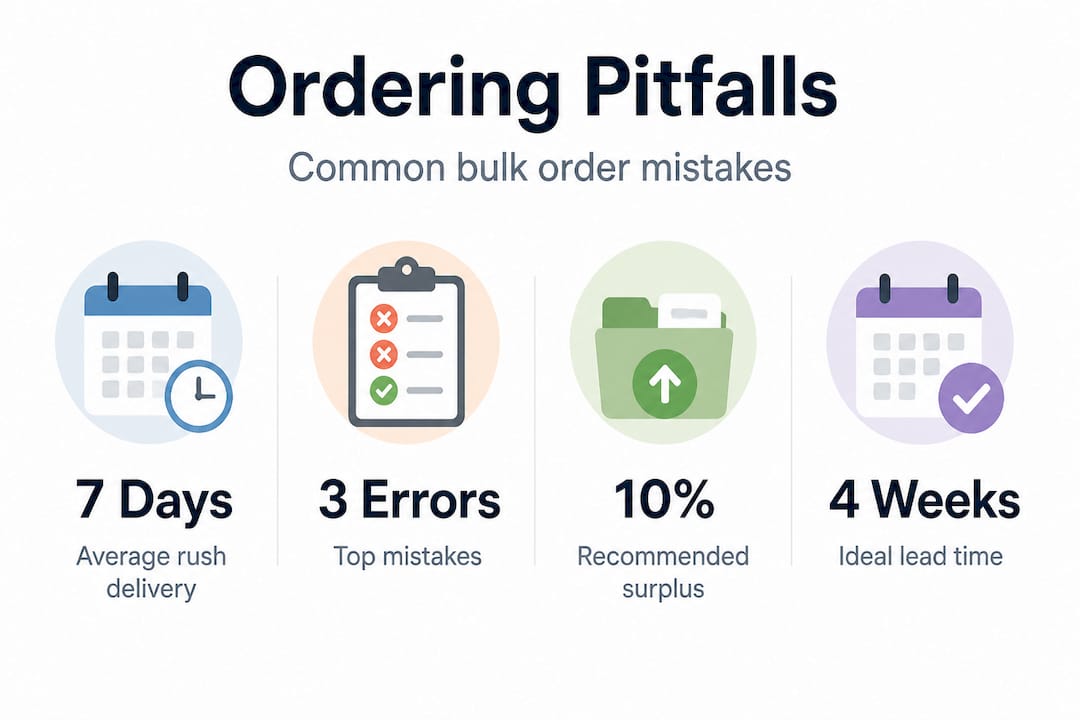
Pro Tip: Place your bulk order for certificate holders a minimum of four weeks before the ceremony date even if your vendor promises fast turnaround. This buffer protects you from production delays, shipping disruptions, and inspection time to verify that all holders meet your quality standards before the event.
For teams who want a structured overview of how different certificate folder types affect cost and turnaround, a review of certificate folder types and savings provides both the product context and the pricing benchmarks needed to make an informed decision. Administrators preparing for their first large-scale bulk purchase will also benefit from a dedicated guide on ordering bulk certificate holders without encountering avoidable surprises.
Choosing the right certificate holder for your event
With your procurement and distribution plan established, the final substantive decision is selecting the optimal type of holder for your specific event and audience. Not all certificate holders are equal in material quality, format, or visual impact, and the right choice reinforces the prestige of the recognition moment rather than diminishing it.
Primary holder types and their event fit:
- Tent-style certificate covers are the gold standard for formal graduation ceremonies at high schools, colleges, and universities. Their self-standing format allows recipients to display the cover on a table or desk immediately after receiving it, and metallic foil printing with institutional branding adds an heirloom quality that recipients retain long after the event.
- Soft-bound presentation folders are better suited to corporate training completions or departmental recognition events where recipients are seated and portability matters more than display.
- Hard-bound document cases project the highest level of prestige and are appropriate for doctoral degree presentations, senior executive recognition awards, or military commendations where the physical quality of the cover is expected to match the gravity of the achievement.
- Custom-size specialty covers address a genuine gap in the market: institutions with documents that do not conform to the standard 8.5 x 11 inch format often struggle to find holders that fit properly. A poorly fitted cover — one that is too loose or requires folding the certificate — undermines the presentation entirely.
Criteria for matching holder style to occasion:
| Event type | Recommended holder style | Key feature priority |
|---|---|---|
| University graduation | Tent-style, foil-printed | Branding, heirloom feel |
| K-12 graduation | Soft or tent-style | Durability, color variety |
| Corporate HR recognition | Soft-bound folder | Logo, professional finish |
| Employee training completion | Economy folder or mailing sleeve | Cost efficiency, clean design |
| Military or government award | Hard-bound case | Prestige, durability |
| Healthcare certification | Custom-size or hard cover | Regulatory display, longevity |
Customization is particularly important for audience engagement. When a recipient opens a holder and sees their institution’s logo rendered in metallic gold foil, the presentation immediately feels ceremonial rather than administrative. That emotional distinction matters because recognition events succeed or fail on the quality of the moment they create.
For a thorough overview of the options available across different event types, the explained: certificate cover options resource covers both the protective and the personalization dimensions of the decision. Administrators focused specifically on maximizing ceremony impact will find value in reading about memorable graduation covers, while those interested in the full spectrum of customization possibilities should consult the customizing diploma covers guide.
Pro Tip: If your institution or organization is presenting certificates across multiple departments or programs at a single event, consider a color-coded approach using different foil colors or cover stock colors for each department. This visual distinction makes stage-side distribution faster and reduces the chance of a recipient receiving the wrong holder in the moment.
The overlooked details: Why seamless bulk certificate holder operations matter
Here is something that rarely appears in vendor brochures or event planning checklists: the cost of a failed certificate holder operation is almost never just financial. It is reputational, emotional, and organizational.
When a graduate walks across a stage and receives a cover that is the wrong size, mislabeled, or visually inconsistent with their institution’s branding, the error is witnessed by hundreds of family members, colleagues, and administrators. When a newly minted employee receives a training certificate in the mail three weeks late — or with no protective holder at all — the recognition moment has passed and the investment in the recognition program is partially wasted. These are not hypothetical scenarios. They are the routine consequences of treating bulk certificate holder operations as a low-stakes logistics exercise.
What experience teaches is that the most effective administrators treat terminology precision and internal communication as first-line defenses. A single shared document that defines what your team means by “certificate holder,” distinguishes it from any postal or regulatory usage, and maps each stage of distribution to a named responsible party can prevent the majority of common errors. This is not a technology problem. It does not require a new software platform or a complex tracking system. It requires discipline and a habit of anticipating the unexpected before it arrives.
The second lesson that experienced administrators often share is that surplus planning is not waste — it is professionalism. Ordering 7 to 10 percent more holders than your confirmed headcount feels like an unnecessary expense until the day when three boxes arrive with a printing defect, or fifteen late registrants are added to the roster 36 hours before the ceremony. At that point, a modest surplus is not an extravagance; it is the difference between a seamless event and a logistical emergency.
Finally, the practice of avoiding bulk order surprises begins well before the order is placed. It begins in the planning meeting where terminology is defined, responsibilities are assigned, and timelines are agreed upon in writing. The administrators who consistently execute flawless recognition events are not the ones with the largest budgets or the most sophisticated tools. They are the ones who treat the details of certificate holder operations with the same seriousness they bring to commencement speakers, venue logistics, and photography.
Simple organization and clear communication consistently outperform complex solutions when it comes to recognition event execution. That is not a comfortable truth for vendors selling event management software, but it is the truth that experienced coordinators confirm every year.
Make your next recognition event seamless with the right certificate holders
Selecting the right bulk certificate holders shapes not just the appearance of your event, but the lasting impression it makes on every recipient. Whether you are planning a university commencement for hundreds of graduates, a quarterly employee recognition ceremony, or a training completion event for a small department, professional-grade holders communicate that the achievement genuinely matters.
Honor U at WeHonorU.com offers a full line of custom certificate covers designed for exactly these moments, with 1-business-day production turnaround, no minimum order quantity, free shipping on orders over $30, and metallic foil customization available for institutional logos and event-specific text. For graduation events, the classic diploma holders and high school diploma covers bring an heirloom quality to every presentation. Browse the full collection, upload your branding, and order with confidence knowing your holders will arrive ready for your event.
Frequently asked questions
What is the difference between a certificate holder and a certificate of bulk mailing?
A certificate holder is a physical presentation case used to display or deliver awards and diplomas at recognition events, while a certificate of bulk mailing is a USPS postal verification form that confirms items were sent in bulk — the two have no operational connection.
How do I handle certificate holders for students or employees who miss the ceremony?
Prepare a separate batch of holders specifically designated for post-event mailing, package them in protective rigid mailers to prevent bending, and maintain a tracking record for returned or undelivered items so they can be re-sent promptly.
How many extra certificate holders should I order for a large event?
Order at least 5 to 10 percent more holders than your confirmed headcount to account for last-minute attendee additions, any items damaged during sorting or staging, and VIP recipients who may require a premium-grade cover upgrade.
Can certificate holders be customized for different departments or programs within the same institution?
Yes, many suppliers offer tiered customization options that allow institutions to apply department-specific logos, program names, or foil colors to distinguish holders across multiple cohorts presented at the same event.
What are the most common pitfalls in bulk certificate holder orders?
The most frequent mistakes include failing to separate ceremony and mailing quantities in the purchase order, confusing presentation holders with unrelated regulatory documents, and not building a surplus buffer into the initial order — all of which can be prevented with clear internal communication and early procurement planning.
Recommended
- Bulk certificate holders: Fast, customizable options in 2026 | Honor U
- How to order bulk certificate holders without surprises | Honor U
- Custom Certificate Holders - Cut Costs 30-50% in 2026 | Honor U
- Certificate holder trends 2026: choose the best option | Honor U
- Credential Verification: Reduce Hiring Risks & Protect Safety