
Diploma cover terminology explained: Your complete guide

TL;DR:
- Ordering diploma covers can be confusing due to industry-specific terminology and product distinctions. A diploma cover is designed for staging presentations, while certificate holders and commencement folders serve different functions with specific features. Using precise language when communicating with suppliers ensures the correct product, material, and customization are delivered on time, reflecting institutional standards and honoring graduates.
Ordering diploma covers sounds straightforward until you are standing in front of a supplier’s catalog, staring at terms like “commencement folder,” “padded deluxe,” “debossed seal,” and “fulfillment window,” wondering whether you ordered the right product for next month’s ceremony. The vocabulary of the diploma cover industry is precise and layered, and a single miscommunication can mean mismatched branding, wrong sizes, or covers that arrive after the ceremony date. This guide decodes every essential term across materials, structure, customization, and logistics so that you can order with confidence, communicate clearly with suppliers, and ensure every graduate receives a presentation that honors the moment.
Table of Contents
- Understanding core diploma cover terms
- Material and construction: Industry terms you must know
- Customization and branding in diploma covers
- Production and fulfillment: Timing, logistics, and rush terms
- Top mistakes and expert tips when using industry terminology
- Our perspective: Why precision in diploma cover language matters now more than ever
- Next steps: Find the perfect diploma cover for your ceremony
- Frequently asked questions
Key Takeaways
| Point | Details |
|---|---|
| Core terms decoded | Knowing the difference between covers, folders, and commencement folders saves you headaches when ordering. |
| Material impacts formality | Standard, padded, or leather materials directly influence event presentation and document protection. |
| Branding drives identity | Personalization options let you showcase school pride and create lasting keepsakes for graduates. |
| Timing language matters | Terms like fulfillment window and rush production are crucial for avoiding last-minute event stress. |
| Clarity prevents errors | Using precise industry terminology ensures smooth communication with suppliers and flawless ceremonies. |
Understanding core diploma cover terms
The first source of confusion in this industry is the casual interchangeability of three distinct product types: diploma covers, certificate holders, and commencement folders. Each serves a related but different purpose, and using the wrong term when placing an order can result in receiving a product that does not fit your ceremony’s needs.
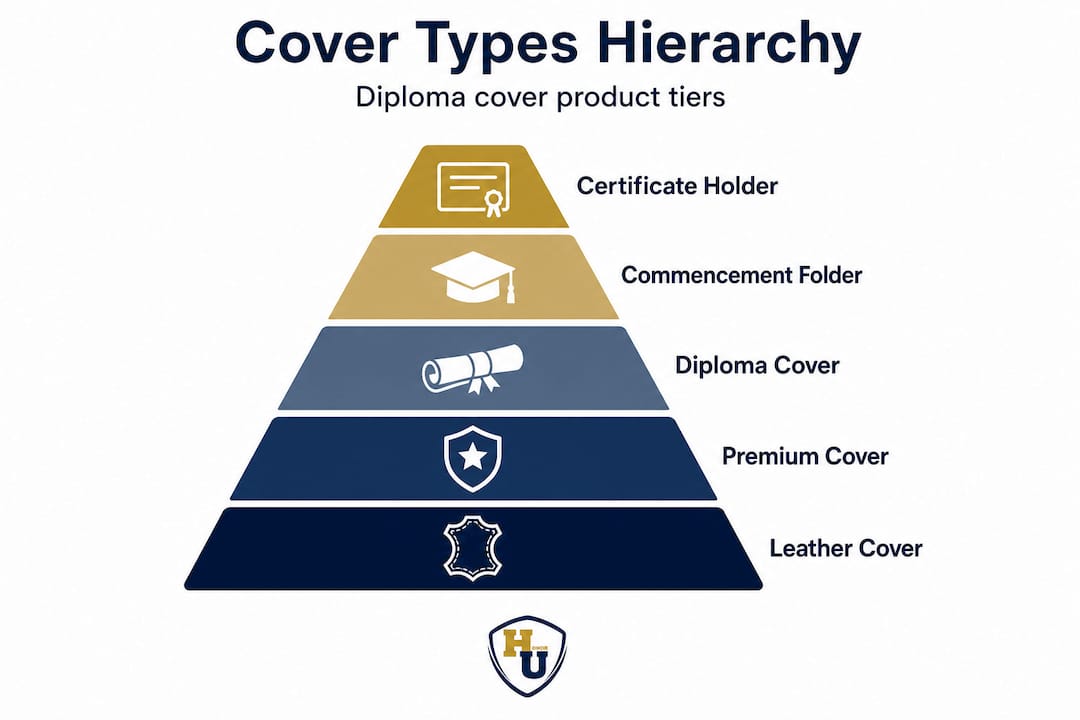
A diploma cover is a presentation holder designed to encase a diploma or certificate during the actual ceremony. It is the item a graduate holds while crossing the stage, and it protects the document from handling damage while creating a visually polished moment for photographs. Diploma covers are typically tent-style, meaning they stand open on a flat surface for display after the event.
A certificate holder is functionally similar but is often used in non-graduation contexts such as corporate training completions, employee recognition events, or professional licensing. The term signals a slightly more utilitarian purpose, though premium versions are indistinguishable in quality from diploma covers.
A commencement folder is a broader term that industry suppliers use to describe ceremony-specific presentation products, sometimes including interior pockets for programs, class photos, or additional documents alongside the diploma itself. Understanding this distinction is critical when communicating with a supplier, because ordering a “folder” when you need a “cover” could mean receiving a multi-pocket document organizer rather than a clean, stage-ready presentation holder.
For a detailed breakdown of when each product type is appropriate, the diploma cover vs folder guide from WeHonorU.com is a practical starting point. You can also explore the presentation folder guide for HR and education contexts specifically.
Side-by-side comparison
| Product type | Primary use | Interior features | Best suited for |
|---|---|---|---|
| Diploma cover | Ceremony presentation | Single document slot | Graduation ceremonies |
| Certificate holder | Recognition events | Single or dual slot | Corporate, healthcare, awards |
| Commencement folder | Ceremony with extras | Multi-pocket design | Large university ceremonies |
Common pitfalls when treating these terms as interchangeable include:
- Receiving a multi-pocket folder when a clean stage cover was needed
- Ordering certificate holders in a size calibrated for 8.5 x 11 inch documents when your diplomas are 11 x 14 inches
- Specifying “folder” to a supplier who interprets it as a filing product rather than a presentation item
- Missing the opportunity to request tent-style display functionality, which is often exclusive to diploma cover product lines
Precision in terminology from the first conversation with your supplier eliminates these risks entirely.
Material and construction: Industry terms you must know
Once you understand the basic product categories, the next layer of vocabulary involves materials and construction quality. These terms directly affect how a cover looks, how long it lasts, and how it signals the formality of your event.
Industry production terminology organizes covers into a clear hierarchy: standard, padded, premium, deluxe, and leather or genuine leather. Each label carries specific expectations about the tactile feel, visual weight, and perceived prestige of the finished product.
Standard covers are typically constructed from a single-ply paper or lightweight vinyl. They are cost-effective and appropriate for large-volume events where budget is the primary constraint, such as district-wide elementary school recognition days or high-volume corporate training completions.
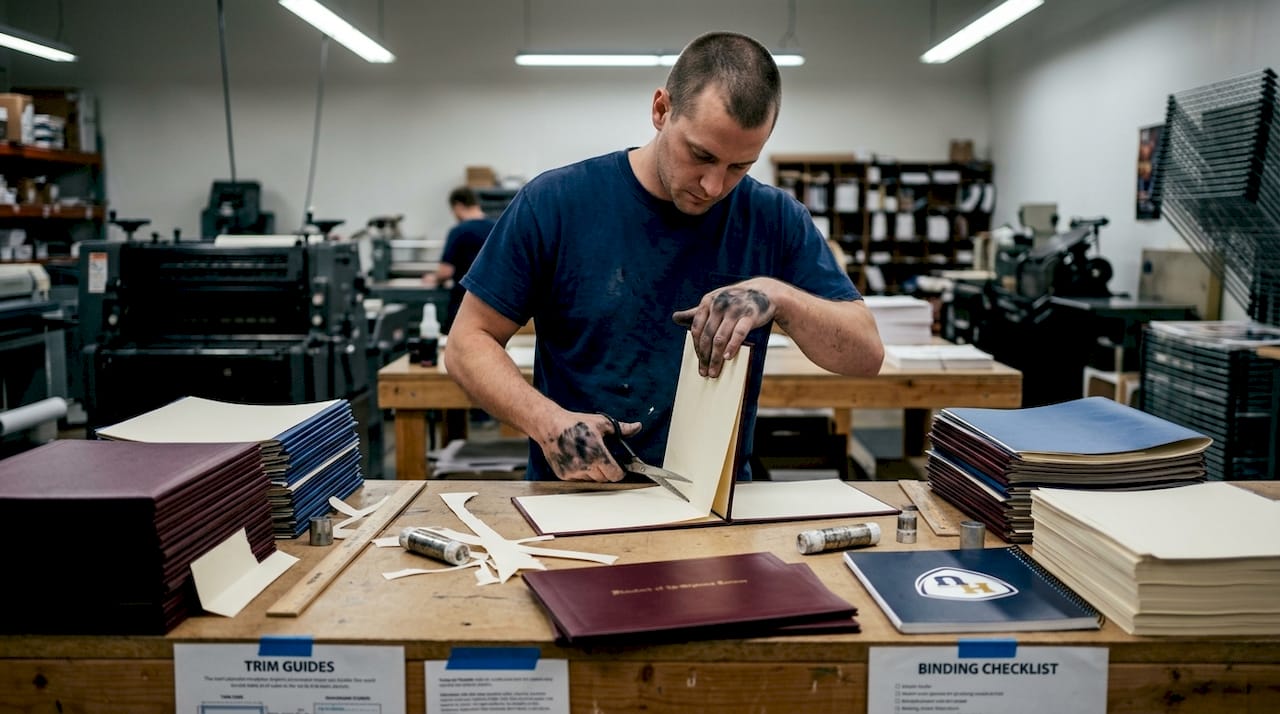
Padded covers add a layer of interior cushioning between the outer material and the inner lining. This creates a noticeably firmer, more substantial feel in the hand, which elevates the perceived value of the document inside. Padded covers are the most common choice for high school and college graduation ceremonies because they strike a balance between cost and ceremony prestige.
Deluxe and premium are terms that suppliers use inconsistently, which is a genuine source of ordering errors. One supplier’s “deluxe” may refer to a padded vinyl cover, while another’s may mean a genuine leather product with gold foil. Always request the actual material specification in writing before confirming any order.
Leather and genuine leather covers represent the top tier of the market. They carry an heirloom feel that is appropriate for doctoral ceremonies, executive recognition events, and military commendation presentations. Faux leather (sometimes labeled as “leatherette” or “bonded leather”) is a more affordable alternative that closely mimics the look without the price premium.
Pro Tip: When a supplier uses the word “deluxe,” always ask for the specific material composition. Request a physical sample if your order exceeds 50 units. This single step prevents the most common material-related ordering errors.
Material comparison table
| Material label | Construction | Best event type | Relative cost |
|---|---|---|---|
| Standard | Single-ply paper or vinyl | Mass recognition events | Low |
| Padded | Cushioned vinyl or faux leather | High school, college graduation | Moderate |
| Deluxe | Varies by supplier | Mid-tier ceremonies | Moderate to high |
| Genuine leather | Full-grain or top-grain leather | Doctoral, executive, military | High |
| Leatherette | Bonded or faux leather | Professional ceremonies | Moderate |
For a thorough breakdown of material options and how they affect ceremony tone, the diploma cover materials guide provides detailed specifications alongside real-world use case examples.
Customization and branding in diploma covers
After selecting the right material tier, personalization is where a diploma cover transforms from a generic holder into a meaningful institutional keepsake. The terminology in this area is particularly important for procurement professionals and event planners who need to communicate branding requirements accurately to suppliers.
Foil stamping (also called foil printing or hot stamping) is the process of applying a metallic or pigmented foil to the cover surface using heat and pressure. It produces the sharp, reflective text and logos you see on premium diploma covers. Foil colors typically include gold, silver, copper, and black, and the choice of foil color should align with your institution’s official color palette.
Embossing raises the surface of the cover material to create a three-dimensional impression, giving logos and seals a tactile, sculptural quality. Debossing is the reverse, pressing the design into the surface to create a recessed impression. Both techniques add a level of craft and permanence that screen printing cannot match.
Screen printing applies ink directly to the cover surface and is generally used for full-color designs or large-format graphics where foil stamping would be cost-prohibitive. It is less common in diploma covers but appears in some corporate presentation folders.
The branding elements that suppliers most commonly incorporate include:
- School colors: Applied through foil selection or cover material color
- Logos and seals: Reproduced via foil stamping or embossing for maximum durability
- Recipient name: Personalized text printed or foiled directly on the cover
- Graduation year: Often included as part of a class-year design
- Degree or program title: Relevant for professional schools and specialized programs
These choices matter well beyond aesthetics. In an era of social media documentation, ceremony photographs are shared widely, and a cohesive, branded cover reinforces institutional identity in every image. For guidance on building a complete personalization strategy, the certificate cover personalization resource and ceremony branding advice from WeHonorU.com are both worth reviewing before finalizing your order specifications.
Pro Tip: Always request a digital proof before approving production on any custom order. Verify that the logo resolution is sufficient for foil stamping, that all text is spelled correctly, and that the foil color matches your institution’s official branding standards. A five-minute proof review prevents costly reprints.
Production and fulfillment: Timing, logistics, and rush terms
Understanding production and fulfillment language is arguably the most operationally critical part of this guide. Graduation dates are fixed. Award ceremonies are announced months in advance. Missing a fulfillment window is not a recoverable situation.
Fulfillment terminology in this industry centers on turnaround time, which refers to the number of business days between order approval and the moment the product ships from the supplier’s facility. This is distinct from transit time, which is the number of days the carrier takes to deliver the package after it leaves the warehouse. The shipping buffer is the combined total of turnaround time plus transit time, and it represents the true lead time you need to plan around.
Rush production refers to an expedited turnaround option, typically available at a premium price, that compresses the standard production window. Some suppliers offer fulfillment as fast as 24 hours for rush orders, while standard production generally runs 6 to 10 business days.
“Fastest fulfillment available in as little as 24 hours; standard orders typically ship within 6 to 10 business days. Graduation dates are fixed, so plan your shipping buffer accordingly.”
To ensure on-time delivery for any ceremony or event, follow these steps in sequence:
- Confirm your event date and count backward from it to establish your latest acceptable ship date.
- Add transit time based on your carrier and destination to determine your latest order approval date.
- Add the supplier’s turnaround time to find your artwork submission deadline.
- Submit your logo and branding assets at least two business days before that deadline to allow for proof review.
- Approve the digital proof promptly so production can begin without delay.
- Track your shipment from the moment a tracking number is issued and communicate proactively with your supplier if any delays appear.
For institutions planning large ceremonies, the custom diploma cover solutions guide outlines how to structure your order timeline for 2026 events with specific attention to custom foil printing lead times.
Top mistakes and expert tips when using industry terminology
Even experienced procurement professionals make terminology-related ordering errors. The following patterns appear repeatedly across K-12 schools, university purchasing departments, and corporate HR teams, and each one is entirely preventable with the right habits.
The most common terminology mix-ups include:
- Confusing “padded” with “deluxe” and assuming they are equivalent across all suppliers
- Ordering “certificate holders” when “diploma covers” with tent-style display functionality were required
- Specifying a standard 8.5 x 11 inch size without verifying the actual diploma dimensions, resulting in covers that do not fit
- Using “foil printing” and “embossing” interchangeably when requesting quotes, leading to incorrect pricing and production methods
- Failing to distinguish between turnaround time and total shipping buffer, causing late arrivals
Material-tier terminology is particularly prone to supplier-specific interpretation, which means a term that is precise at one vendor may be vague at another.
Best practices for clear supplier communication:
- Always request a written definition of any material label before placing an order
- Confirm cover dimensions against your actual diploma measurements, not assumed standard sizes
- Specify foil color by name and, where possible, by a Pantone reference number
- Ask for a physical sample or a digital mockup before approving large orders
- Document all specifications in a written purchase order, not just a verbal or email conversation
Pro Tip: Get every product specification in writing before production begins. A brief specification sheet listing material, size, foil color, logo placement, and quantity protects both you and your supplier and creates a clear reference point if any discrepancy arises.
For a practical walkthrough of how to evaluate and select the right product for your specific event, the selecting diploma folders guide provides a step-by-step framework that applies directly to procurement decisions.
Our perspective: Why precision in diploma cover language matters now more than ever
There is a broader shift happening in how schools, corporations, and event organizations approach recognition ceremonies, and it is changing the stakes around terminology in ways that were not true a decade ago. Ceremonies are now documented in real time, shared on social media within minutes, and reviewed by prospective students, clients, and employees. A cover that looks mismatched, cheaply constructed, or generically branded is no longer just a minor aesthetic disappointment. It is a visible signal about institutional standards.
We have seen, firsthand, how a five-minute terminology check at the start of an order process can prevent situations that take weeks to resolve. One particularly instructive example involved a school district that ordered “deluxe certificate holders” for a district-wide graduation event, assuming the term meant padded vinyl covers in the school’s navy and gold colors. The supplier interpreted “deluxe” as a standard paper cover with no foil printing. The covers arrived two days before the ceremony, there was no time to reorder, and the event photographs reflected the mismatch for years afterward.
That situation was not caused by a bad supplier or a careless buyer. It was caused by two professionals using the same word to mean different things, with no written specification to resolve the ambiguity. The fix is simple: treat industry terminology as a shared language that requires explicit definition at the start of every supplier relationship.
The argument we would make, based on years of working with schools, HR departments, and event planners, is that diploma cover terminology is no longer just supplier-speak. It is mission-critical vocabulary that directly affects institutional reputation, event quality, and the lasting impression a ceremony leaves on every graduate and their family. The best ceremonies we have seen start with precise, shared language between the institution and its supplier. That precision is what allows the personalized graduation covers to arrive on time, in the right colors, with the right branding, and ready to honor every achievement with the dignity it deserves.
Next steps: Find the perfect diploma cover for your ceremony
Armed with a clear understanding of diploma cover terminology, you are now positioned to order with confidence, communicate precisely with suppliers, and deliver a ceremony presentation that reflects your institution’s standards.
WeHonorU.com offers a full range of diploma covers and certificate holders designed for K-12 schools, colleges, corporate HR teams, and event planners, with production that starts the next business day, with most orders finished in 1 to 2 business days and no minimum order quantities. Whether you need a ready-to-ship classic graduation cover, a year-specific class of 2026 cover with metallic foil printing, or a fully custom diploma cover featuring your institution’s logo and colors, the product lines are built to meet tight deadlines without sacrificing quality. Request a digital proof, confirm your specifications in writing, and let your new terminology expertise guide every decision from material selection to final approval.
Frequently asked questions
What is the difference between a diploma cover and a diploma folder?
A diploma cover is a presentation holder designed for ceremony use, while a diploma folder typically includes additional pockets or compartments for storing multiple documents, as industry terminology confirms that “commencement folders” serve a related but distinct function from standard covers.
What are standard fulfillment and rush order terms for diploma covers?
Standard fulfillment generally runs 6 to 10 business days from order approval to shipment, while rush production can compress that window to as little as 24 hours, not including carrier transit time.
Which branding elements can be added to a diploma cover?
Most suppliers can incorporate school colors, logos, seals, and personalized text such as the recipient’s name, graduation year, and degree title using foil stamping, embossing, or screen printing techniques.
What does “padded” mean in diploma cover terminology?
“Padded” refers to a cover with an interior cushioning layer that creates a firmer, more substantial feel in the hand, signaling a higher level of formality and perceived value compared to standard single-ply covers, as material-tier distinctions confirm.
Do diploma covers come in different sizes?
Yes, diploma covers are produced in multiple standard dimensions to accommodate common document sizes, and specialty suppliers such as WeHonorU.com also offer made-to-fit custom sizing for non-standard diploma and certificate formats.
Recommended
More on sizes
The size chart and Made-to-Fit answers stay on the FAQ.
Taylor Pace writes Honor U guides. Blair Black reviews them. Honor U sells empty covers and holders.