
Why Order No Minimum Covers for Graduations

TL;DR:
- No minimum order covers allow organizations and individuals to buy exactly what they need without penalties or waste. Modern digital printing ensures high-quality, professional results, even for single-unit requests. This flexible model reduces costs, obsolescence, and environmental impact while accommodating various recognition scenarios.
No minimum order covers are document presentation folders produced without a required purchase quantity, meaning organizations and individuals can order exactly one unit or one hundred without penalty. The question of why order no minimum covers matters most to schools managing small graduating classes, HR teams recognizing a handful of employees, and individuals honoring a single milestone. Traditional bulk printing forces buyers into large commitments that generate waste, tie up capital, and create storage headaches. Wehonoru’s no minimum model, backed by modern digital print-on-demand technology, eliminates every one of those constraints while delivering professional quality on every order.
Why order no minimum covers: the core operational and cost advantages
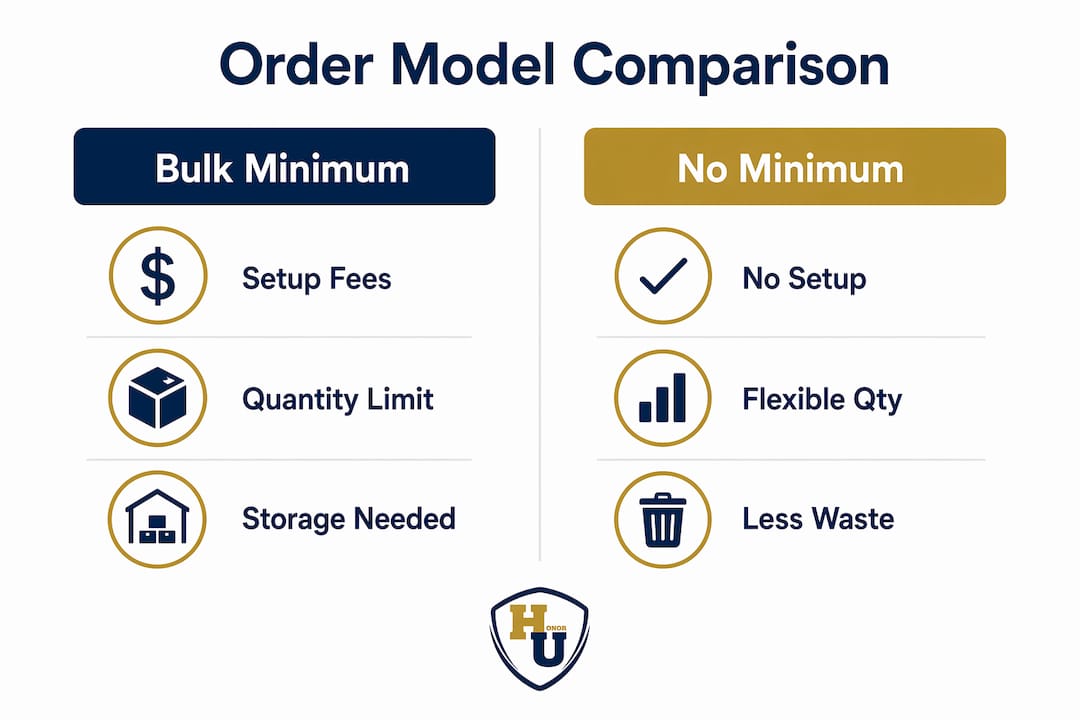
The most direct financial benefit of no minimum order covers is the elimination of warehousing and storage costs. When an institution orders 500 diploma covers for a class of 80, the remaining 420 units occupy shelf space, gather dust, and often become obsolete when branding changes. Ordering no minimum covers eliminates the need to forecast print volumes and removes the risk of discarded, outdated materials entirely.
The cost math behind this is worth understanding clearly. Offset printing becomes cost-effective only when print runs exceed approximately 4,200 units. That threshold is far beyond what any school, nonprofit, or HR department needs for a typical recognition event. Digital print-on-demand technology closes the per-unit cost gap for small runs, making it genuinely economical to order 10 covers or 10,000 covers through the same production process.
Organizations that adopt no minimum ordering also avoid a less obvious cost: inventory taxes and obsolescence liabilities. Companies avoid inventory bloat and storage costs by switching to on-demand models, freeing capital for higher-priority spending. For a small nonprofit or a homeschool co-op, that freed capital is not a minor accounting detail. It is the difference between affording professional presentation materials and going without.
Here is a practical breakdown of where the savings appear:
- No setup fees: Wehonoru charges $0 in setup fees, compared to the $50–$150 industry standard at traditional print suppliers.
- No storage overhead: Covers are produced and shipped immediately, so no warehouse space is consumed.
- No obsolescence risk: If your institution updates its logo or rebrands, you are not stuck with a closet full of outdated covers.
- No forecasting errors: Order exactly what the event requires, nothing more.
- Free shipping threshold: Orders over $30 ship free through Wehonoru, making even small orders cost-efficient.
Pro Tip: If your organization holds multiple small recognition events throughout the year, place separate no minimum orders for each event rather than one large annual order. You get fresher materials, accurate quantities, and zero leftover inventory.
| Cost Factor | Bulk Minimum Order Model | No Minimum Order Model |
|---|---|---|
| Setup fees | $50–$150 per order | $0 |
| Minimum quantity | 25–100 units typical | 1 unit |
| Storage required | Yes, often months | None |
| Obsolescence risk | High | None |
| Per-unit cost at small runs | High | Competitive |
How do no minimum covers maintain professional quality?
A common concern about small-batch printing is that quality suffers when volume drops. That concern is outdated. Modern professional digital printing equipment delivers resolution and finish rivaling traditional offset printing, even for orders as small as one unit. The quality gap between offset and digital has effectively closed for presentation-grade products like diploma covers and certificate holders.

Wehonoru’s tent-style covers use metallic foil printing for logos, institutional names, and custom text. Foil printing is a finishing technique that applies a thin metallic layer to specific areas of the cover surface, producing a reflective, prestige appearance that reads as premium to anyone who handles the document. This finish is available on every order, regardless of quantity. A single cover ordered for one graduate receives the same foil treatment as a bulk order for an entire university class.
Brand consistency is a second quality dimension that no minimum ordering actually improves, not compromises. Presentation covers serve as tangible branding tools that reinforce organizational standards. When an institution orders only what it needs for a specific event, every cover in that batch reflects the current logo, current color palette, and current institutional identity. Bulk orders placed months in advance often arrive with branding that is already slightly out of date.
The role of the cover itself in the ceremony experience deserves direct attention. A diploma or certificate placed inside a well-made, foil-printed cover communicates that the institution takes the achievement seriously. That physical signal matters to graduates, their families, and the organizations presenting the documents. Presentation covers build internal cohesion and serve as a living example of an organization’s professional standards to both staff and recipients.
“A high-quality, custom-branded presentation folder signals value and attention, enhancing professional perception in competitive, high-stakes settings. Presentation covers serve as tangible branding tools that reinforce organizational standards.” Custom Printed Folders Benefits
Pro Tip: For graduation ceremonies, choose a cover color that complements your institution’s official colors. Wehonoru offers five color options in tent-style format, so matching institutional branding is straightforward even on a single-unit order.
For organizations managing student engagement and recognition programs, custom-branded document covers consistently rank among the most valued physical recognition items, reinforcing the significance of the achievement beyond the ceremony itself.
What practical scenarios drive the choice to order covers without limits?
The benefits of no minimum covers become most visible when you map them against real organizational situations. The following scenarios represent the most common cases where no minimum ordering solves a genuine problem.
-
Small graduating classes. A homeschool co-op graduating 12 students has no use for a 50-unit minimum. No minimum ordering means each of those 12 graduates receives a professional cover without the institution paying for 38 unused units.
-
Last-minute ceremony planning. Wehonoru ships orders the next business day. When a school realizes two weeks before graduation that it needs covers, a no minimum order placed Monday arrives by Wednesday without expedited shipping fees.
-
Pilot programs and new recognition initiatives. A corporate HR team launching an employee-of-the-quarter program for the first time does not know how many covers it will need annually. Ordering 10 covers for the first quarter costs nothing extra and creates no inventory risk.
-
Segmented audiences requiring different cover designs. A university with separate undergraduate and graduate ceremonies may want different cover designs for each group. No minimum ordering allows two separate custom orders of exactly the right quantity for each audience, with no penalty for splitting the order.
-
Individual milestone recognition. A parent ordering one cover for a homeschool graduate, a couple ordering one marriage certificate holder, or a fitness studio ordering three personal training certification covers all benefit equally from no minimum access. These buyers have no path to professional presentation under a bulk minimum model.
-
Government and military recognition events. Military installations and government agencies often present commendations and achievement certificates in small batches at irregular intervals. No minimum ordering matches that unpredictable cadence without forcing large advance purchases.
-
Religious and community organizations. A church presenting confirmation certificates to 15 students, or a youth organization honoring 8 Eagle Scouts, needs exactly that quantity. No minimum ordering serves these organizations with the same professionalism available to large institutions.
Agility in print production allows teams to fulfill immediate opportunities with quick turnaround times, often within 48–72 hours. That speed, combined with no quantity floor, makes no minimum ordering the practical default for any organization whose recognition needs are event-driven rather than volume-driven.
How do no minimum covers compare to minimum order requirements?
Understanding the rationale behind minimum order quantity policies clarifies why no minimum ordering represents a genuine structural advantage, not just a marketing claim. Minimum order quantity policies typically exist to streamline production and reduce per-unit cost for the supplier, not the buyer. They transfer the burden of production efficiency onto the customer in the form of forced volume.
No minimum ordering shifts that dynamic. The supplier absorbs the production complexity through digital print-on-demand workflows, and the buyer orders exactly what the event requires. Print-on-demand workflows significantly reduce waste and storage needs by producing only what is ordered, minimizing obsolete printed materials. That waste reduction has a measurable environmental dimension as well. Print-on-demand reduces over 30% of printed marketing materials becoming unused or outdated, lowering paper waste and environmental impact compared to bulk print models.
The table below compares the two ordering models across the dimensions that matter most to organizations managing recognition events.
| Attribute | Minimum order model | No minimum order model |
|---|---|---|
| Quantity flexibility | Restricted to minimums of 25–100 units | Order 1 to 1,000+ units |
| Upfront cost | High, tied to minimum quantity | Low, pay only for what you need |
| Inventory risk | High, excess stock common | None |
| Branding currency | Risk of outdated materials | Always current |
| Sustainability | Higher waste from overproduction | Lower waste, on-demand production |
| Speed to delivery | 5–10 business days typical | Next business day with Wehonoru |
| Setup fees | $50–$150 industry standard | $0 with Wehonoru |
The financial and logistical case for no minimum ordering is strongest for organizations that hold recognition events fewer than four times per year or whose class and cohort sizes vary significantly between cycles. For those buyers, a minimum order model creates chronic overstock. A no minimum model creates none.
For a deeper look at how presentation covers matter for diplomas and certificates, Wehonoru’s resource library covers the full range of quality, format, and customization considerations.
Key Takeaways
No minimum order covers are the most cost-efficient and flexible choice for organizations and individuals managing small-quantity, high-impact document presentation needs like graduations and certifications.
| Point | Details |
|---|---|
| No minimum eliminates waste | Ordering only what you need removes excess inventory, storage costs, and obsolescence risk. |
| Digital print quality matches offset | Modern print-on-demand equipment delivers professional, foil-quality results on orders as small as one unit. |
| Cost savings are structural | Zero setup fees and no minimum quantity requirements reduce total order cost significantly versus bulk models. |
| Flexibility serves diverse needs | From single graduates to small cohorts, no minimum ordering fits every recognition scenario without penalty. |
| Sustainability improves | On-demand production reduces unused printed materials, lowering paper waste compared to bulk ordering. |
The case for rethinking bulk ordering in recognition programs
Working with organizations across education, healthcare, and corporate HR, I have seen the same pattern repeat itself: an institution places a large bulk order to capture a per-unit discount, then spends the next 18 months trying to use up covers that no longer match their current branding. The discount that looked attractive at the time of purchase quietly evaporates when you factor in storage space, the staff time spent managing inventory, and the eventual cost of discarding outdated materials.
The shift to no minimum ordering is not simply a convenience upgrade. It is a structural correction that aligns purchasing behavior with actual organizational needs. Recognition events are not predictable at the volume level. Class sizes change. Programs launch and wind down. Branding evolves. A no minimum model accommodates all of that without requiring the organization to absorb the cost of its own uncertainty.
The quality argument against small-batch printing no longer holds up in 2026. The equipment producing Wehonoru’s foil-printed covers operates at a resolution and finish level that is indistinguishable from traditional offset output. I have handled covers from both production methods side by side, and the difference is not visible to the recipient. What is visible is whether the cover looks professional and whether it fits the document. Both of those outcomes are fully achievable on a single-unit order.
My recommendation to any decision-maker still defaulting to bulk ordering out of habit: calculate your actual usage rate from the last two years. If you discarded or stored more than 15% of your last order, you are subsidizing your supplier’s production efficiency at your own expense. No minimum ordering puts that money back where it belongs.
— Manager
Professional no minimum diploma covers from Wehonoru
Wehonoru offers classic tent-style diploma covers with no minimum order quantity, metallic foil printing, and next-business-day production. Whether you need one cover for a homeschool graduate or 50 for a corporate recognition ceremony, the ordering process is identical and the per-unit quality is the same.

For graduation events with a specific class year, the Class of graduation cover is available in multiple colors with custom foil text and institutional branding. Orders over $30 ship free. Setup fees are $0. The full no minimum order diploma cover resource explains how schools and organizations of every size use Wehonoru to present achievements with the professionalism they deserve, without the bulk commitment they do not need.
FAQ
What does “no minimum order” mean for diploma covers?
No minimum order means you can purchase as few as one diploma cover without a quantity restriction or penalty. Wehonoru accepts orders starting at a single unit with the same pricing structure and production quality as bulk orders.
Is the print quality lower on small no minimum orders?
Print quality on no minimum orders is not lower than on bulk orders. Modern digital printing equipment delivers professional-grade resolution and metallic foil finishes on orders of any size, including single-unit orders.
Why do some suppliers require minimum order quantities?
Minimum order quantity policies exist to reduce per-unit production costs for the supplier, not the buyer. They shift the burden of production efficiency onto the customer through forced volume commitments.
Are no minimum covers more sustainable than bulk orders?
No minimum covers produce less waste because only the required quantity is printed. Print-on-demand reduces over 30% of printed materials becoming unused or outdated compared to bulk print models.
How quickly can I receive no minimum diploma covers?
Wehonoru ships no minimum orders the next business day after placement. That production speed makes no minimum ordering practical even for last-minute graduation ceremonies and recognition events.