
Choosing the Right Document Cover for Diplomas

TL;DR:
- Choosing the correct document cover involves matching size, material, and safety standards to ensure long-term preservation and professional presentation. Precise measurement of the actual document, not just the paper size, is essential to prevent damage and ensure a proper fit. Selecting archival-safe, acid-free materials with appropriate finishes and design principles enhances both durability and visual impact for any formal credential.
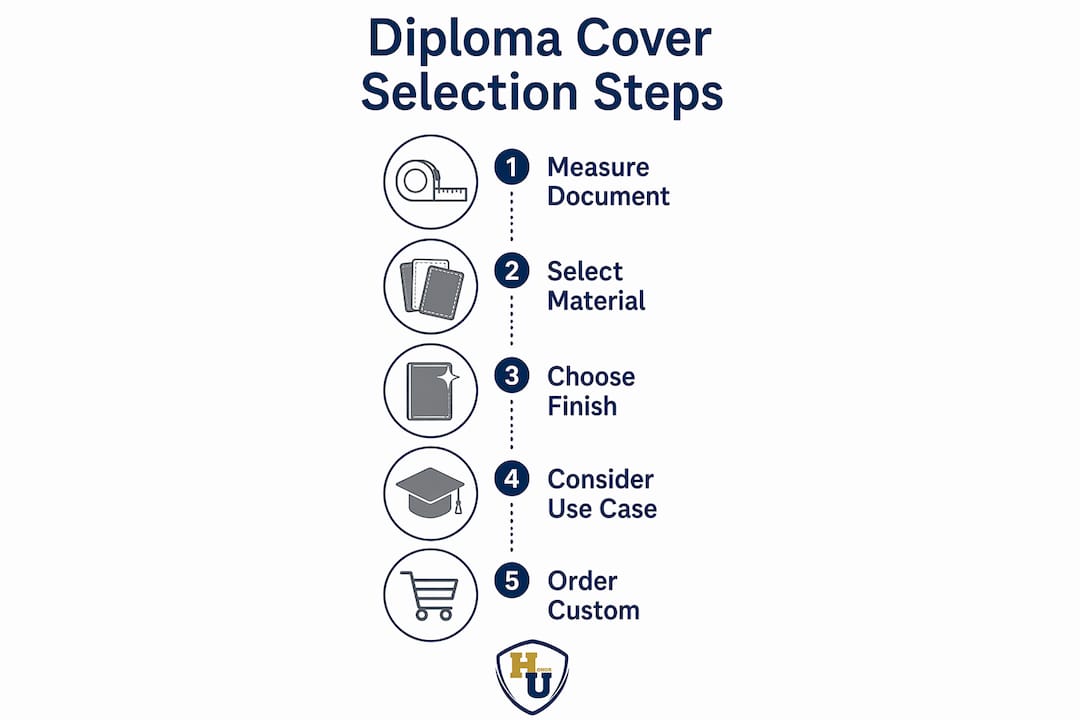
Choosing the right document cover is the process of matching a protective and presentational enclosure to the specific size, material requirements, and intended use of a diploma, certificate, or formal document. The industry term for this category is presentation cover or certificate holder, and selecting the correct one determines whether your document survives decades of storage or arrives at a ceremony looking polished and professional. A mismatched cover causes creasing, chemical degradation, and a presentation that undermines the significance of the achievement it contains. This guide covers size standards, material chemistry, archival safety, design principles, and use-case matching so you can make a confident, informed decision.
What sizes of document covers fit diplomas and certificates best?
Diploma sizes follow regional standards that directly determine which cover will fit without creasing or leaving excess space. Getting this measurement right is the single most consequential step in the selection process, because a cover that is even a quarter-inch too small will buckle the document, while one that is too large allows the diploma to shift and fold during transport or display.
The three dominant size standards are:
- 8.5 x 11 inches: The standard for most North American high school and undergraduate diplomas.
- A4 (210 mm x 297 mm): The international standard used across Europe, Asia, and most of the world outside North America.
- 11 x 14 inches: Common for professional degrees in medicine, law, and architecture, as well as many state-issued licenses.
Common diploma sizes for North America are 8.5 x 11 inches and A4 for international documents, with some professional degrees reaching 11 x 14 inches. This means a single institution may need covers in two or three different sizes if it serves both domestic and international graduates or issues multiple credential types.
Pro Tip: Measure the actual printed document, not the paper it was printed on. Many diplomas use decorative borders that extend to the paper edge, so the visible content area may differ from the nominal sheet size. Always measure width first, then height, and add at least 0.25 inches of clearance on each side when selecting a cover.
Mismatched sizing causes more than aesthetic problems. Not matching cover size to document leads to damage and devaluation over time, particularly when the document is repeatedly inserted and removed. For organizations ordering in bulk, confirming the exact dimensions of each credential type before placing an order prevents costly reprints and replacement covers.
| Document Type | Standard Size (US) | Standard Size (International) |
|---|---|---|
| High school diploma | 8.5 x 11 in | A4 (210 x 297 mm) |
| Undergraduate degree | 8.5 x 11 in | A4 (210 x 297 mm) |
| Professional degree (law, medicine) | 11 x 14 in | A3 (297 x 420 mm) |
| Trade or vocational certificate | 8.5 x 11 in | A4 (210 x 297 mm) |
| Military commendation | Custom (varies) | Custom (varies) |
For non-standard documents, made-to-fit custom sizing is the only reliable solution. Wehonoru produces covers to exact custom dimensions, which is a capability most standard suppliers cannot offer without significant lead times or minimum order requirements.
Which materials and finishes are best for document covers?
The material of a document cover determines its durability, its chemical compatibility with the paper inside, and the overall impression it makes when presented. The two most common synthetic options are PVC (polyvinyl chloride) and polypropylene, while paper-based and cardstock covers serve different functional and aesthetic priorities.
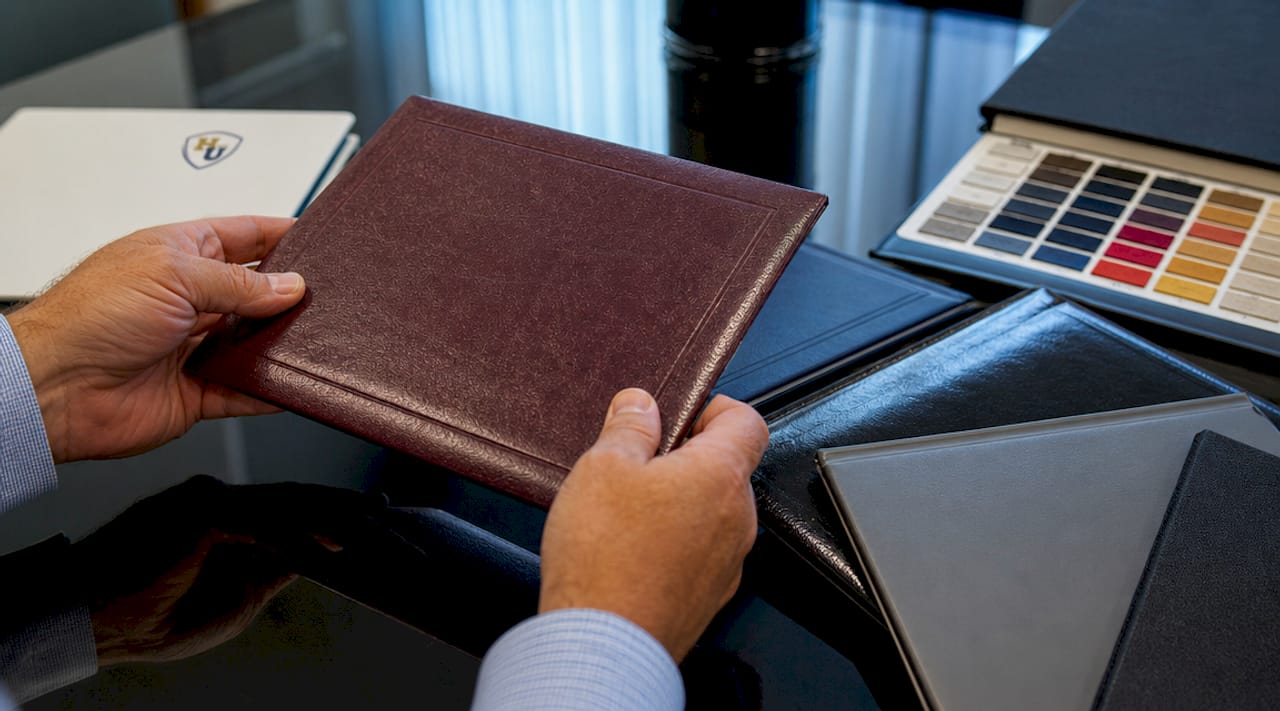
PVC and polypropylene cover sheets are waterproof, tear-resistant, and available in thicknesses typically ranging from 8 to 12 mil for document presentations. This range matters because an 8-mil cover offers flexibility and a lighter feel, while a 12-mil cover provides rigid protection suitable for mailing or repeated handling. Polypropylene is generally preferred over PVC for archival use because PVC can off-gas chlorine compounds over time, which accelerates paper degradation.
Paper and cardstock covers offer a different set of advantages. They accept metallic foil printing, embossing, and custom color finishes that synthetic covers cannot replicate with the same crispness. For graduation ceremonies and formal recognition events, a premium cardstock cover with foil-stamped text conveys prestige in a way that a clear plastic sleeve simply cannot. The trade-off is that cardstock requires additional protective sleeves for long-term storage or transport.
Key material considerations when selecting a cover:
- Acid content: Paper-based covers must be acid-free to avoid transferring acidity to the document inside.
- Thickness: Measured in mil (thousandths of an inch) for plastic or points (pt) for cardstock; 80 pt to 100 pt cardstock is standard for premium diploma covers.
- Finish: Matte, gloss, linen texture, and leatherette finishes each communicate a different level of formality.
- Binding compatibility: Covers must be compatible with the binding method used, whether that is a tent-style fold, a spine binding, or a simple sleeve.
Pro Tip: For organizations that display credentials in patient-facing or client-facing environments, such as medical offices or law firms, choose a polypropylene or premium cardstock cover rather than standard PVC. The visual quality and chemical safety of these materials better reflect the professional standards of those settings.
| Material | Waterproof | Archival Safe | Custom Print | Best Use |
|---|---|---|---|---|
| PVC | Yes | No | Limited | Short-term presentation |
| Polypropylene | Yes | Yes | Limited | Transport and storage |
| Acid-free cardstock | No | Yes | Yes | Ceremony and display |
| Buffered paper board | No | Yes | Yes | Long-term archival storage |
How do archival-safe qualities influence document cover selection?
Archival safety is not a marketing term. It is a measurable chemical property that determines whether a cover will preserve or slowly destroy the document it contains. Acid-free, lignin-free, and buffered materials help prevent yellowing and brittleness in stored documents, and archival-safe covers greatly extend document lifespan by minimizing chemical degradation.
The core chemistry is straightforward. Paper naturally contains acids that cause it to yellow and become brittle over time. A cover made from acidic materials accelerates this process by transferring additional acidity to the document surface. An acid-free cover stops this transfer. A buffered cover goes further by incorporating an alkaline reserve, typically calcium carbonate, that actively neutralizes acids migrating from the document itself.
Buffered archival boxes with an alkaline reserve neutralize acids and slow yellowing and brittleness of paper-based documents, and different documents require buffered or unbuffered storage materials depending on their chemical sensitivity. This distinction matters for organizations managing large collections: photographs and certain dyed papers should not be stored in buffered materials because the alkalinity can damage their colorants, while standard text-based diplomas and certificates benefit directly from buffered protection.
Archival standard to know: The Photographic Activity Test (PAT), defined by ISO 18916, is the recognized benchmark for evaluating whether a storage material is safe for long-term contact with photographic and paper-based documents. When selecting covers for documents intended to last decades, look for materials that meet or reference PAT compliance.
Environmental conditions compound the effect of material choice. Humidity above 50% accelerates mold growth and paper expansion, while direct light exposure causes fading and surface degradation. The cover you select should account for the storage environment, not just the document type. A polypropylene sleeve inside a buffered cardstock cover provides both chemical protection and a physical barrier against humidity fluctuation.
For interior linings, avoid covers with foam padding made from polyurethane, which off-gasses over time. Polyethylene foam or cotton-based interiors are the archivally safe alternatives. Selection of archival-safe materials is as much about preservation as it is about style, and covering or framing choices should consider document lifespan as a primary criterion, not an afterthought.
What design principles should guide a professional cover page?
A professional cover page serves one purpose: to identify the document clearly and signal its importance before the reader opens it. Professional cover pages emphasize a clear title hierarchy, minimal supporting metadata, limited font choices, and intentional spacing to improve readability and convey competence. Overly decorative or text-heavy covers harm professionalism and reader focus.
The essential metadata elements for any formal document cover are:
- Title: The name of the credential, report, or document. This should be the largest and most visually prominent element.
- Subtitle or credential type: For example, “Bachelor of Science in Mechanical Engineering” beneath a university name.
- Recipient name: Centered and clearly legible, in a font size that distinguishes it from supporting text.
- Issuing organization: The institution, company, or agency granting the credential.
- Date: The conferral or issue date, placed at the bottom of the cover in a smaller but readable size.
Typography choices carry significant weight. Using more than two typefaces on a single cover page creates visual noise. A serif font such as Garamond or Times New Roman paired with a clean sans-serif for metadata communicates tradition and clarity simultaneously. Alignment should be consistent throughout: centered layouts suit formal diplomas, while left-aligned layouts work better for corporate presentation folders.
Software tools like Microsoft Word, Google Docs, LaTeX, and Adobe InDesign each affect how effectively you can create structured, stable, and professional document cover pages. Word and Google Docs are accessible for most users, but InDesign and LaTeX offer superior control over typography and layout precision for high-volume or print-ready production. Proper use of section breaks in Word prevents header and footer elements from bleeding onto the cover page, which is a common formatting error that undermines an otherwise polished document.
Minimalist cover design enhances professional perception by focusing the reader’s attention on essential metadata rather than decorative elements. For physical diploma covers, this principle translates directly to foil-stamped text on a clean background rather than complex graphic patterns that compete with the document’s content.
Pro Tip: When ordering custom-printed covers for an institution, request a physical proof before approving a bulk run. Digital proofs do not accurately represent foil color, embossing depth, or cardstock texture. A single physical sample prevents costly reprints across an entire graduating class.
How to match document covers with their intended use case
The right cover for a graduation ceremony is not necessarily the right cover for long-term archival storage or for mailing a diploma across the country. Matching the cover to its primary use case prevents both over-engineering and under-protecting your document.
For presentation and ceremony use, the priority is visual impact. Tent-style covers with metallic foil printing, premium cardstock construction, and a clean interior lining create the heirloom feel appropriate for a graduation stage or an employee recognition event. These covers are designed to be opened, displayed, and photographed, so their exterior finish and structural integrity during handling matter most.
For mailing and transport, protection takes precedence over aesthetics. When mailing diplomas, cushioned or padded covers protect against damage during transit, and transport exposure accelerates document degradation and increases risk of damage. A polypropylene sleeve inside a rigid mailer, or a padded cardstock cover with a secure closure, provides the physical buffer that standard covers cannot. Organizations mailing credentials to remote graduates or international recipients should treat transport protection as a non-negotiable specification.
For long-term storage, the archival material standards described earlier apply fully. The cover must be acid-free, the interior lining must be chemically inert, and the storage environment must be controlled for humidity and light. A document intended to be preserved for 50 or more years requires a fundamentally different cover than one used for a single presentation event.
Practical considerations for organizations ordering in volume:
- Bulk pricing: Most suppliers offer tiered discounts at quantities of 25, 50, and 100 units. Wehonoru applies automatic bulk discounts without requiring a separate quote process.
- Customization scope: Determine whether you need institutional logos, foil colors, or pre-phrased text before selecting a supplier, as not all manufacturers support full custom printing at low minimums.
- Binding compatibility: Confirm that the cover format, whether tent-style, spine-bound, or sleeve, is compatible with how the document will be stored or displayed after the event.
| Use Case | Cover Priority | Recommended Material | Key Feature |
|---|---|---|---|
| Graduation ceremony | Visual impact | Premium cardstock with foil | Tent-style fold, metallic finish |
| Mailing to recipient | Physical protection | Polypropylene or padded board | Cushioned interior, secure closure |
| Long-term archival storage | Chemical safety | Acid-free, buffered board | PAT-compliant lining |
| Corporate recognition event | Brand consistency | Custom-printed cardstock | Logo foiling, institutional colors |
| Medical or legal display | Professional credibility | Polypropylene or linen cardstock | Durable, clean finish |
For a detailed walkthrough of diploma folder selection and customization, Wehonoru’s resource library covers fit, material, and style considerations in depth.
Key takeaways
Choosing the right document cover requires matching size, material chemistry, archival safety, and use case to the specific document and its intended purpose.
| Point | Details |
|---|---|
| Size accuracy is foundational | Measure the actual document before ordering; mismatched sizes cause creasing and long-term damage. |
| Material chemistry matters | Polypropylene and acid-free cardstock outperform standard PVC for both safety and presentation quality. |
| Archival safety is measurable | Look for acid-free, lignin-free, and buffered materials; PAT compliance is the recognized benchmark. |
| Design should be minimal | Limit cover pages to five metadata elements and two typefaces to maintain professional clarity. |
| Match cover to use case | Ceremony covers prioritize visual impact; transport covers prioritize padding; storage covers prioritize chemical inertness. |
What experience with diploma covers actually teaches you
Having worked closely with the diploma and certificate cover category across education, healthcare, and corporate recognition contexts, the pattern I see most consistently is this: buyers focus on appearance and ignore chemistry, then wonder why a beautifully printed cover has left a faint yellow stain on a diploma after three years in a drawer.
The second most common mistake is ordering by nominal paper size rather than measuring the actual document. A university that prints diplomas on 8.5 x 11 paper with a half-inch decorative border on all sides has an effective document area of 7.5 x 10 inches. A standard 8.5 x 11 cover fits the paper but leaves the document floating inside with room to shift and fold. Measuring the document, not the paper, is the correction that most buyers only make after their first bad experience.
For organizations, the calculus between personal and institutional priorities shifts in one important way: consistency. An individual buying a single cover for a personal diploma can optimize entirely for their own preferences. An institution ordering covers for 400 graduates must optimize for a presentation standard that looks uniform across every recipient, holds up through a two-hour ceremony, and survives being carried home in a car. That requires a cover with structural rigidity, a secure closure, and a finish that photographs consistently under stage lighting.
My consistent recommendation is to invest in archival-safe, custom-printed covers even when the budget pressure is toward the cheapest option available. The cost difference between a standard cover and an acid-free, foil-printed cover is measured in dollars. The cost of replacing a degraded diploma or reprinting a damaged certificate is measured in time, institutional credibility, and the recipient’s frustration. The cover for diploma decision is not a commodity purchase. It is a preservation decision that reflects directly on the organization making it.
After the cover is selected and the document is presented, maintenance is straightforward: store flat in a climate-controlled environment away from direct light, avoid stacking heavy objects on top of the cover, and use a clean cotton glove when handling the document itself. These habits extend the life of both the cover and the credential it protects.
— Manager
Professional document covers from Wehonoru
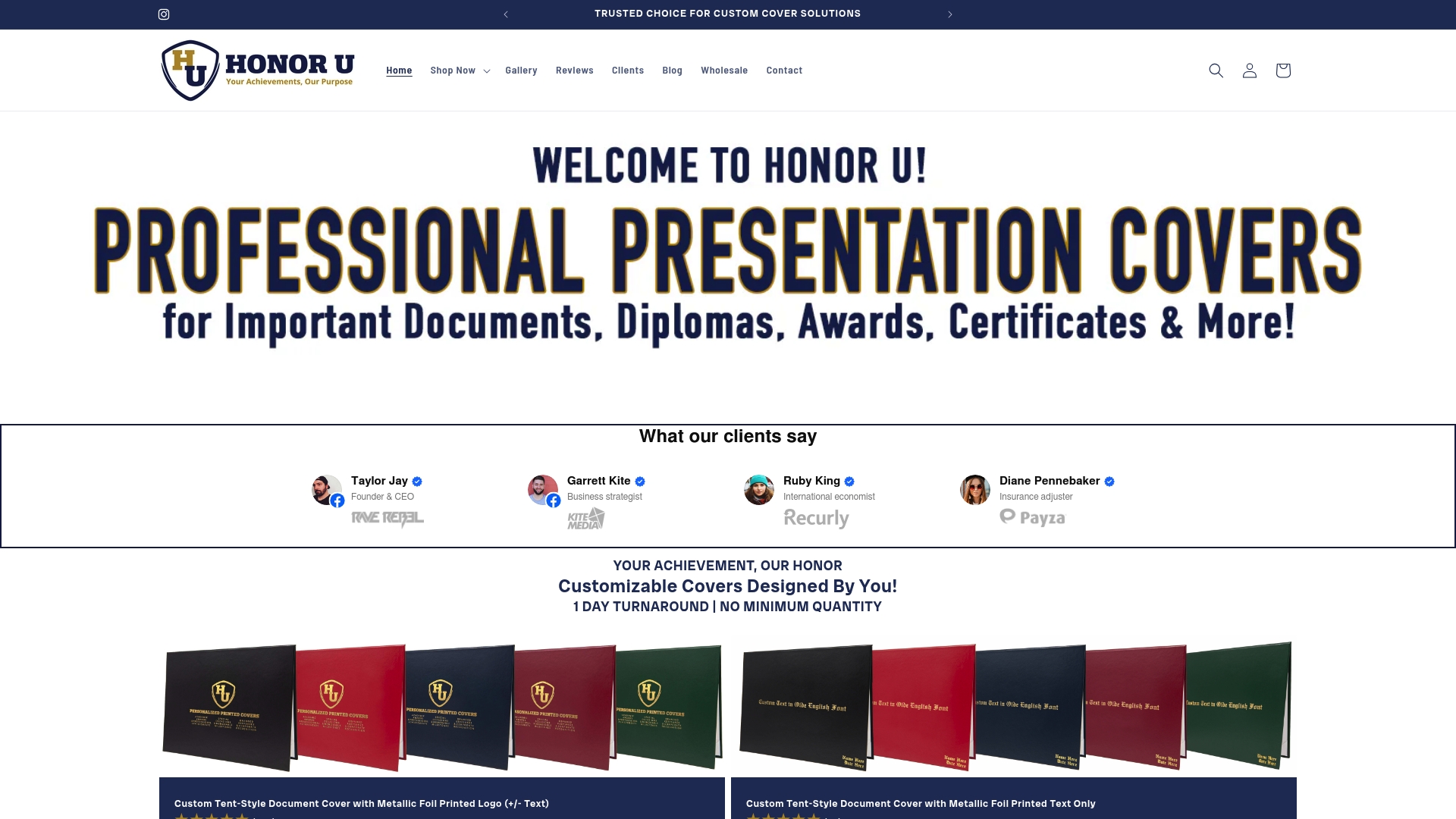
Wehonoru designs and produces tent-style diploma and certificate covers built for exactly the decisions this article describes. Every cover ships with a 1-business-day production turnaround, no minimum order quantity, and free shipping on orders over $30. Materials are selected for both presentation quality and archival compatibility, with metallic foil printing available in multiple colors to match institutional branding.
For graduation ceremonies, the classic graduation document cover delivers the structured, foil-stamped presentation that marks the occasion with appropriate prestige. High school programs can choose the high school diploma cover designed specifically for standard North American diploma dimensions. Organizations ordering for multiple recipients benefit from automatic bulk pricing with no setup fees, making professional presentation accessible at any scale.
FAQ
What is the standard size for a diploma cover in the US?
The standard size for most North American diploma covers is 8.5 x 11 inches, with 11 x 14 inches used for professional degrees in law and medicine. Always measure the actual document before ordering to confirm the correct fit.
What does acid-free mean for document covers?
Acid-free means the cover material has a pH of 7.0 or higher and contains no acidic compounds that would transfer to and degrade the document inside. Acid-free covers prevent the yellowing and brittleness that standard paper-based covers cause over time.
What is the difference between a presentation cover and a storage cover?
A presentation cover prioritizes visual impact through premium finishes, foil printing, and structural rigidity for handling during ceremonies. A storage cover prioritizes chemical inertness, buffered materials, and a sealed interior to protect the document from environmental degradation over decades.
Can I order a single custom diploma cover without a minimum quantity?
Wehonoru accepts orders for a single unit with no setup fees, which is uncommon in the industry where many suppliers require minimums of 25 to 100 units. This makes custom covers accessible for individuals honoring a single graduate as well as for institutions testing a new design.
Which software is best for creating a professional cover page?
Microsoft Word and Google Docs are accessible for most users, while Adobe InDesign and LaTeX provide superior typographic control for print-ready production. Using section breaks in Word prevents header and footer elements from appearing on the cover page, which is the most common formatting error in document cover design.
Recommended
- Graduation certificate cover explained: protect and personalize | Honor U
- How diploma holders protect documents: Security and authenticity | Honor U
- Custom diploma cover guide: tailored solutions for 2026 | Honor U
- Cover for Diploma: Complete Guide to Choosing and Customizing Diploma Covers | Honor U