
How diploma holders protect documents: Security and authenticity

TL;DR:
- A diploma symbolizes years of effort but faces increasing risks of forgery, environmental damage, and digital fraud.
- Combining physical security features, premium presentation materials, and digital verification systems ensures long-term credential integrity and authenticity.
A diploma represents years of effort, sacrifice, and achievement. Yet many graduates and institutions treat it as though it were simply a piece of paper that needs a nice frame. The reality is more serious: credential forgery is a documented and growing problem in the U.S., environmental damage can degrade printed documents within years, and gaps in digital verification systems can leave even legitimate credentials vulnerable to dispute. Understanding how diploma holders protect documents, from physical materials to digital authentication, is not a bureaucratic concern. It is a practical necessity for graduates, educational institutions, and event coordinators who want those credentials to remain credible and presentable for a lifetime.
Table of Contents
- Understanding the risks: Why diploma protection matters
- Physical security features: More than a diploma cover
- Digital verification: QR codes, cryptography, and real-time checks
- Common vulnerabilities and advanced protection strategies
- Choosing the right diploma protection: For graduates and organizers
- What most diploma protection advice misses
- Next steps: Secure and present your diplomas with confidence
- Frequently asked questions
Key Takeaways
| Point | Details |
|---|---|
| Layered security works best | Combining physical and digital verification offers the strongest protection against forgeries and tampering. |
| Digital verification adds trust | QR codes and cryptographic methods make diploma authenticity checking instant and reliable. |
| Continuous validation is essential | Diplomas require ongoing verification to stay valid—don’t rely on a one-time check. |
| Presentation and protection go hand-in-hand | Using premium covers or frames does more than look good—it preserves and secures documents for years. |
| Customize for your needs | Select protections based on risk, ceremony style, and long-term value for graduates and institutions. |
Understanding the risks: Why diploma protection matters
Most people picture diploma protection as simply slipping a certificate into a folder and calling it done. That picture misses the full scope of what can go wrong. The risks facing a diploma fall into several distinct categories, each requiring a different layer of defense.
Forgery and tampering are more common than most institutions acknowledge. Fraudulent credentials are submitted for job applications, graduate school admissions, and professional licensing every year. A diploma printed on standard paper with no security features is trivially easy to reproduce with modern printing equipment.
Environmental damage is a slower but equally destructive threat. Ultraviolet light fades ink and paper over time, humidity causes warping and mold, and even brief exposure to water can render a document illegible. A diploma stored in an attic, a car trunk, or an unregulated storage unit may deteriorate within a decade.
Casual tampering covers a range of scenarios: altered graduation dates, changed names, modified GPA notations, or forged institutional seals. Without embedded security features, these alterations can be nearly undetectable to the untrained eye.
The industry response to these risks has moved well beyond simple covers. Customizing diploma folders is one part of a broader, layered approach to document protection that institutions are increasingly adopting. As research confirms, layered physical security features including watermarks, holographic elements, embossed seals, and microprinting are now standard practice at universities that take credential integrity seriously.
Key risks that every graduate and institution should account for:
- Forgery: Reproduction of diplomas using consumer-grade printing technology
- UV degradation: Fading of ink and paper from prolonged light exposure
- Moisture and humidity: Warping, mold growth, and ink bleeding
- Physical tampering: Alteration of text, dates, or institutional identifiers
- Digital fraud: Fabricated digital credentials submitted without a verifiable trail
- Revocation gaps: Credentials that remain in circulation after being rescinded
Now that the challenge is evident, let’s examine the types of protections graduates and institutions can choose.
Physical security features: More than a diploma cover
Physical protection is the first line of defense, and it operates on two levels: the document itself and the presentation materials surrounding it. Most people are familiar with the second level but underestimate the first.
Document-level security includes features embedded directly into the paper or printing process. Institutions protect diplomas with combinations of the following:
- Watermarks: Invisible or semi-visible logos that appear when held to light, produced during paper manufacturing and nearly impossible to replicate with standard printers
- Microprinting: Text so small it appears as a line to the naked eye but reveals legible words under magnification, making photocopied fakes immediately detectable
- Holographic foils: Reflective elements that shift color and pattern under different lighting angles, a feature that cannot be reproduced by standard inkjet or laser printers
- Embossed seals: Raised impressions pressed into the paper that create a tactile, three-dimensional mark of authenticity
- Security fibers: Colored threads embedded in the paper substrate, visible under UV light
Presentation-level protection addresses what happens after the document leaves the institution. This is where premium covers, archival-quality folders, and tent-style holders come into play. The right presentation material does more than look impressive at a ceremony. It shields the document from UV exposure, physical abrasion, and moisture contact during handling and storage.
| Protection type | Primary function | Best suited for |
|---|---|---|
| Archival-quality cover | UV and moisture barrier | Long-term storage and display |
| Tent-style certificate holder | Ceremony presentation and display | Recognition events and ceremonies |
| Holographic foil overlay | Visual anti-tamper indicator | High-stakes credentials |
| Embossed seal | Tactile authenticity mark | University and professional degrees |
| Microprinting | Forgery detection | Institutional diplomas |
| Lamination | Physical abrasion resistance | Frequently handled documents |
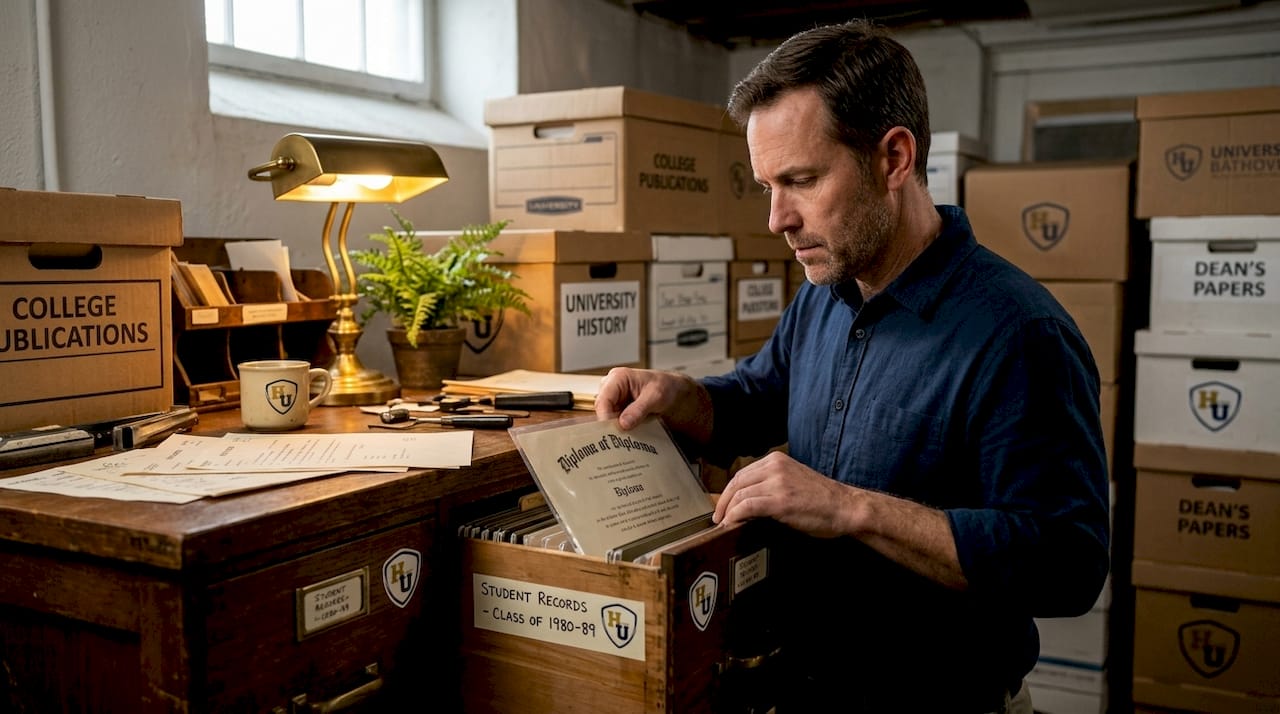
Understanding types of certificate folders helps institutions match the right presentation material to the right security level. There is also a meaningful distinction between a basic folder and a purpose-built holder, which the diploma cover vs folder comparison addresses in detail.
Pro Tip: Pair tamper-evident security paper with a premium archival presentation cover. The security paper protects authenticity, while the cover protects the physical document. Neither alone is sufficient for long-term protection of a high-value credential.
Physical features are one piece. Let’s see how digital innovations add another layer of safety.
Digital verification: QR codes, cryptography, and real-time checks
Digital verification has changed what it means to protect a diploma. Where physical features guard against visual forgery, digital systems guard against identity fraud, unauthorized duplication, and credential fabrication at scale.
The most widely adopted digital protection method in U.S. credentialing is the embedded QR code. Many U.S. credentialing approaches now include QR codes printed directly on diplomas and certificates, linking each document to an official authenticity check. An employer, admissions officer, or licensing board can scan the code and confirm the credential’s validity in seconds, without contacting the institution directly.
Beyond QR codes, more advanced systems use cryptographic methods to protect credential integrity. Best-practice digital protection shifts from simple record-keeping to cryptographic integrity, using digital signatures, unique identifiers, and validation services that confirm a document has not been altered since it was issued. This approach is common in medical credentialing, legal licensing, and graduate-level academic programs where the stakes of fraud are highest.
Blockchain-based credential systems take this further by recording each issued credential on a distributed ledger, making retroactive alteration mathematically infeasible. While blockchain adoption is still growing in U.S. higher education, it is already standard in several professional certification programs.
How QR and digital ID verification works in practice:
- The institution generates a unique credential record in its verification database at the time of issuance
- A QR code or unique alphanumeric ID linked to that record is printed on the physical diploma
- The graduate receives the physical document with the embedded verification element
- A verifier scans the QR code or enters the ID into the institution’s verification portal
- The portal returns the credential’s details, including name, degree, date of issue, and current validity status
- If the credential has been revoked or altered, the portal flags the discrepancy immediately
| Feature | Traditional diploma | Digitally verified diploma |
|---|---|---|
| Forgery detection | Visual inspection only | Instant database cross-check |
| Verification speed | Days (requires institution contact) | Seconds (self-service portal) |
| Revocation visibility | Not visible on document | Flagged in real time |
| Tamper evidence | Physical features only | Cryptographic signature |
| Remote verification | Not possible | Available globally |
For institutions building a document presentation folder program, integrating digital verification elements into the physical presentation is now considered a baseline expectation rather than an advanced feature. Understanding degree verification globally is also relevant for graduates who plan to work or study internationally, where verification standards vary considerably.
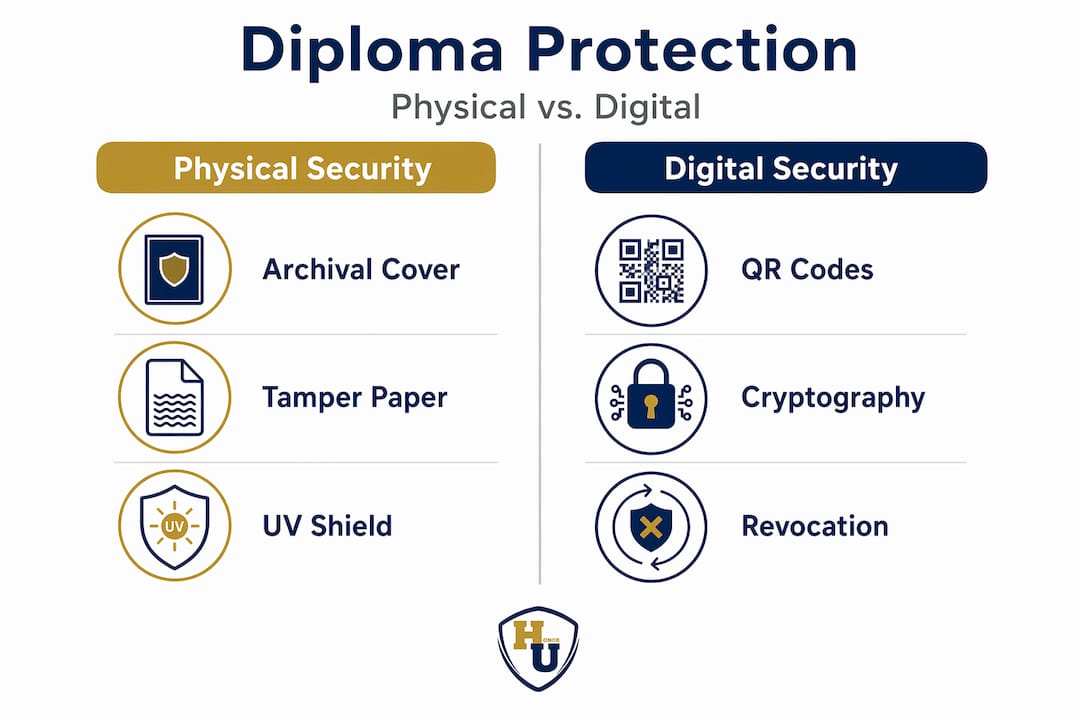
With rapid adoption of digital verification, it is important to understand the security nuances and what can go wrong.
Common vulnerabilities and advanced protection strategies
Even a well-designed credential protection system has failure points. Knowing where those gaps exist is what separates a genuinely secure credential program from one that only looks secure.
Post-issuance tampering is a risk that physical and digital systems handle differently. A physical diploma with microprinting and an embossed seal resists visual alteration well. But a digitally signed document can still be tampered with if the signing key is compromised or if the verification system does not check whether the signature remains valid under current trust policies. As continuous validation research confirms, digital credential security must account for post-signature tampering, revocation drift, and whether the verifying system checks trust policy and revocation status.
Revocation drift is a particularly underappreciated vulnerability. A credential may be revoked after issuance due to academic misconduct, licensing violations, or administrative errors. If the verification system does not actively check revocation status, a revoked credential may continue to pass verification checks indefinitely.
Validation system limitations include outdated trust lists, expired certificates in the signing chain, and verification portals that return a “valid” result based on a cached record rather than a live database query. These are technical failures, but their consequences are very real for institutions whose credentials are being misrepresented.
Even with cryptographic signatures, validation can fail if the credential is revoked and the policy is out of date. A credential that passed verification yesterday is not guaranteed to pass tomorrow.
Best practices for addressing these vulnerabilities include:
- Continuous validation: Implement verification systems that check revocation status and trust policy at the moment of each query, not at the time of issuance
- Trust list maintenance: Regularly update the certificate authority trust lists that underpin digital signatures
- Revocation monitoring: Establish clear internal workflows for revoking credentials and ensuring that revocation propagates to all verification channels promptly
- Physical and digital redundancy: Use both physical anti-tamper features and digital verification so that a failure in one layer does not leave the credential entirely unprotected
- Audit trails: Maintain logs of all verification events so that patterns of suspicious activity can be identified
Custom-size diploma covers are one example of how physical presentation can be tailored to match the specific security requirements of non-standard documents, including oversized institutional diplomas or specialty certifications that do not fit standard cover dimensions. For graduates considering online program credibility, the strength of the issuing institution’s verification infrastructure is a meaningful factor in how well a credential holds up to scrutiny over time.
Pro Tip: Do not assume a credential is permanently valid because it passed verification at issuance. Schedule periodic re-validation of digital credentials, particularly for credentials used in regulated industries like healthcare, law, and financial services.
Bringing together all these methods, how can you apply them or select the right ones for your ceremony or institution?
Choosing the right diploma protection: For graduates and organizers
Selecting the right combination of protections is not a one-size-fits-all decision. The appropriate approach depends on the type of credential, the audience it serves, the formality of the ceremony, and the long-term use case for the document. A high school honor roll certificate and a medical board certification have very different risk profiles and deserve different protection strategies.
A practical decision flow for graduates, institutions, and event coordinators:
- Assess the ceremony context. Is this a formal commencement, a corporate recognition event, or a small classroom ceremony? Higher-profile events call for more polished presentation materials and, often, more visible security features.
- Choose the right cover or folder. Match the presentation material to the document’s significance. Archival-quality covers with metallic foil printing convey prestige and provide physical protection simultaneously.
- Add physical security features at the document level. Work with your printing provider to include watermarks, embossed seals, or holographic elements appropriate to the credential type.
- Integrate digital verification. Embed a QR code or unique ID that links to a live verification portal. Confirm that the portal checks revocation status, not just issuance records.
- Plan for long-term preservation. Advise graduates on proper storage: cool, dry environments away from direct light, ideally in archival-quality covers that prevent UV and moisture damage.
As research on diploma presentation confirms, the most effective approach pairs premium physical presentation with verifiable authenticity mechanisms, rather than relying on appearance alone. A beautiful cover without security features is a presentation product. A secure document without quality presentation undermines the ceremony’s dignity. The two work best together.
Common mistakes to avoid:
- Relying solely on a decorative cover without any embedded security features
- Using standard paper for high-stakes credentials that will be verified repeatedly
- Implementing digital verification without a revocation management workflow
- Ignoring non-standard document sizes, which often end up in ill-fitting covers that damage the document over time
- Skipping long-term storage guidance for graduates, leaving documents vulnerable after the ceremony
For event coordinators, reviewing creating a memorable graduation ceremony with diploma covers offers practical guidance on elevating the presentation moment without sacrificing security. Graduates who want to display their credentials permanently should also consider framing your diploma as a long-term preservation step that complements the initial cover.
With clarity on practical selection, let’s consider what most articles won’t tell you about diploma protection.
What most diploma protection advice misses
Most guides on protecting educational credentials focus almost entirely on the visual. They recommend a nice frame, a quality cover, perhaps a UV-resistant sleeve. That advice is not wrong. It is just incomplete in ways that matter over time.
The deeper issue is that diploma protection is not a single event. It is an ongoing responsibility. A credential issued today may be verified five, ten, or twenty years from now, in contexts the issuing institution never anticipated. A QR code that links to a decommissioned server is worse than no QR code at all, because it actively signals a problem to the verifier. A physical cover that looked premium at the ceremony but was not archival-quality may have allowed UV damage to begin within the first year of display.
The most effective protection strategies are the ones that work quietly in the background. Visible security features like holographic foils and embossed seals serve a deterrent function. But invisible features, such as microprinting, cryptographic signatures, and live revocation checks, are what actually stop sophisticated fraud. As we see it:
The mark of true diploma protection is that most people hardly notice it. But it stops both fakes and failures.
There is also a gap in how institutions communicate protection responsibilities to graduates. Most graduates receive their diploma in a cover at the ceremony and are given no guidance on what to do next. They do not know to store it away from light, to keep a certified copy in a separate location, or to periodically check that any digital verification link associated with their credential still resolves correctly. That communication gap is an institutional responsibility, not just an individual one.
For graduates who want to take preservation seriously, investing in diploma frame preservation is a meaningful step that goes beyond the ceremony cover. It signals that the credential is worth protecting long-term, which is exactly the message a lifetime of hard work deserves.
Pro Tip: Periodically re-validate any digital credentials tied to your diploma, and invest in presentation materials whose quality matches the significance of the document. A credential that survives decades of scrutiny is the ultimate proof of its authenticity.
Next steps: Secure and present your diplomas with confidence
Protecting a diploma well means getting both layers right: the security features embedded in the document and the quality of the materials that present and preserve it. Honor U makes the second layer straightforward, whether you are a graduate looking for a single premium cover or an institution ordering custom-branded folders for an entire graduating class.

Honor U’s classic diploma covers are built from archival-quality materials with metallic foil printing that elevates the presentation moment while providing genuine UV and physical protection for the document inside. For institutions and event coordinators who need branded, custom-sized, or bulk orders, the full custom diploma covers collection offers made-to-fit solutions with a one-business-day turnaround and no minimum order quantity. Every order ships fast, looks exceptional, and honors the achievement it represents. Reach Honor U at 804-223-4339 or contact@wehonoru.com to discuss your ceremony needs.
Frequently asked questions
What are the best ways graduates can protect their diplomas after a ceremony?
Use archival-quality covers and store diplomas in a cool, dry place away from direct light. For added protection, choose covers with tamper-evident features, and keep a certified copy of the credential in a separate secure location. Layered physical security features at the document level, combined with quality storage, provide the most durable long-term protection.
How do QR codes on diplomas protect against forgeries?
A QR code links each diploma directly to an official verification database, allowing any employer, admissions office, or licensing board to confirm authenticity and owner details in seconds. Many U.S. credentialing programs now embed QR codes as a standard anti-forgery measure, replacing the slower process of contacting institutions directly.
Can digital diplomas be tampered with or revoked after issuing?
Yes. Digital credential security must account for post-signature tampering, revocation drift, and verification systems that do not check current trust policy. Continuous validation, not one-time verification, is the correct standard for high-stakes credentials.
What is the difference between a diploma cover and advanced document protection?
A diploma cover provides physical protection and presentation quality, shielding the document from UV exposure, moisture, and abrasion. Advanced document protection adds anti-forgery features such as microprinting and embossed seals, plus digital verification systems. Layered security features at both levels are what institutions with serious credential integrity programs deploy.
How can educational institutions ensure long-term validity of issued credentials?
Institutions should combine physical anti-tampering elements with digital systems that support ongoing trust policy validation and active revocation management. Best-practice verification is policy-aware, meaning it checks not only whether a credential was validly issued, but whether it remains valid under current institutional and regulatory policy at the moment of each verification request.