
Religious Certificate Types: A Complete Faith Guide

TL;DR:
- Religious certificates are official documents issued by faith communities to record sacraments, memberships, pilgrimages, or ministry authorizations. They serve as canonical records with spiritual and institutional significance, but are distinct from civil legal documents like marriage licenses. Proper management, verification, and preservation of these certificates are essential for maintaining their authority and honoring faith traditions.
Religious certificates are formal documents issued by faith communities to mark sacraments, memberships, pilgrimages, or ministry authorizations. Whether you are a parent requesting a baptism record, a clergy member verifying ordination credentials, or a congregation leader organizing confirmation records, understanding the different religious certificate types is the first step toward managing these documents with accuracy and confidence. These certificates carry both spiritual weight and institutional authority, functioning as canonical records that connect individuals to their faith tradition across a lifetime of milestones.
What are the main religious certificate types?
Religious certificates, sometimes called sacramental records or faith documents, fall into several distinct categories depending on the tradition, the rite being recognized, and the purpose the document serves. FamilySearch classifies religious records primarily by specific sacrament or rite types rather than broad generic labels, a practice that improves retrieval accuracy and reduces administrative confusion. This approach reflects a broader truth: precision in categorization matters, because a baptism certificate and a confirmation certificate serve different canonical functions even within the same denomination.
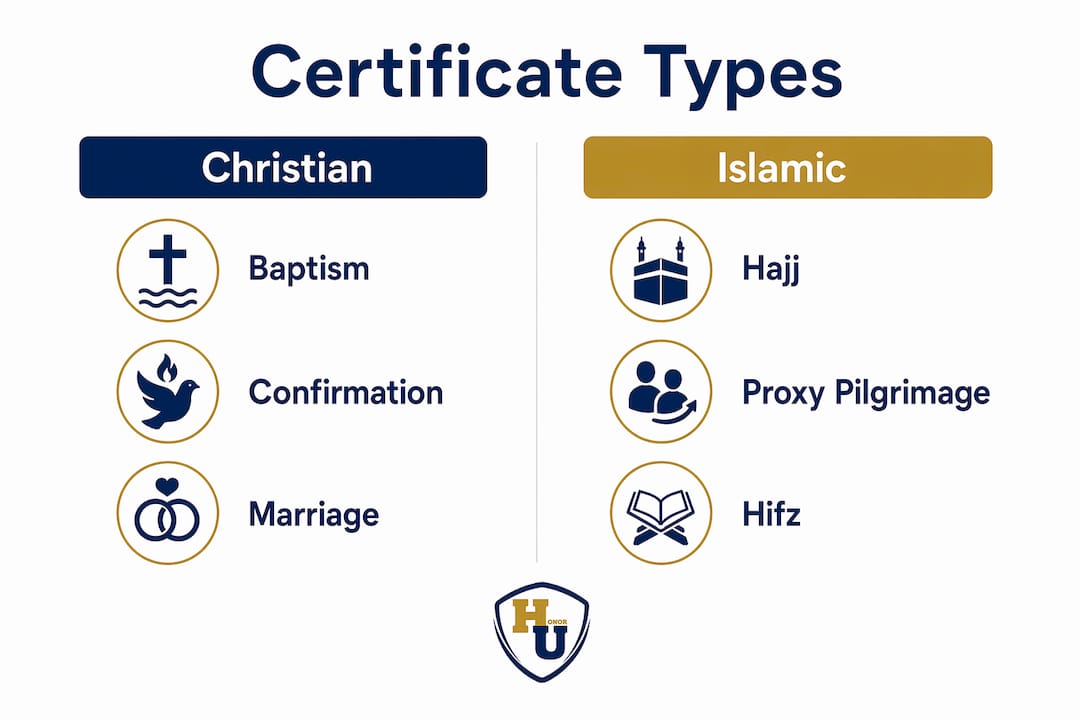
The major categories of religious certificates across Christian and Islamic traditions include:
- Baptism certificates documenting initiation into the faith
- Confirmation certificates recording sacramental maturity and sponsorship
- Marriage certificates commemorating spiritual union
- Dedication certificates for infant or child presentations
- Membership certificates confirming formal congregation affiliation
- Ordination certificates authorizing ministry roles
- Pilgrimage certificates attesting completion of sacred journeys
- Religious education certificates recognizing study and memorization achievements
Each category carries specific content requirements, issuance procedures, and downstream uses that differ significantly across denominations and faith traditions. The sections below examine the most prevalent types in detail.
Common Christian religious certificate types and their contents
Christian traditions produce the widest variety of religious certificate types, reflecting the breadth of sacramental life from birth through ordained ministry. Understanding what each document contains and why it matters helps both individuals and church administrators manage records with the care they deserve.
Baptism certificates
Baptism certificates typically include the baptized person’s full name, baptism date, church name and location, minister’s signature, and often a scripture reference. These elements are treated as standard for legitimacy across Protestant and Catholic traditions alike. The document is not a civil birth certificate, but it carries significant canonical weight. Catholic baptism certificates serve as formal sacramental records needed for subsequent rites including First Communion, Confirmation, and Catholic marriage, and can require translation or apostille for international use.
Confirmation certificates
Confirmation certificates are issued after the event is recorded in the parish confirmation register, and their validity depends entirely on that registration being complete and accurate. The Diocese of Oakland requires certificates to mirror register information for canonical accuracy, meaning a certificate printed before the register entry is finalized holds no official standing. Confirmation certificates typically list the confirmand’s name, confirmation date, sponsor name, presiding bishop or minister, and parish location. They serve as proof of sacramental maturity and are frequently required when preparing for Catholic marriage or joining a new parish.
Marriage and dedication certificates
Religious marriage certificates commemorate a spiritual covenant and are distinct from civil marriage licenses in both purpose and legal standing. Spiritual marriage certificates include the couple’s names, wedding date and location, officiant and witness signatures, and often a scripture passage chosen by the couple. They are keepsakes of profound personal and theological significance, but they do not substitute for a state-issued marriage license when legal recognition is required.
Certificates of dedication, sometimes called baby dedication certificates in evangelical and Baptist traditions, document the formal presentation of an infant or young child to God before the congregation. They record the child’s name, parents’ names, date, and officiating pastor, and are treasured as family heirlooms even though they carry no sacramental status in most Protestant denominations.
Membership and ordination certificates
Church membership certificates confirm that an individual has been formally received into a congregation, typically after a period of instruction or transfer from another church. They serve as institutional records and are sometimes requested when transferring membership or joining denominational programs.
Ordination certificates occupy a distinct and more authoritative category. They prove permanent ordination status, conferring the right to perform sacraments and ministerial functions. This is a critical distinction from a letter of good standing, which verifies current authorization and requires recent issuance. An ordination certificate alone does not satisfy legal requirements for officiating a wedding in many U.S. jurisdictions.
| Certificate Type | Key Contents | Primary Purpose |
|---|---|---|
| Baptism | Name, date, church, minister, scripture | Canonical initiation record |
| Confirmation | Name, date, sponsor, bishop, parish | Sacramental maturity proof |
| Marriage | Couple names, date, officiant, witnesses | Spiritual covenant keepsake |
| Dedication | Child name, parents, date, pastor | Family milestone record |
| Ordination | Ordinand name, date, denomination, authority | Ministry authorization |
Pro Tip: When ordering presentation covers for baptism or confirmation certificates, verify the document dimensions before purchasing. Many parishes use non-standard paper sizes, and a made-to-fit cover from a provider like Wehonoru protects the document without folding or trimming.
What Islamic religious certificates document
Islamic traditions recognize several important certificate categories, with pilgrimage attestations and Quran memorization credentials standing as the most widely recognized and formally structured.
Hajj and proxy pilgrimage certificates
Hajj certificates document Islamic pilgrimage completion including pilgrim identity, sites visited, and dates of the journey. Historically produced as richly decorated manuscripts, they served both as religious testimony and as family mementos passed across generations. Modern digital certificates are now common, issued by Saudi authorities and recognized internationally as proof of Hajj completion. The decorative tradition reflects the profound spiritual significance of the pilgrimage: completing the Hajj is one of the Five Pillars of Islam, and the certificate marks a transformation in the pilgrim’s identity within the community.
Proxy pilgrimage certificates exist as a distinct subcategory. These documents record pilgrimages completed on behalf of a deceased or incapacitated person, a practice permitted under specific Islamic jurisprudence. The certificate identifies both the proxy pilgrim and the person on whose behalf the pilgrimage was performed, along with the dates and sites of completion.
Quran memorization certificates
Quran memorization certificates, known as Hifz certificates, certify full memorization of the Quran after oral examinations conducted by qualified instructors. These certificates include the student’s identity, recitation modes mastered, the institution’s name, completion date, and examiner credentials. They are among the most prestigious religious education credentials in Islamic tradition, representing years of dedicated study and rigorous oral testing.
Hifz certificates differ meaningfully from partial study awards or Tajweed certificates, which recognize correct recitation technique rather than full memorization. A Tajweed certificate confirms proficiency in the rules of Quranic pronunciation, while a Hifz certificate confirms that the student can recite the entire Quran from memory without reference to the text. Both are respected credentials within Muslim educational institutions, but they serve different purposes and carry different levels of scholarly recognition.
Key elements found in Islamic religious certificates include:
- Pilgrim or student full name and identification
- Institution or issuing authority name and location
- Date of completion or pilgrimage
- Examiner or certifying authority signature
- Seal or official stamp of the issuing body
- Description of the rite, journey, or achievement completed
How do religious certificates differ from civil legal documents?
The distinction between religious ceremonial certificates and civil legal documentation is one of the most misunderstood aspects of faith community administration. Religious certificates commemorate spiritual covenants and rites, but they do not confer legal status on their own. This gap creates real administrative challenges for clergy, couples, and institutions.
A religious marriage certificate, for example, is a spiritually meaningful document that the couple and congregation treasure. However, the state requires a civil marriage license for legal recognition of the union. The license must be obtained before the ceremony, signed by the officiant and witnesses, and filed with the appropriate county or state office. The religious certificate and the civil license serve parallel but entirely separate functions.
Clergy credentials and letters of good standing
The credential distinction becomes especially important for wedding officiants. A letter of good standing confirms clergy authorization to perform weddings, and many U.S. jurisdictions impose filing requirements and recency limits of 30 to 90 days. Stale credentials are a common reason for rejected filings, creating legal complications for couples who assumed their ceremony was properly documented.
An ordination certificate proves that a minister was permanently ordained, but it does not verify current standing or active authorization. Many states require the letter of good standing in addition to, or instead of, the ordination certificate when registering a wedding officiant. Clergy and wedding coordinators who understand this distinction avoid the administrative problems that arise when only one document is presented.
| Document | Issued By | Legal Standing | Recency Requirement |
|---|---|---|---|
| Religious marriage certificate | Church or faith community | None (spiritual only) | Not applicable |
| Civil marriage license | State or county government | Full legal recognition | Must be filed promptly |
| Ordination certificate | Denomination or ordaining body | Proof of ordination status | No expiration |
| Letter of good standing | Denomination or church | Verifies current authorization | 30 to 90 days in most states |
Pro Tip: If you are a clergy member preparing to officiate a wedding, request your letter of good standing no more than two weeks before the ceremony date. Filing a letter that falls outside the jurisdiction’s recency window is one of the most common and easily avoided errors in wedding officiant administration.
How to obtain a religious certificate from your faith community
Obtaining a religious certificate is rarely as simple as printing a copy from a file. Catholic baptism certificates involve official request workflows and verification processes, especially when proof is required beyond the original parish community. Most denominations follow a structured process that protects the integrity of sacramental records.
The standard process for requesting a religious certificate follows these steps:
- Identify the issuing authority. For most Christian sacraments, this is the parish or congregation where the rite was performed, not the current church of membership.
- Submit a formal written request. Many parishes require a signed request form identifying the requestor’s relationship to the certificate holder and the purpose of the request.
- Provide verification documents. A government-issued photo ID and, in some cases, proof of relationship (such as a birth certificate for a parent requesting a child’s baptism record) are standard requirements.
- Allow processing time. Most parishes process requests within one to three weeks, though older records or those held in diocesan archives may take longer.
- Request apostille or translation if needed. For international use, certificates may require a notarized translation and an apostille stamp from the appropriate state authority.
- Preserve the original document. Once received, store the certificate in an acid-free sleeve or a quality document cover to prevent deterioration from light, humidity, and handling.
For Islamic institutions, the process varies by organization. Hajj certificates are issued by Saudi authorities through the Ministry of Hajj and Umrah, and digital versions are now accessible through official portals. Hifz certificates are issued by the madrasah or Islamic school where the student completed training, and requests for duplicate copies typically require direct contact with the institution’s administration.
Pilgrimage certificates reflect cultural as well as religious dimensions, with issuance criteria based on pilgrim motivation. The Camino de Santiago’s Pilgrim Office, for example, issues the Compostela only to pilgrims who complete the journey for religious or spiritual reasons, while the Certificado de Distancia is issued for cultural or athletic motivations. This distinction matters when the certificate is used for community recognition or institutional records.
Pro Tip: Request two certified copies of any religious certificate at the time of the original event. Parishes and institutions are far more responsive to first-time requests than to duplicate requests made years later, and having a backup copy prevents the complications that arise when the original is lost or damaged.
Key takeaways
Religious certificates are canonical and institutional records that serve distinct spiritual, administrative, and sometimes legal functions depending on the type and tradition.
| Point | Details |
|---|---|
| Certificate types vary by tradition | Christian, Islamic, and pilgrimage certificates each have distinct formats, contents, and purposes. |
| Religious certificates are not legal documents | A religious marriage certificate does not replace a civil marriage license for legal recognition. |
| Ordination differs from authorization | An ordination certificate proves permanent status; a letter of good standing verifies current authorization with recency requirements. |
| Obtain certificates from the originating institution | Requests must go to the parish, mosque, or institution where the rite occurred, not the current place of worship. |
| Preserve originals with quality covers | Acid-free storage and premium document covers protect certificates from deterioration over decades. |
Why religious certificates deserve more institutional attention than they receive
Working closely with faith communities and religious schools over the years, I have seen the same pattern repeat itself: certificates are treated as ceremonial afterthoughts rather than the institutional records they actually are. A baptism certificate is not just a keepsake for the family photo album. It is the document a Catholic diocese will request before allowing a marriage ceremony to proceed. A confirmation certificate is not just a memento from a meaningful Sunday. It is a canonical record that must match the parish register entry precisely, or it carries no official weight.
The challenge I observe most often is the gap between the ceremony and the record. Parishes invest significant effort in the spiritual preparation for baptism, confirmation, and ordination, and then treat the paperwork as a formality. The result is certificates printed before register entries are finalized, ordination documents presented without current letters of good standing, and families who cannot locate records from parishes that have since merged or closed.
Modern record-keeping technologies, including digital parish management systems like Servant Keeper and ParishSOFT, are closing this gap for many congregations. But technology alone does not solve the problem of institutional culture. Religious leaders who treat certificate issuance as a serious administrative act, with the same care given to the ceremony itself, serve their communities far better than those who delegate it entirely to volunteers or administrative staff without clear protocols.
The other dimension worth addressing is preservation. I have seen ordination certificates from the 1970s stored in cardboard boxes, faded and brittle, with no backup record. A certificate that cannot be read or verified is functionally useless, regardless of its spiritual significance. Investing in quality document covers and archival storage is not an extravagance. It is the minimum standard of respect for documents that carry the weight of a person’s faith history.
, Manager
Protect and present your religious certificates with Wehonoru
Every religious certificate, whether a baptism record, a marriage commemoration, or an ordination credential, deserves presentation that matches its significance.

Wehonoru’s tent-style document covers are designed to protect and display certificates of all types with a polished, heirloom-quality finish. The Classic Certificate of Baptism cover and the Classic Certificate of Marriage cover are pre-phrased for faith community use, while custom options accommodate any denomination or document size. With metallic foil printing, no minimum order quantities, and next-day production, Wehonoru makes it straightforward to present these documents with the dignity they represent. For seminary graduations and religious school completions, the Classic Diploma of Graduation cover offers the same premium quality in a graduation-specific format.
FAQ
What is a religious certificate?
A religious certificate is a formal document issued by a faith community to record a sacrament, rite, membership, ministry role, or pilgrimage. These documents carry canonical authority within their tradition and are often required for subsequent religious rites or institutional verification.
What are the most common types of religious certificates?
The most common types include baptism certificates, confirmation certificates, religious marriage certificates, ordination certificates, and pilgrimage attestations such as Hajj certificates. Islamic traditions also issue Hifz certificates for Quran memorization.
Is a religious marriage certificate the same as a marriage license?
No. A religious marriage certificate commemorates a spiritual covenant and holds no legal standing on its own. A civil marriage license, issued and filed with state or county authorities, is required for legal recognition of the marriage.
How do I obtain a copy of a religious certificate?
Contact the parish, mosque, or institution where the original rite was performed. Submit a formal written request with identification and, if applicable, proof of relationship. Processing typically takes one to three weeks, with longer timelines for archived or international records.
What is the difference between an ordination certificate and a letter of good standing?
An ordination certificate proves that a minister was permanently ordained and does not expire. A letter of good standing verifies current authorization to perform ministerial functions, including weddings, and must be recently issued. Most U.S. jurisdictions require the letter to be dated within 30 to 90 days of the ceremony.
Recommended
Taylor Pace writes Honor U guides. Blair Black reviews them. Honor U sells empty covers and holders.