
Non-Standard Certificate Sizes: What You Need to Know

TL;DR:
- Non-standard certificate sizes fall outside US Letter and A4 formats, requiring extra planning for printing and framing. Using 300 DPI and maintaining margins of 0.75 to 1 inch ensures quality and protection of design elements during production. Matching sizes to retail frames and providing suitable presentation covers help recipients avoid additional costs and display their certificates with dignity.
A non-standard certificate size is any certificate dimension that falls outside the two dominant industry formats: US Letter (8.5 x 11 inches) in North America and A4 (210 x 297 mm) internationally. These two sizes define what printers, frames, and filing systems are built around. Any certificate that deviates from them, whether larger like 11 x 14 or 16 x 20 inches, or smaller like a half-letter or wallet card, qualifies as a non-standard or custom certificate size. Understanding what is non standard certificate size matters because the choice directly affects print quality, framing costs, and how recipients store and display their credentials. Schools, HR departments, and professional organizations all face these decisions when designing certificates that need to stand out without creating logistical headaches.
What are the common non-standard certificate sizes?

Non-standard certificate dimensions span a wide range, from oversized presentation formats to compact portable credentials. Each size serves a distinct purpose, and choosing the wrong one for the context creates real problems for recipients and administrators alike.
Oversized formats for formal recognition
The most common non-traditional certificate formats used for diplomas and formal awards are 11 x 14 inches and 16 x 20 inches. These larger dimensions provide generous space for institutional seals, multiple signatures, decorative borders, and detailed text. Universities issuing honorary degrees often favor 11 x 14 inches because it commands visual authority without becoming unwieldy. The 16 x 20 format appears most frequently in framed wall displays for medical licenses, law degrees, and military commendations, where the document is meant to be seen rather than filed.
Compact and portable formats
On the smaller end, wallet card size (3.37 x 2.125 inches) and half-letter (5.5 x 8.5 inches) serve entirely different needs. Wallet cards work well for professional certifications like CPR credentials, food handler licenses, or trade qualifications that recipients carry daily. Half-letter certificates suit promotional events, short-course completions, and recognition programs where a full-page document feels excessive. Both formats require pre-planning for compatible holders, since standard certificate folders will not fit them properly.
Size comparison at a glance
| Format | Dimensions | Typical Use |
|---|---|---|
| US Letter (standard) | 8.5 x 11 inches | Academic, corporate, general |
| A4 (standard) | 210 x 297 mm | International institutions |
| Half-letter | 5.5 x 8.5 inches | Short courses, events |
| Diploma/Award | 11 x 14 inches | Formal degrees, awards |
| Large display | 16 x 20 inches | Wall display, licenses |
| Wallet card | 3.37 x 2.125 inches | Portable credentials |
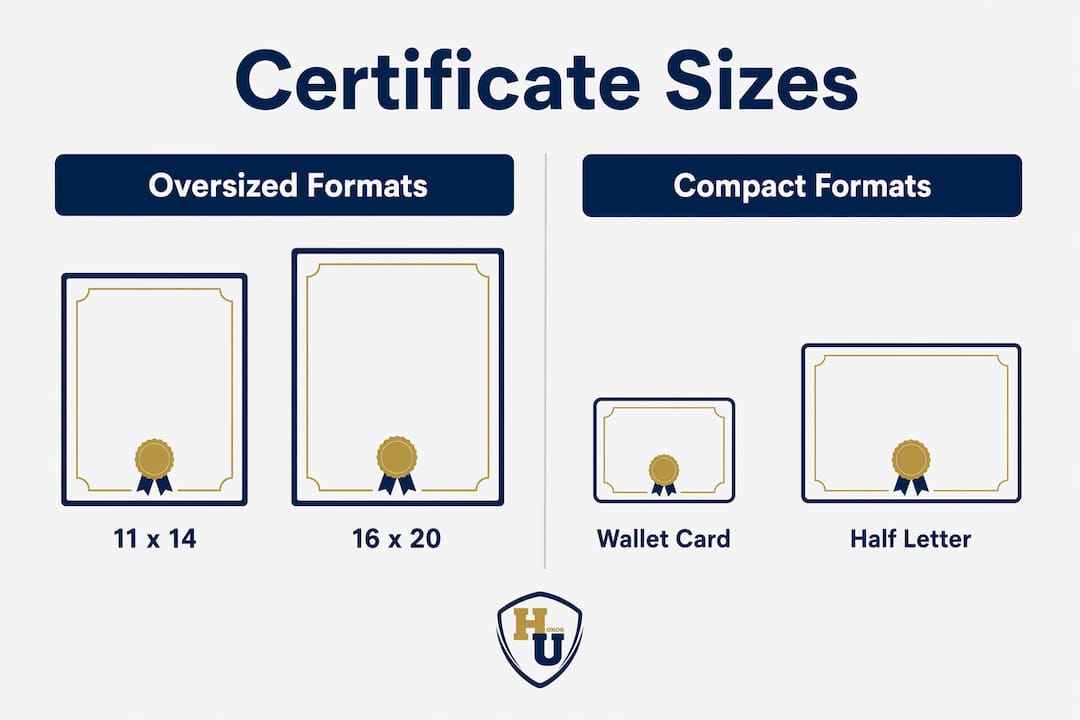
The table above shows that custom certificate sizes cluster at either end of the size spectrum. Organizations should match the format to the recipient’s likely use, whether that is framing, carrying, or filing.
What printing and design considerations affect non-standard certificate sizes?
Print quality is the first casualty of poor planning with custom certificate sizes. The technical requirements for non-standard dimensions are not forgiving, and mistakes at the design stage multiply into costly reprints.
Resolution is non-negotiable
Printing at 300 DPI is the minimum standard for any certificate intended for physical presentation. For an 11 x 14 inch certificate, that translates to a canvas of 3,300 x 4,200 pixels. A 16 x 20 inch format requires 4,800 x 6,000 pixels. These numbers matter because many designers build their files at screen resolution (72 DPI), which produces blurry, pixelated printouts that undermine the prestige of the document. Using 72 DPI for a printed certificate is one of the most common and most avoidable errors in certificate production.
To calculate the correct pixel dimensions for any custom size, multiply the physical measurement in inches by 300. A certificate that is 6 inches wide requires a canvas that is 1,800 pixels wide at minimum. This formula applies to every non-standard dimension without exception.
Margins protect the design
Custom-sized certificates require a minimum margin of 0.75 to 1 inch around all edges. This clear space protects critical design elements from trimming errors during production and from edge wear during handling and storage. Institutions that push text or seals to the very edge of a certificate often find that trimming variation, which can be as much as 0.125 inches on commercial cutters, clips important content. Margins are not decorative. They are a structural safeguard.
Pro Tip: Set up your design file with bleed marks and crop marks enabled, even for non-standard sizes. This gives your print vendor the reference points needed to cut accurately and protects your layout from trimming drift.
Steps to prepare a non-standard certificate for print
- Confirm the exact finished dimensions with your print vendor before building the design file.
- Set the canvas to 300 DPI at the intended physical size, not at screen resolution.
- Apply a minimum 0.75-inch margin on all four sides and keep all critical content inside that boundary.
- Export the file as a high-resolution PDF with embedded fonts and color profiles set to CMYK for offset printing.
- Request a physical proof print on the actual paper stock before approving a full production run.
Each step in this sequence prevents a specific category of error. Skipping the proof print is the single most common cause of bulk reprints, particularly for organizations printing on unfamiliar paper sizes.
How do non-standard certificate sizes impact framing and presentation?
The framing question is where certificate size decisions become financial decisions for recipients. Organizations often overlook this downstream cost entirely, and that oversight damages the perceived value of the recognition.
The framing penalty explained
Custom framing for non-standard sizes can cost up to 500% more than purchasing a standard retail frame. A recipient who receives an 11 x 14 certificate can find a suitable frame at most retail stores for $15–$30. A recipient who receives a 13 x 17 certificate faces a custom framing bill that can reach $100–$300 at a professional framing shop. That cost falls entirely on the person being honored, which creates a quiet resentment that undercuts the recognition itself.
“The framing penalty is real and often invisible to the organization issuing the certificate. Designers recommend including protective covers with non-standard certificates to reduce recipient cost and frustration.”, Certificate Design: Diplomas and Awards
Choosing sizes that align with retail frames
Most diploma frames sold at retail are designed for 8.5 x 11 or 11 x 14 inch documents. Choosing a non-standard size that matches one of these common frame dimensions eliminates the framing penalty entirely. A 16 x 20 inch certificate also aligns with a widely available retail frame size, making it a practical choice for large-format wall display. Sizes that fall between these benchmarks, such as 12 x 16 or 14 x 18, force recipients into the custom framing market.
Practical solutions for non-standard presentation
Organizations that commit to non-standard dimensions for design or branding reasons should take concrete steps to protect recipients from the associated costs and inconvenience:
- Include a presentation folder or cover with every certificate at the time of distribution. A custom certificate holder designed for the specific document size protects the certificate immediately and provides a dignified presentation experience.
- Communicate framing options to recipients in advance, including links to vendors who carry the relevant frame size.
- Consider archiving implications. Standard certificate sizes facilitate easier filing, scanning, and archiving. Non-standard sizes may not fit standard file folders, scanner beds, or document management systems, creating administrative friction for both the issuing organization and the recipient.
- Provide a digital copy in the exact dimensions of the physical certificate so recipients can print locally if needed.
The goal is to ensure that the certificate’s physical format enhances the recognition rather than creating a logistical burden.
What best practices should organizations follow with non-standard certificate sizes?
Planning for non-standard certificate dimensions requires attention at every stage, from design through distribution. Organizations that treat size as an afterthought consistently encounter preventable problems.
Printer compatibility is a real constraint
Many standard office printers default to US Letter or A4 and will either reject non-standard paper sizes or apply automatic “shrink-to-fit” scaling that distorts the design. A certificate designed at 11 x 14 inches printed on a letter-sized sheet through shrink-to-fit scaling loses approximately 21% of its intended dimensions. The result looks unprofessional and may cut off border elements. Organizations should verify that their print vendor’s equipment supports the chosen dimensions before finalizing the design.
Pro Tip: Always request a single test print on the actual paper stock and at the actual finished size before approving a production run. One test print costs almost nothing. A reprinted batch of 500 certificates costs significantly more.
Selecting the right protective cover
The right presentation folder for a non-standard certificate is not a minor detail. It is the first thing a recipient sees and touches. A cover that fits poorly, gaps at the edges, or bends the certificate during handling sends a message that contradicts the purpose of the recognition. Key considerations when selecting covers for unusual certificate sizes include:
- Exact interior dimensions. The cover’s interior pocket should match the certificate’s finished size within 0.25 inches to prevent sliding and creasing.
- Material weight. Heavier stock covers protect better during mailing and storage.
- Closure type. Tent-style covers with a spine provide self-standing display capability, which adds presentation value at ceremonies.
- Branding options. Metallic foil printing on the cover exterior reinforces institutional identity and gives the package a premium, heirloom quality.
Communicating with recipients
Recipients who receive a non-standard certificate deserve clear guidance on how to store, frame, and display it. A brief insert card explaining the document’s dimensions, suggested frame sizes, and care instructions costs almost nothing to produce and significantly reduces recipient confusion. Organizations that issue credentials in non-traditional formats, such as trade schools issuing 11 x 14 completion certificates or corporate HR departments issuing oversized recognition awards, benefit most from this kind of proactive communication.
Reviewing the full range of certificate cover options before committing to a size is a practical step that saves time and money later. The cover and the certificate should be planned together, not sequentially.
Key Takeaways
Non-standard certificate sizes require deliberate planning across printing, framing, and presentation to deliver the prestige they are designed to convey.
| Point | Details |
|---|---|
| Define your size against standards | Any size outside US Letter (8.5 x 11 in) or A4 (210 x 297 mm) is non-standard and requires extra planning. |
| Use 300 DPI for all print files | Multiply physical inches by 300 to get the correct pixel dimensions for any custom certificate size. |
| Apply 0.75–1 inch margins | Minimum margins on all edges protect critical design elements from trimming errors and edge wear. |
| Match retail frame sizes when possible | Sizes like 11 x 14 and 16 x 20 align with common retail frames, eliminating costly custom framing for recipients. |
| Pair every certificate with a fitted cover | A properly sized presentation folder protects the document and delivers a dignified experience from the moment of distribution. |
What I have learned from years of working with non-standard certificate formats
The most common mistake organizations make is treating the certificate size as a purely aesthetic decision. They choose a larger format because it looks impressive, and then they hand it to recipients without a cover, without framing guidance, and without any acknowledgment that they have just created a logistical problem for the person they are honoring.
The framing penalty is the detail that surprises people most. A $300 custom framing bill is not a trivial inconvenience for a recent graduate or a nonprofit volunteer. When the organization issuing the certificate does not account for that cost, the recognition loses some of its warmth. The recipient remembers the inconvenience alongside the achievement.
The second thing I have found is that organizations consistently underestimate the importance of margins. A beautifully designed 11 x 14 certificate with a decorative border that runs to the edge of the page will almost always show trimming variation in production. That variation clips the border, and the certificate looks unfinished. A 1-inch margin costs nothing at the design stage and prevents a problem that is impossible to fix after printing.
My honest recommendation is this: choose a non-standard size only when it genuinely serves the recipient’s experience, not just the organization’s visual identity. If the size creates framing, filing, or printing complications that fall on the recipient, reconsider. When a non-standard size is the right choice, invest equally in the presentation cover. A well-fitted, quality cover transforms a document into a keepsake. That is the standard every recognition program should aim for.
, Manager
Presentation covers built for every certificate size
When a certificate does not fit standard dimensions, the presentation cover matters as much as the document itself. Wehonoru designs and produces tent-style document covers specifically for non-standard and custom certificate sizes, with no minimum order quantity and a one-business-day production turnaround.
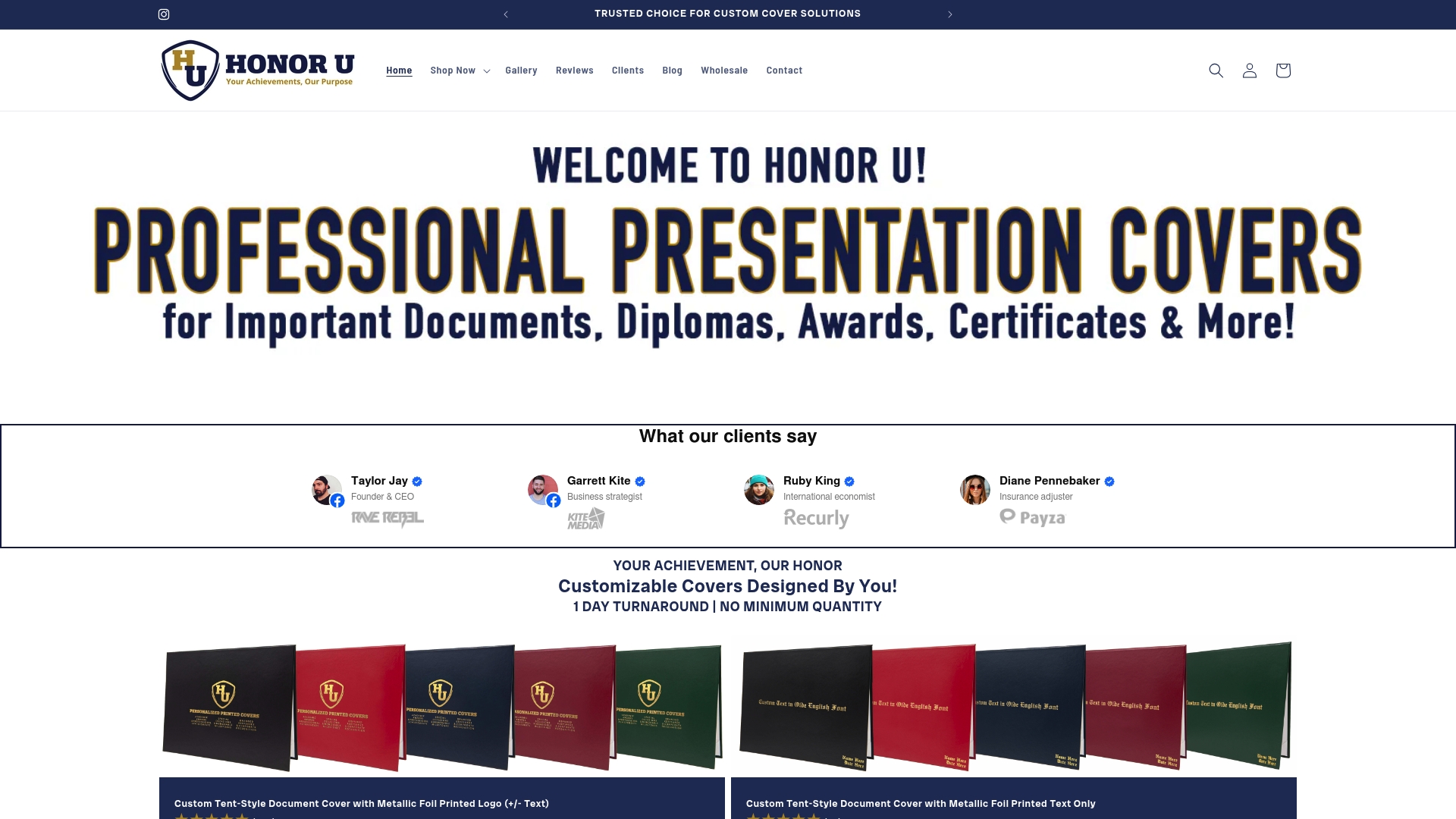
The Classic Diploma of Graduation Tent-Style Document Cover is available in made-to-fit custom dimensions, with metallic foil printing options for institutional logos and text. Whether you are issuing 11 x 14 formal awards, oversized recognition certificates, or compact credential cards, Wehonoru produces a cover that fits the document and honors the achievement. Orders ship the next business day, and free shipping applies to orders over $35.
FAQ
What is a non-standard certificate size?
A non-standard certificate size is any dimension outside US Letter (8.5 x 11 inches) or A4 (210 x 297 mm). Common examples include 11 x 14, 16 x 20, half-letter (5.5 x 8.5), and wallet card (3.37 x 2.125 inches).
What DPI should I use for a non-standard certificate?
Print resolution must be 300 DPI for any physical certificate. An 11 x 14 inch certificate at 300 DPI requires a canvas of 3,300 x 4,200 pixels.
Why do non-standard certificate sizes cost more to frame?
Custom framing for non-standard dimensions can cost up to 500% more than standard retail frames. Sizes that match common retail frame dimensions, such as 11 x 14 or 16 x 20 inches, avoid this cost entirely.
How much margin should a non-standard certificate have?
A minimum margin of 0.75 to 1 inch on all edges is required. This protects critical design elements from trimming errors and edge wear during handling and storage.
Can standard office printers handle non-standard certificate sizes?
Most standard office printers default to US Letter or A4 and may apply shrink-to-fit scaling or jam when loaded with non-standard paper. Organizations should test print on the intended paper size and verify vendor equipment compatibility before a full production run.
Recommended
Taylor Pace writes Honor U guides. Blair Black reviews them. Honor U sells empty covers and holders.