
Educational Certificate Importance: Career and Growth Guide

TL;DR:
- Educational certificates serve as credible proof of skills and knowledge, impacting career advancement when aligned with employer needs. Relevance, certification type, and recognition determine their true value, with job-relevant credentials delivering significantly higher wage premiums. Careful evaluation of recognition, outcomes, and purposeful selection optimize credential investments for personal growth and professional success.
An educational certificate is an official document that verifies an individual’s acquisition of specific skills or knowledge, serving as credible evidence of educational achievement recognized by employers, licensing bodies, and professional associations. Understanding educational certificate importance is no longer optional for students and working professionals. The credential market has expanded dramatically, and the difference between a certificate that advances your career and one that wastes your time and money comes down to a few precise factors. This guide draws on 2026 research from Brookings, RAND, and UPCEA to give you a clear, evidence-based framework for selecting and leveraging credentials that deliver real returns.
How do educational certificates impact career advancement and earnings?
The career impact of educational certificates is measurable, but the size of that impact depends almost entirely on whether the credential aligns with your target job. Job-relevant credentials yield a 3.8% wage premium, more than double the 1.8% premium earned from job-irrelevant credentials. That gap compounds over time: each additional relevant credential adds roughly 1% in wage growth, meaning a deliberate, sequential credentialing strategy builds real earning power across a career.
The distinction between credential types matters here. Certificates, certifications, and digital badges are often grouped together, but they function differently in the labor market. A certificate typically marks completion of a structured course or program. A certification requires passing a proctored exam and often demands periodic renewal to remain valid. A badge is a digital marker of a skill or achievement, frequently issued by platforms like Coursera or LinkedIn Learning. Each signals something different to an employer, and their wage returns reflect that difference.
Certifications show wage returns only when job-relevant, indicating genuine skill acquisition rather than mere signal. Badges and certificates, by contrast, produce an initial wage bump regardless of relevance, which suggests they function primarily as signals of motivation and learning orientation rather than proof of mastery. This is a critical insight: if you hold a certification in a field directly tied to your role, employers read it as evidence of real competence. If you hold a badge in an adjacent area, they read it as evidence of curiosity.
Pro Tip: Before enrolling in any certificate program, search the job postings for your target role and confirm the credential appears explicitly in the requirements or preferred qualifications. If it does not appear in at least 20% of relevant postings, the wage return is likely to be modest.
Non-college workers and early-career professionals receive larger wage premiums from relevant credentials than college graduates and experienced workers do. This means certificates carry the highest financial return precisely when you are starting out or transitioning fields, which is when the investment feels most daunting. The data supports taking that risk, provided the credential is the right one.

What types of educational certificates exist and how do they differ?
The credential landscape includes five primary formats, each with distinct characteristics, time requirements, and labor market signals. Understanding these differences is the foundation of any sound credential strategy.
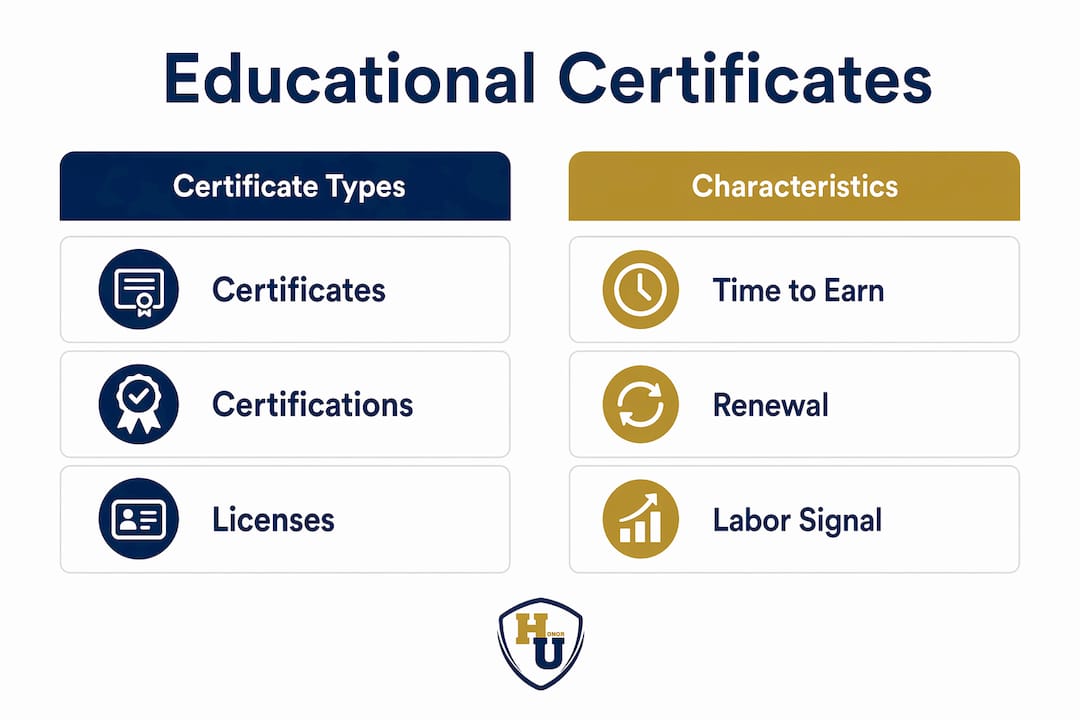
| Credential Type | Typical Time to Earn | Renewal Required | Primary Labor Market Signal |
|---|---|---|---|
| Certificate | Weeks to months | No | Program completion, foundational knowledge |
| Certification | Months, exam-based | Yes (typically every 1-3 years) | Verified skill mastery, ongoing competence |
| Badge (microcredential) | Hours to weeks | Rarely | Skill awareness, learning motivation |
| License | Months to years | Yes (state-mandated) | Legal authorization to practice |
| Degree-embedded certificate | 1-2 semesters | No | Academic specialization within a degree |
Licenses occupy a category of their own because they carry legal authority. A Registered Nurse license issued by a state board, a real estate license, or a Certified Public Accountant credential are not optional signals. They are legal requirements to practice. The value of educational credentials in licensed professions is therefore non-negotiable, and the renewal requirements are enforced by law rather than professional convention.
Renewable and maintained credentials in fast-changing industries better reflect real skill acquisition and continued professional development than one-time certificates do. This is particularly relevant in fields like cybersecurity, healthcare, and data analytics, where the underlying knowledge base shifts every two to three years. A CompTIA Security+ certification, for example, requires renewal every three years, which signals to employers that the holder’s knowledge is current, not a snapshot from five years ago.
Microcredentials deserve special attention because their institutional adoption is accelerating. 85% of institutions design microcredentials for workforce development and 84% for professional advancement, though adoption remains uneven across sectors. That institutional backing matters: a microcredential from a regionally accredited university carries more weight with HR screening systems than one from an unaccredited platform, even if the content is identical.
Pro Tip: When evaluating a microcredential or badge program, check whether the issuing institution is regionally accredited and whether the credential appears in any state or federal workforce databases. Credentials embedded in recognized workforce frameworks carry significantly more portability across employers.
The practical implication for students and professionals is straightforward. Match the credential type to your goal. If you need legal authorization to practice, pursue a license. If you need to demonstrate current mastery in a technical field, pursue a renewable certification. If you need to signal motivation and foundational awareness quickly, a certificate or badge may serve the purpose while you build toward a more rigorous credential.
Why is job relevance critical when choosing educational certificates?
Job relevance is the single most important variable in determining whether an educational certificate delivers a meaningful return. The 3.8% wage premium for relevant credentials versus 1.8% for irrelevant ones is not a small rounding difference. Over a 30-year career, that gap in annual wage growth compounds into tens of thousands of dollars in cumulative earnings. Relevance is not a soft preference. It is the primary driver of credential value.
The risks of what researchers call “credential shopping” are real and underappreciated. Many students and professionals accumulate certificates across unrelated domains, believing that more credentials signal more capability. Employers with skill-based hiring systems see through this pattern quickly. A resume with eight loosely related certificates in project management, digital marketing, Python, and leadership coaching signals scattered focus rather than deep competence in any one area.
Only 8 state Workforce Innovation and Opportunity Act (WIOA) plans provide measurable benchmarks for credential value, which means most public workforce systems cannot tell you with precision which credentials in your state actually lead to employment and wage gains. This creates a real information gap for job seekers. You cannot rely on state workforce agencies to guide your credential choices. You need to do the research yourself.
Here is a practical framework for assessing job relevance before you invest:
- Check employer demand directly. Search 50 to 100 job postings in your target role on LinkedIn, Indeed, or your sector’s specialized job boards. Note which credentials appear most frequently in requirements and preferred qualifications.
- Verify recognition by gatekeepers. Confirm whether the credential is recognized by HR screening systems, relevant licensing bodies, or apprenticeship programs in your field.
- Assess portability. A credential recognized only by one employer or in one state has limited value. Credentials recognized nationally or by professional associations travel with you across jobs and geographies.
- Look for outcome data. Some credential programs publish employment and wage outcome data for completers. Programs that publish this data transparently are more likely to deliver on their promises.
Pro Tip: Use the Occupational Information Network (ONET) database to identify which credentials are listed as typical requirements for your target occupation. ONET pulls from real employer data and provides a reliable starting point for relevance assessment.
Credentials offer greater returns when they align closely with occupational requirements and employer demand, which underscores the importance of treating credential selection as a strategic decision rather than an academic one. The question is never “Is this certificate interesting?” The question is always “Does this certificate solve a specific problem that employers in my target field are paying to solve?”
How do educational certificates support personal development beyond career benefits?
The value of educational certificates extends well beyond wage premiums and job titles. Certificates validate continuous learning as a practice, not just an outcome. For professionals navigating career transitions, certificates provide structured pathways into new domains without requiring a full degree program. A marketing manager moving into data analytics, for example, can complete a Google Data Analytics Certificate or an IBM Data Science Professional Certificate to build foundational competence before committing to a graduate program.
The personal development benefits of certificates operate through several distinct mechanisms:
- Skill validation builds confidence. Completing a rigorous certificate program and passing an associated exam gives professionals documented proof of competence, which reduces the imposter syndrome that often accompanies career transitions or role expansions.
- Structured learning accelerates mastery. Certificate programs impose a curriculum, a timeline, and often a community of peers. This structure produces faster skill acquisition than self-directed reading or informal learning.
- Credentials signal commitment to employers and colleagues. Holding a Project Management Professional (PMP) certification or a Certified Information Systems Security Professional (CISSP) credential tells your professional network that you take your field seriously enough to invest in formal validation.
- Certificates support adaptability in changing markets. Workers who hold current, relevant credentials adapt more readily to technological shifts because they have demonstrated the capacity and habit of structured learning.
- Recognition reinforces motivation. The act of earning and displaying a credential, whether framed on an office wall or listed on a LinkedIn profile, creates a tangible milestone that reinforces the value of lifelong learning as a personal practice.
85% of institutions design microcredentials for professional advancement, which reflects a broader institutional recognition that credential attainment serves motivational and developmental functions alongside purely economic ones. The significance of educational achievements is not reducible to salary data. Credentials mark transitions, affirm growth, and create a visible record of a professional’s commitment to their field.
The role of certificates in employment is also shifting as organizations build internal credentialing programs. Companies like Amazon, Google, and IBM now issue their own professional certificates through platforms like Coursera and edX, creating credentials that carry brand recognition alongside technical content. These corporate-issued credentials occupy a unique space: they are not accredited in the traditional academic sense, but they carry significant weight with employers in their respective industries.
What should students and professionals consider when selecting educational certificates?
Selecting the right credential requires a structured evaluation process. The credential boom has produced hundreds of options across every field, and states like Texas and Ohio maintain lists of 500 and 600-plus credentials respectively, many of which vary widely in actual wage and employment benefit. Quantity does not equal quality in the credential market.
A sound selection process addresses these factors in sequence:
- Accreditation and recognition status. Confirm that the issuing body is accredited by a recognized authority. For academic certificates, look for regional accreditation. For professional certifications, look for recognition by the relevant industry association, such as PMI for project management or (ISC)² for cybersecurity.
- Alignment with specific career goals. Map the credential’s learning outcomes directly to the skills listed in job postings for your target role. If the mapping is loose or indirect, the credential is unlikely to move the needle with employers.
- Measurable outcomes. Prioritize programs that publish completion rates, employment rates, and median wage data for graduates. Programs that cannot or will not share this data are a warning sign.
- Renewal and maintenance requirements. In fast-moving fields, a credential with no renewal requirement may become outdated within two to three years. Credentials that require continuing education to maintain signal ongoing relevance to employers.
- Quality over quantity. Two or three well-chosen, job-relevant credentials carry more weight than eight loosely related ones. HR screening systems and hiring managers alike respond better to depth than breadth.
- Research tools and verification resources. Use O*NET, the Credential Engine Registry, and your state’s workforce agency database to verify credential recognition and outcome data before enrolling.
Policy frameworks need to shift focus from quantity of credentials to quality and measurable outcomes to produce equitable labor market benefits. This policy gap means that students and professionals cannot outsource credential evaluation to public systems. The responsibility for due diligence sits with the individual. Treat credential selection with the same rigor you would apply to any significant professional investment, because that is precisely what it is.
The two-step evaluation recommended by Brookings is a reliable starting framework: first, confirm the credential is recognized by relevant authorities such as HR systems, licensing boards, or apprenticeship programs; second, confirm it directly matches the skills required for your target role. Both conditions must be true for the credential to deliver its full potential return.
Key takeaways
Educational certificate importance is determined primarily by job relevance, credential type, and alignment with employer demand rather than by the number of credentials held.
| Point | Details |
|---|---|
| Job relevance drives wage returns | Relevant credentials yield a 3.8% wage premium, more than double the return from irrelevant ones. |
| Credential type signals differently | Certifications with renewal requirements signal verified mastery; badges and certificates signal learning motivation. |
| Microcredentials are growing but uneven | 85% of institutions design microcredentials for workforce development, but quality and recognition vary widely. |
| Credential shopping reduces value | Accumulating loosely related credentials signals scattered focus rather than deep competence to employers. |
| Personal development benefits are real | Certificates build confidence, structure skill acquisition, and reinforce lifelong learning habits beyond salary impact. |
Why I think most people approach credential selection backward
Most students and professionals I have observed start with the credential and then try to justify its relevance to their career. They find a program that sounds impressive, enroll, complete it, and then wonder why it did not move the needle with employers. The research confirms what experience shows: the credential itself is not the asset. The alignment between the credential and a specific employer need is the asset.
The credential boom has made this problem worse, not better. When Texas lists 500-plus credentials and Ohio lists 600-plus, and most of those credentials vary widely in actual wage benefit, the abundance of options creates the illusion of progress. Collecting certificates feels productive. It rarely is, unless each one maps directly to a documented employer need.
What I have found actually works is starting with the job posting, not the program catalog. Identify the three to five credentials that appear most consistently in postings for your target role. Research each one using Credential Engine and O*NET. Select the one with the strongest recognition and the clearest outcome data. Complete it. Then repeat the process for the next skill gap. This sequential, demand-driven approach produces credentials that compound in value rather than accumulate without purpose.
The other thing worth saying plainly: the physical presentation of a credential matters more than most professionals acknowledge. A certificate displayed in a quality certificate holder in a professional setting communicates that you take the achievement seriously. That perception is not trivial in client-facing roles or in healthcare and legal settings where credentials are displayed publicly. The document and its presentation together form the complete signal.
, Manager
Honor your credentials with presentation that matches their value
Every certificate you earn represents real effort, real skill, and real professional commitment. The document deserves presentation that reflects that significance.

Wehonoru designs and produces premium tent-style certificate covers and diploma holders built to protect and display your credentials with the professionalism they warrant. The Classic Diploma of Graduation Tent-Style Document Cover is crafted with durable materials and metallic foil printing, available with no minimum order quantity and shipped within one business day. Whether you are an individual honoring a single achievement or an institution recognizing hundreds of graduates, Wehonoru delivers quality presentation at practical pricing. Explore the full range of custom certificate holders to find the right fit for your credential.
FAQ
What is the wage premium for a job-relevant certificate?
Job-relevant non-degree credentials yield a 3.8% wage premium, more than double the 1.8% return from job-irrelevant credentials, with each additional relevant credential adding roughly 1% in wage growth.
How do certificates differ from certifications?
A certificate marks completion of a structured program, while a certification requires passing a proctored exam and typically demands periodic renewal. Certifications signal verified, current mastery; certificates signal program completion and foundational knowledge.
Why does job relevance matter so much for credential value?
Credentials aligned with occupational requirements produce measurably higher wage returns and stronger employer recognition than credentials earned without direct job alignment. Relevance determines whether a credential signals genuine skill or merely learning motivation.
Are microcredentials worth pursuing for professional advancement?
Microcredentials are worth pursuing when issued by accredited institutions and recognized in your industry’s hiring systems. 85% of institutions design microcredentials for workforce development, but quality and portability vary significantly across programs and issuers.
How should I verify whether a certificate is recognized by employers?
Use a two-step process: confirm the credential appears in job postings for your target role, and verify it is recognized by relevant HR screening systems, licensing boards, or professional associations. The Credential Engine Registry and O*NET are reliable starting points for this research.
Recommended
Taylor Pace writes Honor U guides. Blair Black reviews them. Honor U sells empty covers and holders.